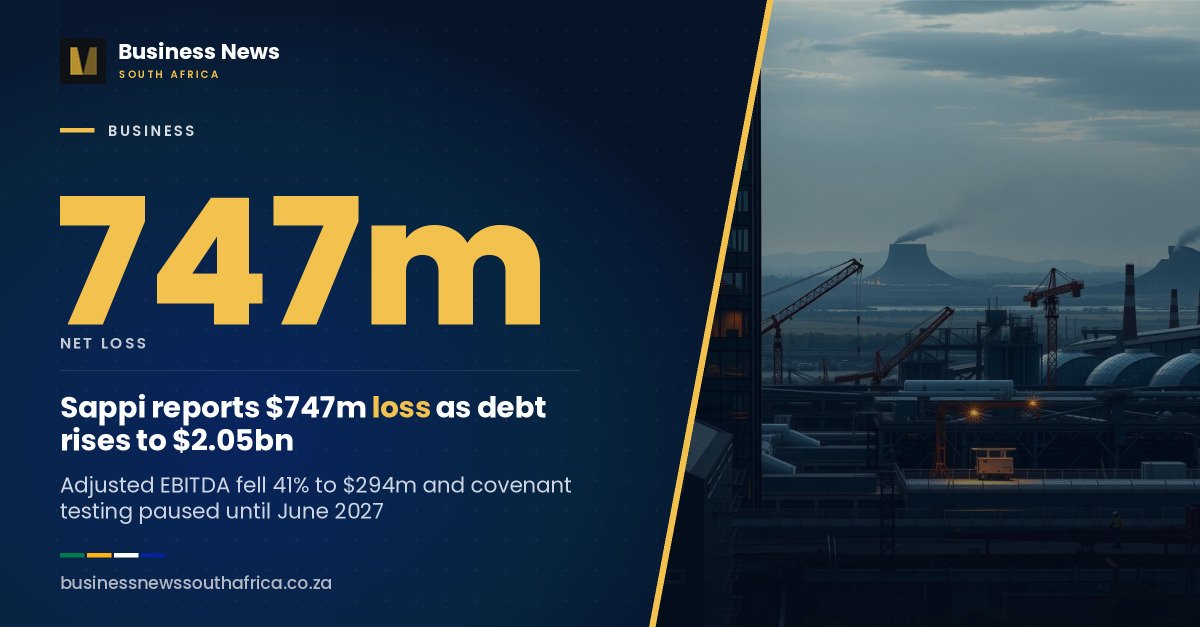
Sappi reported a net loss of US$747 million for the year to September 2026, against a loss of US$177 million a year earlier, in results published on the JSE’s Stock Exchange News Service on 6 November 2026. Adjusted EBITDA, the company’s preferred measure of operating earnings, fell 41% to US$294 million, and net debt rose to US$2,050 million from US$1,920 million.
Revenue slipped 3% to US$5,277 million. The company said it delivered its result in a difficult and volatile operating environment, and that it responded with a targeted cost savings programme, liquidity management and tight capital allocation.
Why the loss was so much larger
Sappi said special items reduced earnings by US$405 million for the year, made up mainly of impairments of US$319 million and US$26 million of costs linked to strategic projects. A forestry fair value price adjustment, a non-cash accounting charge, was a loss of US$269 million. Sappi attributed that largely to adverse currency movements on rand-denominated hardwood timber prices and to persistent fuel cost inflation. Net finance costs rose to US$114 million because of higher debt.
The company named several operating pressures. A stronger rand against the US dollar reduced profitability in South Africa. Higher fuel, logistics and chemical costs linked to the Middle East conflict added to the strain, and the slower-than-expected commercial ramp-up of the Somerset Mill PM2 paper machine in North America weighed on the first half. Sappi said operational interventions stabilised that machine and that it contributed increasingly positively in the second half.
Debt, liquidity and lenders
Net cash utilised during the year was US$146 million. Capital expenditure was held to US$210 million, below the company’s guidance of US$240 million. Liquidity stood at US$707 million, made up of US$165 million in cash and US$542 million of committed, undrawn revolving credit facilities in South Africa and Europe, which have been extended to 2031.
Sappi said it engaged with its lenders in the fourth quarter. The suspension of covenant testing on its international revolving credit facility and bank term debt, which was due to expire in March 2027, was extended to June 2027. Revised leverage covenant thresholds, which gradually decrease over time, have been agreed for the period after that and, the company says, give it sufficient headroom through to December 2027. Sappi said it will keep talking to lenders about arrangements beyond that date.
The fourth quarter
For the quarter, Sappi reported adjusted EBITDA of US$99 million, against US$111 million a year earlier, and a loss of US$116 million. The company said the quarter was substantially above the prior quarter and in line with its guidance. It said dissolving wood pulp prices rose US$22 per ton during the quarter to end at US$920 per ton, but that a stronger rand, cost inflation and a scheduled maintenance shutdown of one Saiccor Mill line, which cut earnings by about US$8 million, offset the benefit.
Pulp segment sales volumes fell 18% for the quarter. Sappi said about 38,000 tons of dissolving wood pulp sales slipped into the first quarter of its 2027 financial year because of congestion at the port of Durban, and that boiler tube leaks at Ngodwana Mill also hurt production.
UPM deal, board changes and the outlook
On the proposed European graphic papers joint venture with UPM, Sappi said the two companies formally submitted remedy proposals to the European Commission on 4 November 2026 and that it expects a decision early in January 2027. The board also named Brian Beamish as Lead Independent Director, succeeding Mike Fallon, who retires at the annual general meeting on 10 February 2027.
Sappi expects first quarter 2027 adjusted EBITDA to be below the fourth quarter of 2026, citing planned maintenance expected to cost about US$41 million and elevated oil prices. It estimates capital expenditure of about US$240 million for FY2027 and says it expects the forestry fair value adjustment to stay negative.
What it means for businesses
Sappi’s report is a read on the cost pressures facing heavy industry: fuel, chemicals, a strong rand and port delays all appear in the company’s own explanation. Exporters and importers who rely on Durban should note that a listed manufacturer is naming port congestion as a reason for delayed sales. Suppliers to the paper and packaging chain will want to watch how the cost savings programme and covenant arrangements play out. The company’s local trade protection fight is covered in our reports on the 5% newsprint import duty and on Itac’s rejection of a 20% tariff hike on paper imports.
What is not yet known
The announcement is a summary of the full financial statements and does not give complete detail. It does not say whether jobs or mill capacity will be affected by the cost programme, and the outcome of the European Commission review of the UPM joint venture is pending. Lender arrangements beyond December 2027 have not been agreed.