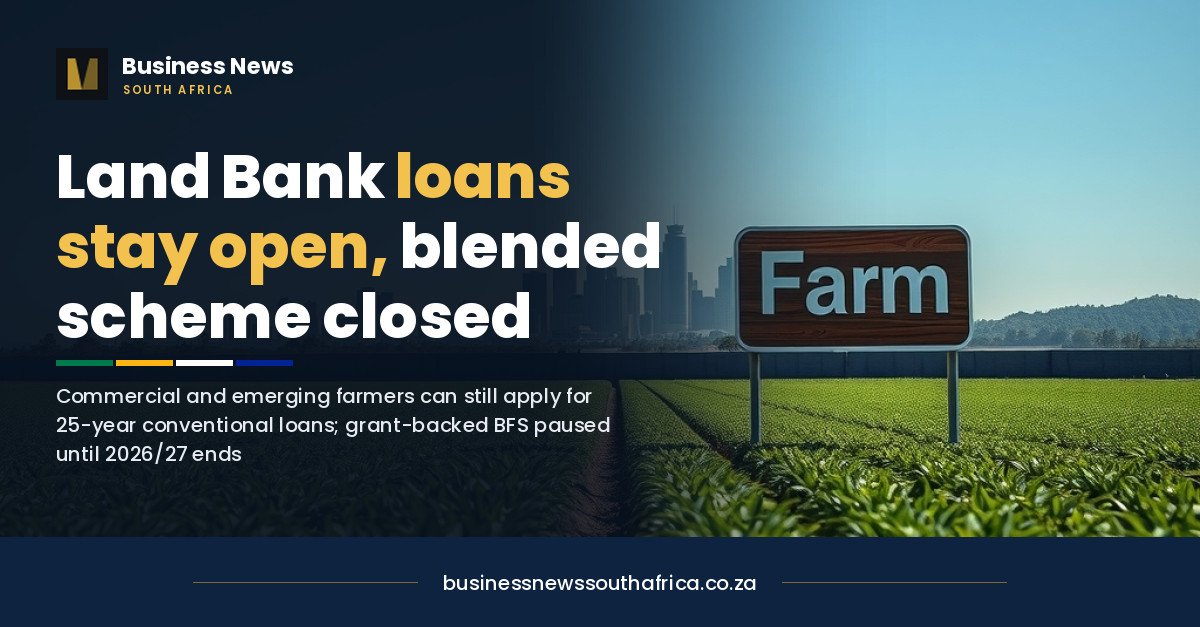
The Land Bank lends to commercial farmers, emerging and developing farmers and agribusinesses across the agricultural value chain, and, according to its own products page, it can offer loan terms such as 25 years on agricultural land purchases. As read on 2 November 2026, its conventional lending is open, while its grant-backed Blended Finance Scheme (BFS) is closed to new applications for the rest of the 2026/27 financial year.
What this means for your business
If you farm, process or supply agricultural products, the Land Bank is a lender you can approach today for conventional finance, whatever your size. If you were hoping for the grant-backed BFS route, that door is shut for now, so plan around loan finance and speak to the bank before you budget for a grant. Nothing here is a promise of approval: the bank says every application goes through its normal credit assessment.
Open, closed or paused: the status as at 2 November 2026
- Conventional loan finance: open. In its media statement of 16 October 2026, the Land Bank says it remains open for business and offers conventional agricultural financing through 100% loans to qualifying farmers, subject to normal credit assessment and approval.
- Blended Finance Scheme, new applications: paused for the rest of 2026/27. The same statement says the temporary suspension of new BFS applications remains in place. A separate Land Bank statement (it carries no date in the text we read) says the scheme has not been discontinued, but will not be open for the remainder of the 2026/2027 financial year.
- The extra R500 million: for applications already received. According to the 8 October 2026 statement, the Department of Land Reform and Rural Development will provide R500 million in grant funding for the rest of 2026/27. The 16 October statement says this money goes to qualifying transactions already in the BFS pipeline and does not reopen new applications at this stage.
- 2027/28 reopening: no date. The bank says a further annual grant of R325 million from the Department of Agriculture is expected for 2027/2028 and that it will communicate when applications can resume. It gives no reopening date.
This confirms what we reported in our 27 October funding overview. For the story as it developed, see our reports on the pause at planting time and on the funding that arrived without a reopening date. We do not repeat those details here.
Who the Land Bank lends to
The bank describes itself as a specialist agricultural development finance institution serving the commercial farming sector and agri-businesses, and it also backs new entrants and historically disadvantaged persons. Its products page lists these features, as read on 2 November 2026:
- loan terms longer than competitors, with 25 years given as an example for agricultural land;
- instalments matched to income, which can be monthly, quarterly, bi-annual or annual;
- flexible security options (the page does not say what security is required);
- support for established medium to large farmers with transformational projects;
- syndicated loans to large commercial businesses, co-funded with commercial banks;
- support for smallholder farmers and for Black agri-entrepreneurs through equity structures.
The bank’s website also lets you start an enquiry as an agro-processor or as an investor looking for opportunities in agriculture, so the scope is wider than primary production.
What it funds
The bank’s statement on the BFS pause lists its conventional products: mortgage loans for agricultural land and property, revolving credit for working capital and production, instalment finance for machinery and equipment, term loans and structured finance.
One product has its own page. The Production Revolving Facility is short-term production finance for approved seasonal costs. The page names commercial and developmental farmers, crop and livestock producers, mixed farms and other qualifying agricultural businesses. It lists seed and fertiliser, feed and veterinary costs, fuel and irrigation, contractors, insurance, farm wages and packaging and marketing. A full re-advance can be requested once 80% of the outstanding loan is repaid on annual crops, or 55% on perennial crops such as wine grapes, subject to the facility terms.
The site also carries pages for the Agro Energy Fund, a blended programme for energy assets such as irrigation and cold chain, and the Wine and Spirit Fund, a transformation programme with the Department of Agriculture and the European Union. Both pages are thin on terms, and we could not confirm who can currently apply to either.
How to apply
- Decide which route you need. Conventional loan, production facility, or an agro-processor or investor enquiry.
- Log an enquiry on the bank’s e-services portal, as the website describes. Note that on 2 November 2026 the homepage carried a notice that the e-services portal is unavailable, and told clients to use provincial branches or their relationship manager.
- Contact the bank directly: switchboard 012 686 0500 or toll free 0800 00 52 59, or info@landbank.co.za. The contact page gives branch hours of 07h30 to 16h00, Monday to Friday, and a head office at 148 Kelvin Drive, Woodmead.
- Expect an appointment, by phone or in person. The site says the team will arrange one and guide you through the process.
- For the Production Revolving Facility, prepare your annual production plan, which is the first step the page lists.
- Check any offer against the National Credit Act, which the bank says applies to credit agreements with natural persons and entities with an asset value or turnover below R1 million.
Compare terms across lenders. Our IDC funding explainer covers another development funder, and our report on Absa and Agrico irrigation finance covers a commercial bank option.
What we could not confirm
- Interest rates, fees, loan sizes and minimum or maximum amounts: could not confirm on the funder’s own site.
- The security or collateral required, and a checklist of documents: could not confirm on the funder’s own site.
- Turnaround times for decisions: could not confirm on the funder’s own site.
- BFS eligibility criteria and the share of grant to loan: could not confirm on the funder’s own site, which has no BFS product page in its menu.
- The publication date of the BFS pause statement, and any reopening date for 2027/28: could not confirm on the funder’s own site.
- When the e-services portal will return: could not confirm on the funder’s own site.