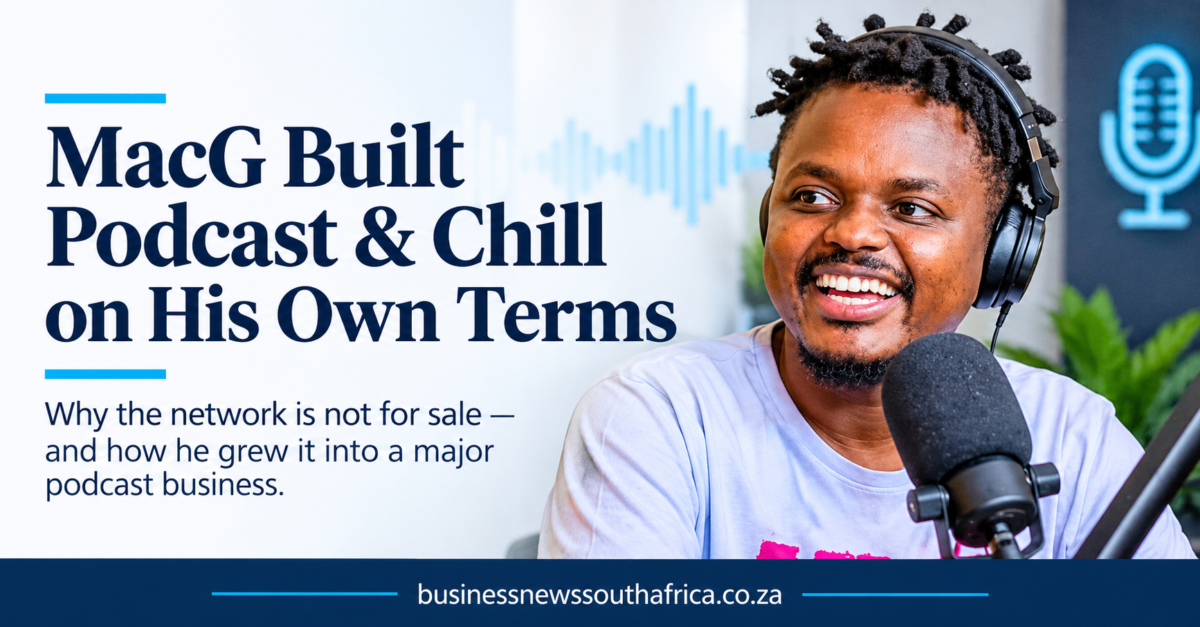
MacG, the broadcaster behind Podcast and Chill, says no offer would make him sell the network, and that he built it to be a business that does not depend on advertisers or on him. He made the case in a long interview on The Inside Show with host George, covering the network’s costs, a live arena show that nearly lost money, a television deal that fell through and the drinks brands he launched instead. Most of what follows is MacG’s own account, and we mark where it is his opinion or a claim we could not check.
Why he says Podcast and Chill is not for sale
The interview opens and closes on the same question: would he sell for R100 million, or R500 million? His answer both times was no. Asked what he would do with the money, he joked about going to Bali and coming back bored, then made the serious point that selling would take away the work he is built around.
“Zero. Zero, bro. There’s no amount of money, bro.”
MacG
He framed it as a question about purpose: “How much is your purpose worth?” That is a founder’s feeling rather than a financial argument, and not every owner can afford it. Still, it explains the choices that follow, from refusing advertiser control to building products he owns. He did leave one door open, joking that he might sell a product, “but not the podcast.”
From a garage to about 60 staff
MacG describes the start as a forced one. He had been in radio and says he was fired in June. Radio line-ups reshuffle with the financial year, which starts in April, so he expected to wait about eight months for another slot. Six months earlier he had bought recording equipment that sat in the garage and blocked his wife’s car, so he started a podcast while he waited. He says it “started flying” by August.
Money came slowly. He says he worked for two to three years without payment before his first YouTube AdSense payout of R8,000, which he spent on dinner with his wife and remembers as feeling like a million rand. He says the network’s best month produced “maybe 500k” in rand from AdSense, and that AdSense is now small next to the overheads. These are his recollections; we could not check them.
Today, he says, there are about 60 people in the business. The biggest cost, in his words, is the hosts. He declined to put a monthly figure on running the network, because people lift the number out of context and ignore the nuance behind it. The biggest headache, he said, is people management.
“It’s managing egos, bro. Like, literally Monday to Friday, I’m just putting out fires”
MacG
He built a network of several shows for a business reason: if the company depends on one star, it is not yet a business. In his words, “if it just relies on me, it’s not a business,” and the aim is to have a show that outgrows his own.
The DStv channel that did not happen
The extra shows, MacG says, began as the programming block for a 24-hour channel for content creators on DStv. He says the team ran a proof of concept for a few months, that the numbers were good and that approval for the full channel followed. Then, in his telling, “the French came”. We read that as Canal+, the group that took over MultiChoice, though he does not name it in the clip. He says the deal was not killed, but the carriage fees the plan relied on, which would have paid creators, were taken off the table, and the economics no longer worked. The team pivoted and kept the shows. For background on that owner, see our report on MultiChoice’s revenue under Canal+.
The live show that nearly lost R1.5 million
The most useful business story in the interview is how the Road to 1 Million show, celebrating the podcast’s first million YouTube subscribers, was rescued. MacG says he is not from the events world, so he brought in George, an events producer, and they split the show 50/50. MacG had predicted a sell-out in three months because of his audience. George says he replied that it does not work like that and that they needed six months, and that sales stood at about 150 tickets when he pushed to move the date. George recalls the two of them being set to lose about R1.5 million, and MacG adds that they had no sponsor yet. These are recollections, not audited numbers.
Two things saved it, as they tell it. First, MacG asked his audience, the people he says he built the show with, whether to postpone, and they agreed. Second, George explained a rule of thumb from events: build a base of tickets early, because once people see others buying, the rest follow. His version was that if you have 1,500 to 2,000 tickets three weeks out, especially in South Africa, you can see “a 600% 800% peak in your sales.” That is his experience, not a published benchmark, so treat it as a rule of thumb.
George says that six days before the event the show had broken even, and a sponsor that the captions render as Striped Horse came in. Separately, MacG describes how he structured that sponsorship: if the brand wanted to walk away over something said on the show, it would have to pay R500,000 to leave. He suggests other creators build the same protection into their contracts. The show reached 8,000 tickets, George says. MacG adds that the lesson was that a live show is its own product.
“recording a podcast and doing a live podcast is two different things.”
MacG
The next event, Road to 2 Million, is in an arena in Cape Town. MacG says it is self-funded and that he expects to lose money on it, which he calls a high-risk, high-reward bet on memories the audience cannot buy elsewhere. Whether that pays off is not something the interview can tell us.
Why he built his own brands
MacG’s view of advertisers is blunt, and it is an opinion. He says his first plan was to build an audience and let brands follow, until he saw what came with them: attempts to control content. He also says brands in South Africa are quick to pull out when there is controversy.
“brands in South Africa like they’re cowards. They don’t have a backbone.”
MacG
His answer was to make his own products, starting with the drinks. His reasoning is about who sits between you and the customer: the brand becomes a middle person, and if you sell straight to your audience you do not need it. In his words, “the chillers are the brand,” using the name for his fans. He is not saying the network refuses advertisers, only that the business model is not reliant on them.
He claims Chillers Punch is the fastest-growing spirit cooler in the country, and the only local brand among the top five. We could not verify that, so read it as his claim. He adds that a second drink, a lager, sold out on delivery apps across Cape Town. MacG says others now handle most of the operations while he covers creative and marketing, an example of the pattern he repeated: bring in experts for what you do not know.
Staying authentic
On the show itself, MacG says he does not prepare with his co-host Sol Phenduka at all. He does his own research, comparable to method acting in his words, and structures the conversation in his head on the drive in. His advice to anyone starting out is to stay away from social media.
“Stay off social media. It’s my best advice.”
MacG
His reasoning is that constant exposure to other people’s opinions crowds out your own ideas. That is a personal view, not evidence, and plenty of owners need social media to run their business. He also says the next step is global, and that he is already planning for 2028.
What business owners can take from it
- Do not build a company that only works while its founder is in the room. MacG’s network of several shows was designed to outgrow him.
- Use experts for what you do not know. He partnered 50/50 with an events producer rather than learn events from scratch.
- Model the downside before a large fixed-cost event, and check demand early. Their near R1.5 million exposure came from assuming sales would arrive on schedule.
- Put an exit clause in sponsorship contracts if your content can be controversial, as the R500,000 exit penalty did here.
- Be wary of depending on one channel. MacG’s case is that selling to your own audience reduces reliance on advertisers. For the economics of that, see our guides on how creators monetise YouTube and South Africa’s podcast ad market.
These are one founder’s opinions and recollections, shared in a conversation with friends, so some figures are approximate and a few are claims we could not independently confirm. Adapt any of it to your own numbers.