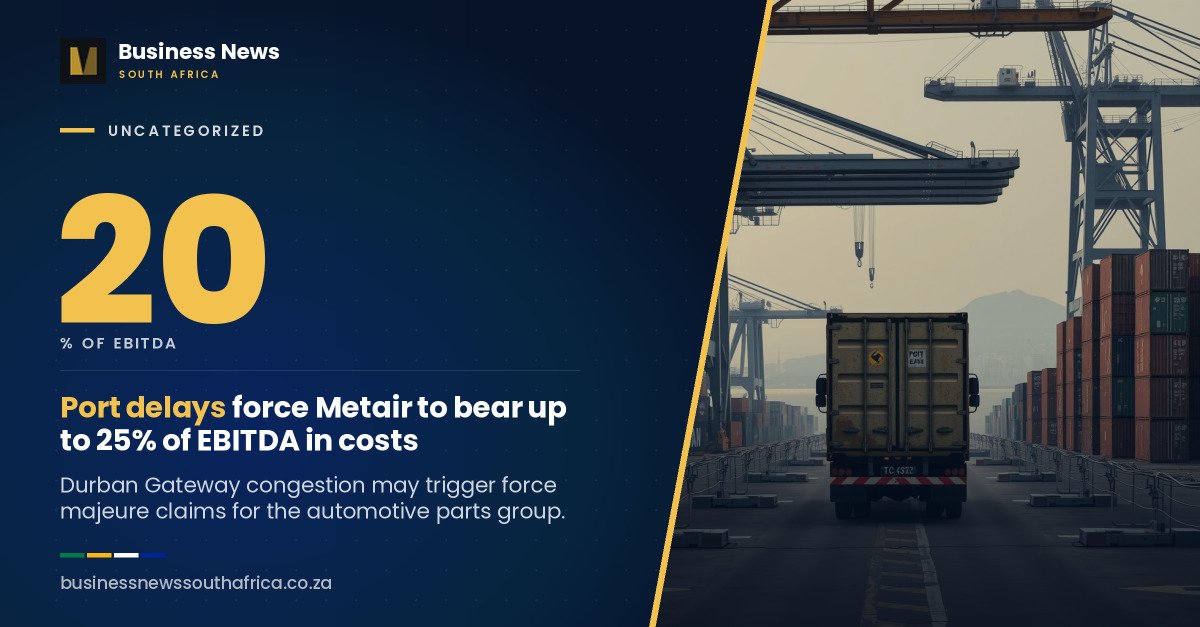
Metair Investments, the JSE listed automotive components group, says the extra costs of working around delays at Durban Gateway Terminal will come to roughly 20% to 25% of its EBITDA, and that it may have to consider invoking force majeure if port congestion continues. The figures come from the company’s own operational and trading update on JSE SENS, published on 13 November 2026. Metair has not declared force majeure. It said it “may be required to consider invoking” those contract clauses if conditions persist.
For any business that imports parts or raw materials through Durban, the update puts a hard number on the problem, and signals that a large manufacturer expects congestion to run into 2027.
Metair says delays at the terminal reached almost 20 days
According to the announcement, the new terminal operating system at Durban Gateway Terminal “severely disrupted container handling”, and equipment failures and limited crane availability made matters worse, with delays at times approaching 20 days. Metair listed three effects on businesses that rely on imports: production interruptions, stock shortages that push up working capital needs, and higher logistics costs from airfreight and extra road freight.
For Metair itself, the company said it has used airfreight as a substitute since August 2026 and called the related costs “exorbitant”. Late deliveries forced significant overtime, and the disruption contributed to a temporary stoppage on one of its customers’ production lines. Metair did not name the customer.
The cost estimate is measured against last year’s EBITDA
The 20% to 25% range needs careful reading. Metair said the total additional costs it has incurred, and expects to incur, for the year ending 31 December 2026 are estimated at approximately 20% to 25% of the group’s reported EBITDA before exceptional items for the year ended 31 December 2025. The yardstick is last year’s earnings, not this year’s, and the announcement does not give a rand amount.
Metair added that these costs cannot be recovered from customers, so the full amount falls on the group. The board said the financial information has not been audited or reviewed by its external auditors.
Force majeure is a possibility the company has raised, not a step it has taken
The company said Durban continues to experience serious congestion, with indications that meaningful improvement might not come before the end of the first quarter of 2027. If conditions persist, Metair said it may be unable to meet certain commitments to customers and suppliers. In that case, and where the disruption is beyond its reasonable control, it may need to consider invoking force majeure provisions in its contracts or exercising other rights under South African law.
Metair said it is working with its primary lender and its customers to manage the operational and financial effects. It also reported a separate problem: the industrial electron beam machine at its subsidiary Unitrade 745 broke down several times from August 2026, adding to the strain on that business. The machine has been repaired and its operations have stabilised over recent weeks, the company said.
Transnet still owns most of the terminal
Durban Gateway Terminal is a joint venture. In its results statement of 10 September 2026, Transnet said it sold a 49.999% interest in the terminal to International Container Terminal Services Inc (ICTSI) for R10.5 billion with effect from 1 January 2026. Transnet keeps a 50.001% shareholding, while management control passed to ICTSI. Transnet’s media centre had no statement on the terminal’s current delays when we checked on 15 November.
We covered the wider backlog, the government response and the freight industry’s view in our report on the Durban port backlog and the R10.5bn private deal, and the earlier switch to the Navis N4 system. On 29 October the Western Cape health minister wrote to the national transport minister asking for help with delays to imported medicines, particularly at Durban.
What this means for businesses that import through Durban
Our view: Metair’s update is useful because it turns port delays into a share of earnings. Companies that depend on imported inputs should run the same exercise on their own numbers, using their actual airfreight, overtime and holding costs since August. Metair’s estimate that congestion may last until the end of March 2027 is a reasonable planning assumption until the terminal shows a sustained improvement.
Two practical points follow. First, check the force majeure and delay clauses in your supply contracts now, because a supplier relying on them could leave you short of parts. Second, talk to your lender early if working capital is stretched, as Metair says it is doing. For context on the sector, our guide to investing in automotive components covers the incentives and risks facing parts makers.
What we do not know
Metair did not say which contracts could be affected, which customer’s line stopped, or what the 20% to 25% range is in rands. It did not say whether its full year results will include the costs as exceptional items. Transnet and ICTSI have not, in any statement we could find, responded to Metair’s estimate of when conditions might improve.