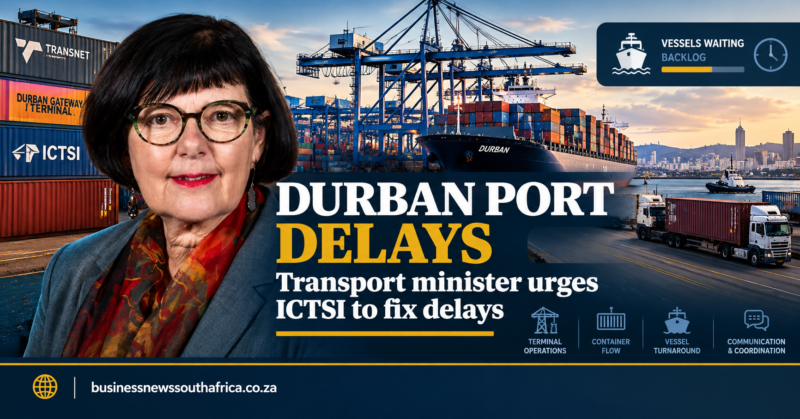
South Africa’s most congested infrastructure story this month has nothing to do with Eskom. On 15 August 2026, Durban Gateway Terminal, which handles more than 40% of the country’s container traffic, switched its cargo-handling operating system to Navis N4 4.0. The transition itself was meant to modernise a terminal running on ageing software. Instead, it triggered a backlog that, a month later, the port is still working through.
Weekly throughput at the terminal dropped by roughly 26% in the weeks immediately following the cutover, according to trade press covering the disruption. Some shipping lines reported vessels waiting offshore for eight to twelve days before berthing space became available. On land, truck drivers queuing to collect or deliver export containers faced waits of 24 to 30 hours just to reach a booking slot, according to industry reporting from WorldCargo News and freight-industry updates from the South African Association of Freight Forwarders.
Why a software switch caused a physical backlog
A container terminal’s operating system does not just track paperwork. It assigns where each container is stacked in the yard, sequences which ones get loaded onto which vessel and in what order, and coordinates truck appointment slots against actual crane and yard capacity. When that system changes, the terminal is effectively relearning its own physical layout in real time while still trying to move live cargo through it. A slowdown during the transition is normal. An 8 to 12 day vessel wait is not: it means the yard filled up faster than containers could be evacuated, creating a physical bottleneck that a stabilised system cannot simply undo overnight.
By early September, the Navis N4 platform itself was reported to be running stably. That did not end the crisis, it changed its shape. The problem shifted from a software transition to an accumulated backlog: too many containers sitting in a yard designed to hold fewer, with equipment availability and yard density now the binding constraint rather than the software. Durban Gateway Terminal has been working with Transnet Freight Rail to schedule additional trains specifically to evacuate backed-up containers by rail rather than truck, a sign of how serious the yard-density problem became.
Who is actually paying for this
Citrus exporters have been among the hardest hit, since South Africa’s citrus season runs directly through this window and fruit does not wait well in a queue. Freight industry reporting has specifically flagged disrupted citrus export schedules as one of the most visible casualties of the DGT backlog. Every day a reefer container sits in a congested yard rather than on a vessel is a day closer to the fruit inside it losing value, a cost that lands directly on farmers and exporters, not on the terminal operator.
For South African importers and exporters more broadly, the practical costs compound in less visible ways: demurrage and detention charges accrue on containers that sit past their free time, whether the delay is the shipping line’s fault, the terminal’s, or nobody’s in particular. Businesses with tight delivery windows, retailers restocking for a season, manufacturers waiting on imported components, have had to absorb either the direct charges or the cost of expediting alternative routes through Cape Town or Ngqura.
What SME importers and exporters should actually do
Freight forwarders and logistics advisories covering the crisis have converged on similar practical guidance for businesses moving cargo through Durban right now: confirm actual vessel ETAs directly with shipping lines rather than relying on original schedules, since sailing dates from weeks ago no longer reflect current berthing reality; build in longer buffers before contractual delivery deadlines, particularly for time-sensitive or perishable goods; and where possible, get quotes on routing through Cape Town or the Port of Ngqura as an alternative, even at a higher inland transport cost, if a shipment cannot tolerate an open-ended wait.
Cargo insurance is the other practical checkpoint. Standard goods-in-transit policies do not automatically cover losses purely from delay, only from physical loss or damage, so a business whose goods are simply sitting in a queue rather than damaged may find a claim does not apply the way it might expect. Reviewing policy wording now, before a specific shipment is caught in the backlog, is cheaper than discovering the gap after the fact.
Transnet has not published a specific date by which normal throughput is expected to resume. Given that the backlog is now a physical yard-capacity problem rather than a software one, clearing it will depend less on further IT fixes than on sustained additional rail evacuations and whatever spare handling capacity the terminal can free up, both of which take weeks, not days, to meaningfully shift a queue of this size.
For more on this beat, see our Energy & Infrastructure coverage.