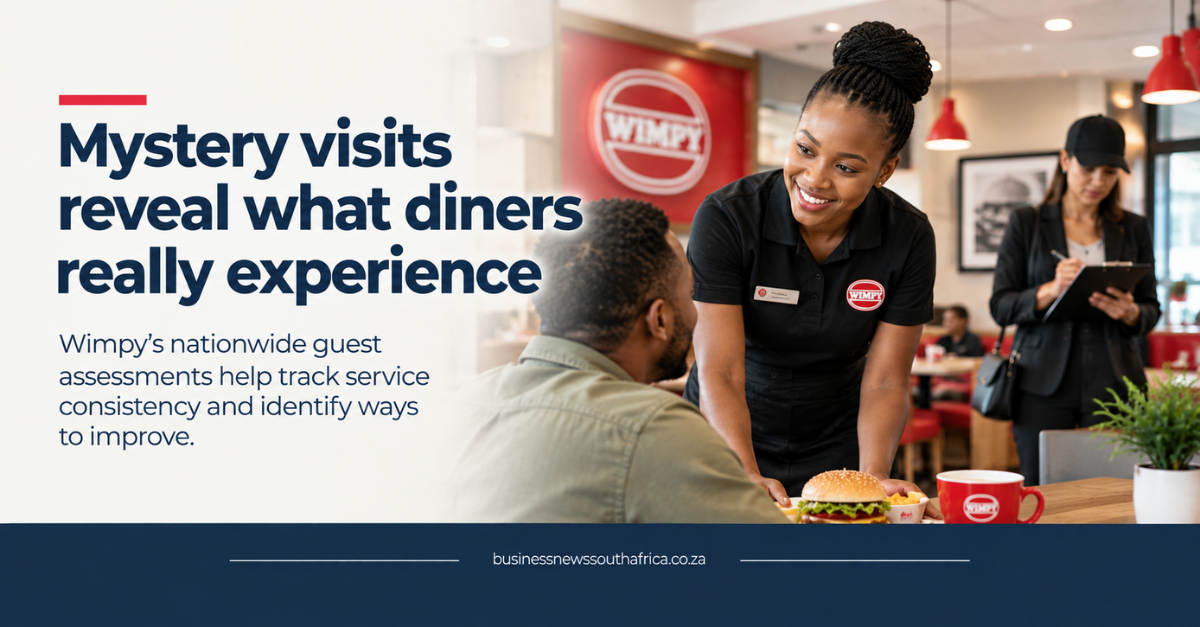
BMi Research, a market research firm, says its latest wave of mystery shopping for Wimpy covered more than 400 restaurants across South Africa. The company set this out in an article on Bizcommunity’s Biz Press Office on 1 October 2026, so this is BMi’s own account of its work, not an independent assessment.
According to BMi, it has worked with Wimpy for the past few years on the Wimpy Guest Experience Assessment. Several waves are run each year, and mystery shoppers assess the in-store experience from the moment a customer enters a restaurant until they leave, including how likely they are to recommend the brand.
BMi said that in the latest wave, “promoters” (customers likely to recommend the brand) were considerably more likely than “detractors” to have experienced staff availability, attentiveness, a warm restaurant atmosphere and being thanked or invited back when leaving. Michele Daines, head of research at BMi Research, said in the article that this shows why looking beyond a single satisfaction or Net Promoter Score is important. BMi did not publish the underlying scores.
Daines said the long-running nature of the programme lets Wimpy track performance over time rather than rely on a single snapshot, and that new measures can be added as the framework evolves. BMi also said that, for franchise and multi-site brands, the method can separate individual stores and regions and tell isolated problems from wider operational ones.
The wider evidence on poor service
BMi’s article cites a 2025 Qualtrics XM Institute consumer survey of more than 20,000 people. Qualtrics’s own release on the study says 34% of consumers reduce their spending with a company after a negative experience and 13% cut it entirely, and that fast food restaurants were the industry most at risk, with 62% of customers stopping or reducing spending after a problem. The survey covered 14 countries, not including South Africa. Qualtrics estimated poor experiences could cost businesses nearly $3 trillion in sales globally.
BMi’s article quotes different dollar figures ($2.1 trillion of reduced spending and $865 billion in lost revenue). We could not match those to a Qualtrics publication, so we have not repeated them.
What it means for a business
For restaurant owners and franchisees, the practical point from BMi’s account is that regular checks using the same criteria let a brand compare outlets and see whether training or operational changes make a difference. For related reading, see our reports on Famous Brands, which owns Wimpy and on how Vodacom’s CIO sees AI agents changing customer service.
Correction, 1 November 2026: an earlier version of this article said Wimpy had expanded its programme to more than 400 outlets, that Qualtrics had found $2.1 trillion of reduced spending and $865 billion in lost revenue, and that these were linked. BMi said only that its latest wave covered more than 400 restaurants, and we could not confirm the Qualtrics dollar figures. It has been corrected.