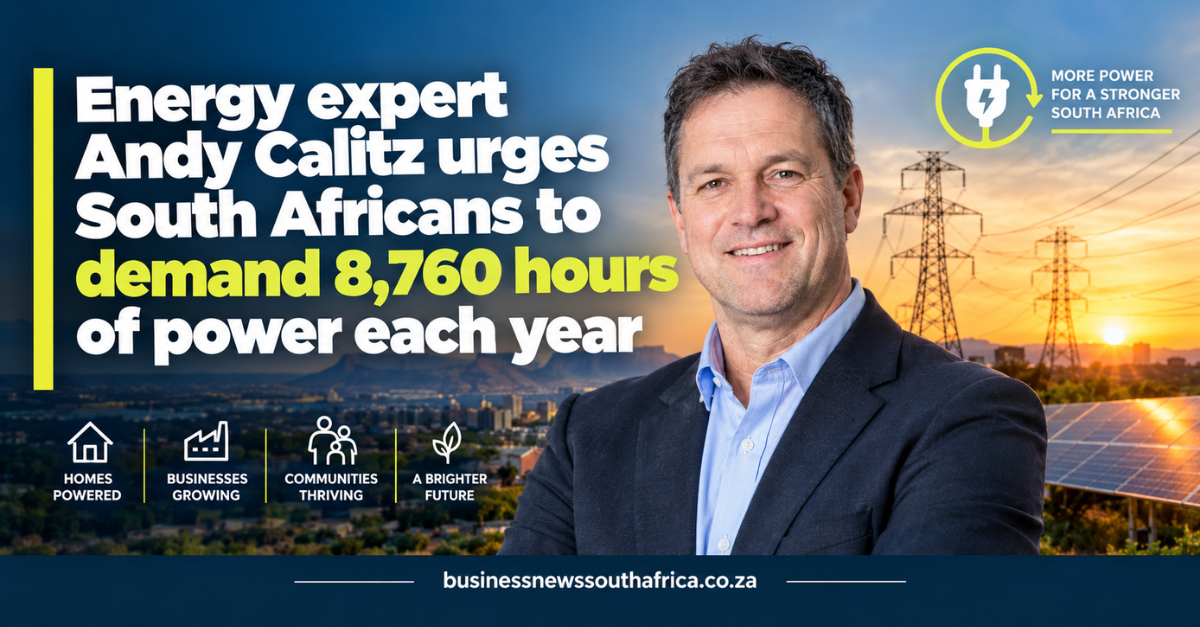
Andy Calitz, who once managed South Africa’s national transmission grid at Eskom, used an interview with BizNews to tell South Africans that reliable electricity should not be treated as a luxury. “Every farm, every restaurant, every school, every university, every business, has a right to demand 8,760 hours of supply per year,” he said, as BusinessTech reported. That figure is the number of hours in a calendar year, 24 hours for 365 days.
Calitz’s demand is his own view of what citizens should expect in a democracy, not a regulatory standard. He argues that South Africans have been too accepting of unreliable supply and that the democratic system gives them the right to hold authorities to account for it.
Who Calitz is
Calitz started his career at Eskom and joined Shell in 1996, according to his profile at the World Energy Council. At Shell he worked on alliances with Gazprom in Russia and with CNOOC and Sinopec in China, on LNG shipping, on Sakhalin Energy, on the Gorgon LNG project in Australia and on LNG Canada. He later managed Fujairah LNG operations at the Abu Dhabi National Oil Company and became the first secretary general of the London-based International Gas Union secretariat. He is now executive chair and special adviser at FutureEnergy, a World Energy Laureate and a judge for the S&P Platts Global Energy Awards, is based in London and has lived and worked across six continents. The BizNews interview, conducted by Alec Hogg, was published on 25 September 2026.
South Africans know him mostly as the man who lost out on the top job at Eskom. In November 2019 Public Enterprises Minister Pravin Gordhan announced that André de Ruyter, then chief executive of packaging group Nampak, would run the utility from 15 January 2020. De Ruyter had spent more than two decades in senior management at Sasol before Nampak. Engineering News reported that the appointment surprised observers, because media speculation had focused on Calitz, Jacob Maroga, Thembani Bukula and Dan Marokane. Of 142 initial candidates, six were interviewed and the board ranked three finalists before Cabinet ministers approved its recommendation. BusinessTech noted at the time that Calitz, with extensive energy sector experience, had been considered the frontrunner a few weeks earlier. Analyst Peter Attard Montalto of Intellidex observed then that “Eskom has had 10 CEOs in 10 years and has strict deadlines set in the Eskom roadmap”.
What he says the country needs
Electricity, Calitz says, is a fundamental requirement, and energy availability should not hold back economic growth. He stresses that energy underpins education, communications and healthcare.
He also warns against treating the energy future as a simple choice between technologies. No energy source is completely clean, he says, and every technology has environmental impacts. The BizNews interview covers nuclear, offshore gas and renewable energy, and his new book, Navigating World Energy, is listed on the World Energy Council profile.
Another strand of his argument is skills. Calitz says South Africa needs substantially more engineers and technical specialists to support economic development. He also points to the rise of “prosumers”, consumers who generate their own electricity, as a sign that the public is engaging more with the cost and reliability of power.
Why it matters to small businesses
For a restaurant, a farm or a small manufacturer, an interruption in supply means lost trading time and idle equipment, and Calitz’s point is that firms should not accept that as normal. His call is best read as a statement of principle from a former grid executive. It is not a forecast of when supply will be that reliable. More on power supply is in our Energy & Infrastructure coverage, alongside our SME & Entrepreneurship and Regulatory & Policy sections.