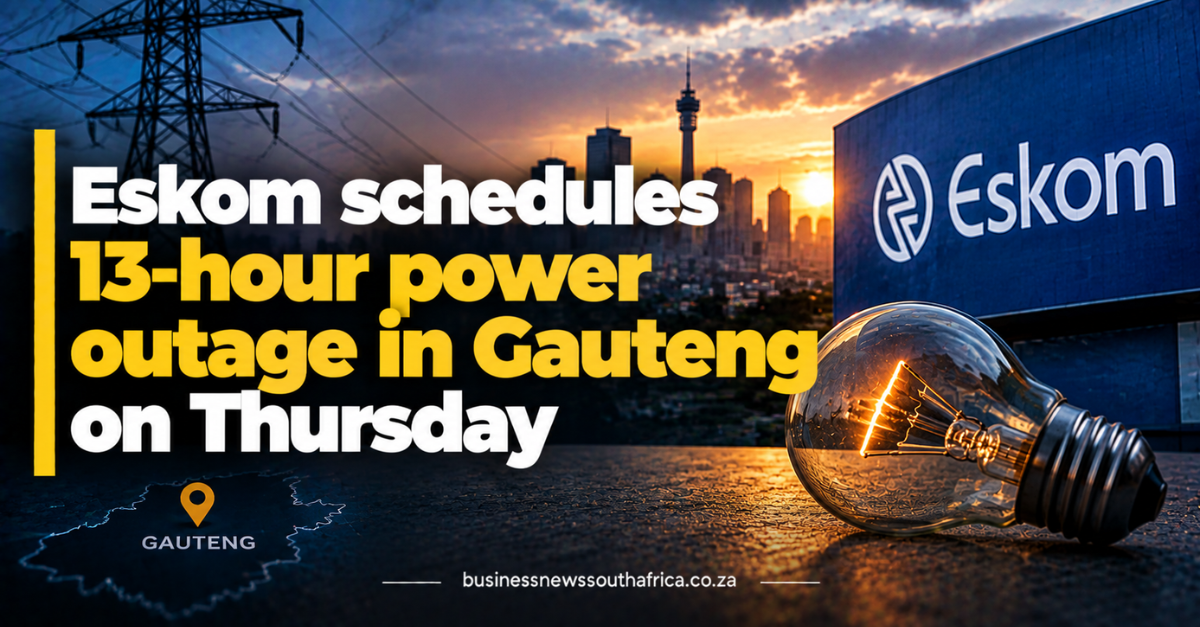
In the early morning, the hum of servers in a Johannesburg call centre fell silent as the lights dimmed, a reminder that South Africa’s power grid still has a habit of surprising its users. Eskom confirmed that a 13-hour scheduled outage will affect the Gauteng province on Thursday.
A scheduled outage (a planned shutdown of generation units for maintenance) is different from load shedding, which is a rolling, emergency cutback of supply to avoid a total blackout. The utility says the lengthy interruption is needed to service critical infrastructure and to keep the wider system stable.
Gauteng is the country’s economic engine, contributing roughly 34% of South Africa’s gross domestic product and housing a dense concentration of small and medium enterprises (SMEs). For a retailer that depends on refrigeration, a manufacturer that runs on continuous production lines, or a tech start-up that hosts client data, a 13-hour power gap can mean lost sales, spoiled stock and missed deadlines.
What the outage means for SMEs
SME owners will need to assess whether existing backup generators can cover the full duration. Many generators are sized for short-term load shedding and may not run for half a day without refuelling. If a business cannot stay operational, it may have to look at short-term financing to bridge cash-flow gaps caused by the interruption. The commercial funding suite can help identify quick-access loans or credit lines for such emergencies.
Beyond finance, the outage highlights the importance of a robust continuity plan. The National Energy Regulator of South Africa (Nersa) requires large consumers to submit load-shedding mitigation strategies, but smaller firms often overlook formal documentation. A simple checklist, confirming generator capacity, arranging fuel deliveries, and communicating with customers, can reduce the impact of an unexpected power dip.
For businesses that operate across provinces, the outage may also create a bottleneck in logistics. Freight trucks travelling from the Free State into Gauteng could be delayed if loading bays lose power, potentially pushing delivery windows beyond contractual limits.
While Eskom’s statement does not specify the exact start time, it does note that the outage will be continuous for 13 hours. That duration is longer than the average load-shedding block, which usually runs for two to four hours. The extended window gives firms a clearer picture for planning, they can schedule critical tasks either before the cut or after power returns.
In the broader picture, the outage is a symptom of the utility’s aging plant fleet and the ongoing challenge of balancing generation capacity with demand. Analysts have warned that without significant investment in new capacity or renewable integration, scheduled maintenance will continue to bite into the supply curve, forcing more frequent large-scale cuts.
For now, the immediate concern is practical: keep the lights on, protect inventory, and keep cash flowing. SME owners who have not yet reviewed their power-risk strategies may find Thursday a harsh reminder that electricity reliability remains a key business risk in South Africa.
Eskom’s generation fleet, in context
Eskom operates a generation fleet with an installed capacity of roughly 44,000 megawatts across its coal, nuclear, gas and hydro stations, most of it built between the 1970s and 1990s, according to Eskom’s own published plant data. A fleet that age requires regular planned outages simply to keep individual units running safely, which is the maintenance logic behind a scheduled cut like Thursday’s, distinct from the emergency load shedding triggered when unplanned breakdowns outpace available capacity. The practical distinction for a business owner is timing: a scheduled outage is known in advance and can be planned around, while load shedding stages can change with only a few hours’ notice.