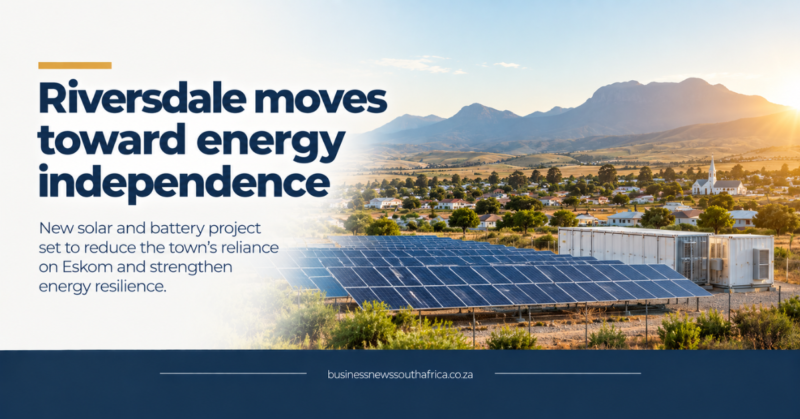
Energy minister Kgosientsho Ramokgopa has announced a determination for 9.6 gigawatts (GW) of new capacity made up entirely of battery storage and gas-fired power, with no new wind or solar, to tackle a daytime electricity surplus, TechCentral reports. It provides for 4.6GW of battery storage and 5GW of gas-to-power.
Ramokgopa told a briefing in Pretoria on Wednesday that it is the first determination under the 2025 Integrated Resource Plan (IRP), the government’s blueprint for new generation capacity, and that it brings forward battery storage the plan had phased in up to 2035. It is made under section 34 of the Electricity Regulation Act, which lets the minister decide, in consultation with regulator Nersa, what new generation must be procured. “We are sitting with the problem now, as I’m speaking to you,” he said. “We are seeking to resolve an immediate problem.”
The problem: power that has nowhere to go
That problem is curtailment: generators being told to switch off because the grid cannot absorb their power. Eskom’s generation recovery and the rapid growth of private generation have left the system with a surplus averaging more than 4GW, mostly during the day, according to the minister. Contracts with independent power producers (IPPs) are take-or-pay, meaning the buyer pays for electricity whether or not it takes it, so the National Transmission Company South Africa (NTCSA), which administers the agreements, still has to settle curtailment claims for power producers are told not to deliver. “So essentially, we are losing electricity, and we are throwing electricity away, and that’s money,” Ramokgopa said. He said the intervention was needed to “avert the possibility of market failure”, warning that curtailment would make future private projects more expensive to finance and more likely to fail.
Gav Hurford, acting general manager of the NTCSA’s system operator, said curtailment “suddenly became quite a large problem to manage” around April. “We had a particularly bad time during winter 2026, where we’ve seen curtailment of up to 3 000MW in a particular day. It is almost a daily routine at this stage,” he said. “If we don’t act now, this beast that we are dealing with at the moment is going to become a significant problem.”
What gets built, and what it might cost
The batteries will charge from power that would otherwise be curtailed and discharge during the evening peak, at sites chosen by the system operator. The allocation is almost nine times the 513MW procured in the first battery storage bid window, whose five projects attracted R15.4 billion in investment. Ramokgopa put the likely investment in the new allocation at “upwards of R90-billion”. Localisation requirements “will be more ambitious than the last round”, he said: the first window delivered 42.3% shareholding by black South Africans and 4.4% by local communities, and “those numbers are not as ambitious as they could be”.
Gas is meant to supply dispatchable power, electricity that can be switched on when needed, when renewable output falls. The first gas-to-power bid window is still being evaluated and requires a minimum load factor of 50%, meaning plants must run at least half the time on average; the Independent Power Producer (IPP) Office will set the load factor for the new allocation. Ramokgopa acknowledged the risks of imported gas, citing price spikes linked to the war in the Middle East and currency exposure. “A generating plant without dependable fuel cannot provide dependable electricity,” he said.
A second determination will cover wind and solar, including hybrid projects with storage, plus pumped storage, and a state-led power parks programme will follow in the next round, under which the state will prepare land, carry out grid studies and provide bulk services to cut upfront costs for emerging developers. Transmission remains a constraint: Eskom can build about 800km of lines a year against the 1 450km a year required, Ramokgopa said, and he wants stronger regional interconnectors to export surplus power.
Bitcoin miners as a grid resource
Asked about bitcoin mining as a source of grid flexibility, Ramokgopa said talks were under way. “We are sold on the idea that mining provides a unique solution to our problem,” he said, adding: “We’re looking at up to 1-3GW in the next two years.” TechCentral notes that is far more than the interest cited in Nersa’s consultation on Eskom’s proposed pilot tariff for crypto miners, in which two mining companies indicated combined initial demand of about 10MW, potentially rising to 500MW.
For more on the energy outlook, see our Energy & Infrastructure coverage.