Busi Mabuza, chairperson of the South African BRICS Business Council, told the Mzansi Way Makers series, in an episode published on 27 September 2026, that South Africa’s BRICS partners could take far more value-added goods from it, because its exports into the bloc still consist mainly of raw commodities. The host introduced her as having most recently been chairperson of the Industrial Development Corporation (IDC); we could not confirm whether she still holds that post.
What it means for a business: Mabuza’s message for exporters is to aim for finished and value-added goods rather than raw material, and she says Indian prime minister Narendra Modi has asked the business council for concrete trade-barrier, start-up and partnership targets. These are her accounts of the summit, not independently verified.
What she said about the New Delhi summit
Asked about the BRICS summit in New Delhi, Mabuza said it was high energy and that South Africa had the biggest business delegation she has seen since she started with the council in 2019. She said she was the first of four speakers to give a report back from the business engagements, with heads of state present.
She called BRICS “a game changer for an emerging economy such as South Africa” because the large economies matter for South Africa “especially where they can in their import baskets” take value-added goods. She said these range from agricultural produce to manufactured equipment, and that closing the gap is an opportunity to narrow the trade deficit.
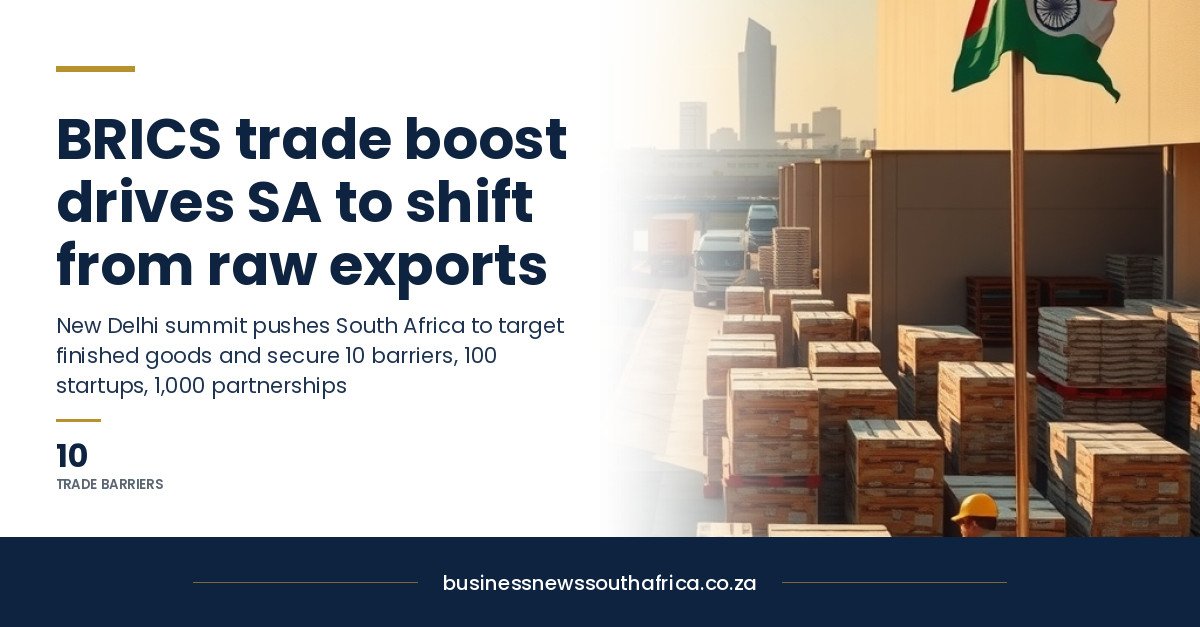
She said Modi told the council: “Please bring to us the 10 most important trade barriers that you would like to have addressed by the heads of state. Please bring to us a hundred startups that can benefit from intra bricks trade.” She said he wanted this measured at each annual meeting and asked the council to find a thousand partnerships within a reasonable period.
She gave one example of BRICS trade in action: an Indian company that has bought a small packaging business near Pretoria and the land next to it, to expand and export to the rest of Africa, with funding from an investor in the United Arab Emirates. She did not name the company.
Related reading on our site: President Ramaphosa says South Africa is ready for a new era of trade with India and Ramaphosa warns South Africa to prepare for possible loss of AGOA benefits.
Funding, tourism and energy
Asked what single change would help most, Mabuza said: “where I would start if I had a magic wand is giving easy and ready access to funding for small and medium enterprises,” because “that is where the impact is going to be closest to where it’s needed the most”. She said each small business employing two to five people has immediate impact, whereas a large business may be constrained in how fast it can grow.
She named services and tourism as opportunities that depend on resolving crime: “our country has beauty that compares to the best in the world,” she said, and the sector suits youth employment.
On energy, she said she was “pleased that an entity such as” Eskom “has turned the corner and is now able to offer preferential rates to the big consumers of energy”, which she said manufacturing needs, and that some mothballed plants might be revived. That is her view; we have not checked it.
On funding for growing firms, she said intermediaries and angel investors are lacking and that “development finance entities do have a healthier risk appetite than banks”, so partnerships between banks and development finance institutions could unlock opportunities for firms a bank may turn away.
Career advice and corruption
Mabuza credited Almorie Maule, a former chief executive of Engen, whose preparation and clear speaking she admired, and Phumzile Mlambo-Ngcuka, who was Deputy Minister of Trade and Industry when Mabuza was one of a small group of volunteers briefing her on research. “I wouldn’t have come through CEO without the benevolence and support of people who had walked the path ahead of me,” she said. She said she worries that “young people have a much shorter attention span” and can end up “pivoting away from getting the depth that they require too soon”.
She said she wakes at 4:00, which she traced to her parents, both teachers, and uses the quiet to meditate, reflect and read.
On corruption, she said she believes it is “being surgically dealt with” through commissions such as the Madlanga Commission, but that “we of course can’t then sit back” and “we need to call corruption out wherever we see it”. She recalled a primary school teacher who said a pupil who walks past a piece of paper on the ground shows the kind of intolerance the country needs towards corruption.