According to BusinessTech, President Cyril Ramaphosa will chair a newly created commission to coordinate the work of South Africa’s state-owned firms, after the government shelved a plan to place them under a single holding company.
The commission will review a national strategy that sets out the role each entity should play and ensure the government exercises ownership “in a coherent and professional manner,” Minister in the Presidency Maropene Ramokgopa said in response to questions. It will also standardise and strengthen governance practices, improve monitoring, and help rationalise and restructure the entities to eliminate duplication.
The holding-company idea was first introduced in a draft law presented to parliament in 2024, proposing a management company to oversee all state firms. The bill was never processed and was formally withdrawn last month. “Circumstances have changed considerably” since it was drafted, Ramokgopa said, adding that once stakeholder engagements and consultations with political parties had run their course, “we realised that the bill could not simply be rewritten; we needed to take it back to cabinet.”
South Africa has scores of state entities, including power utility Eskom, logistics group Transnet and the South African National Roads Agency. A number of them have been dogged by mismanagement and financial problems, leaving them reliant on government funding and fuelling calls for improved oversight, calls that have run alongside the load-shedding, rail delays and road maintenance backlogs those firms have produced. For businesses of every size, unreliable electricity, freight bottlenecks and poor road conditions translate directly into higher operating costs and lost productivity.
A commission instead of a new law
The new panel will be a hybrid of the type of structures China and Norway use to oversee their own state entities, and can be established relatively quickly. “Our Constitution allows for the president to directly chair a commission using regulations, rather than the long process of creating a law,” Ramokgopa said. “If necessary, we can still create a management company down the road should we need to.”
In the interim, the Department of Planning, Monitoring and Evaluation (DPME) is working on reform proposals for the state companies, including appointment and remuneration guidelines for senior officials and a framework for rationalising the portfolio of entities. Some of the biggest state firms previously fell under the Department of Public Enterprises, which was disbanded in March 2025, with oversight transferred to the relevant line ministries. The new commission is meant to sit above that arrangement rather than replace it.
The government has previously suggested that some state companies could be listed on the Johannesburg Stock Exchange or privatised, but Ramokgopa’s comments make clear that process never gained traction and is not the current focus. The announcement does not signal privatisation or listings in the near term; it signals a shift toward more disciplined oversight, with the stated goal of catching problems at state firms before they require the kind of repeated bailouts that have strained the public finances to date.
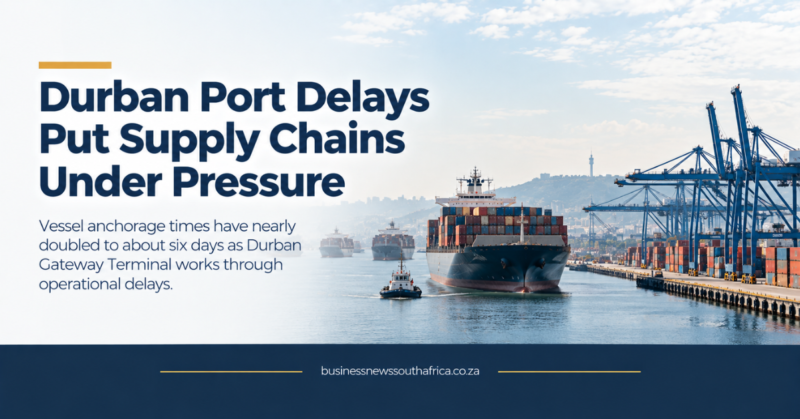
The coordination problem the commission is meant to address is already visible on the ground. We reported this month on Durban’s Gateway Terminal delays doubling vessel anchorage times and threatening supply chains, and on the transport minister having to publicly urge port operator ICTSI to fix the backlog. Both involve Transnet infrastructure and are the kind of cross-cutting, multi-entity problem a single coordinating commission is supposed to catch before it reaches the point of ministerial intervention.
Read more about how regulatory reforms are shaping the business environment in our Regulatory & Policy coverage.