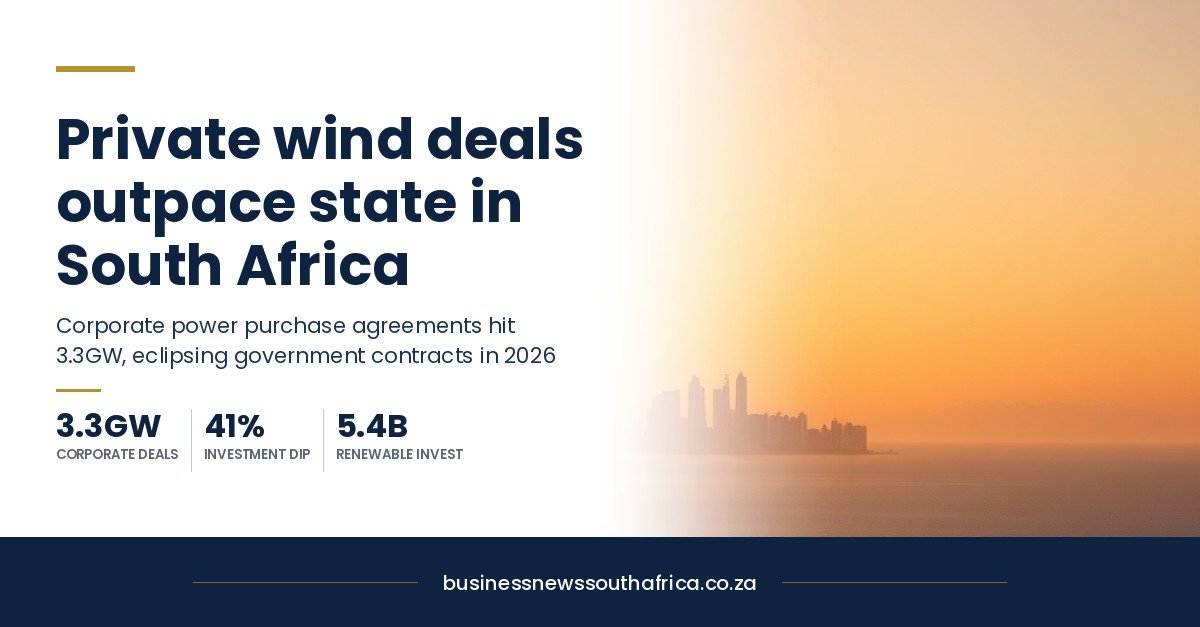
Private wind investment in South Africa now outpaces the state, delegates heard at Windaba 2026 in Cape Town on 7 October, according to Farmer’s Weekly. The report said more than 3.3GW of corporate power purchase agreements, which are contracts under which a company buys electricity directly from a generator, reached financial close in under three years.
Regulatory changes now let mining and industrial companies buy renewable electricity directly. For a business that buys power, the point is that private supply deals are now where much of the new capacity is coming from, but grid access, not generation, is what delegates said holds projects back.
What the private money has built
The University of Cape Town’s Power Futures Lab found that 17 independent power producer (IPP) projects, totalling 1 920 MW, began commercial operation in the first six months of 2026, according to research reported by the Cape Chamber of Commerce. That is the highest capacity ever added in a single half-year, and already above the previous full-year record of 1 472 MW, set in 2016.
Ten of the 17 projects, with a combined 1 046 MW, supply mining operations and industrial consumers directly. Seven projects, with 874 MW, came from government programmes: bid windows 5 and 6 of the Renewable Energy IPP Procurement Programme (the state’s competitive auction for private power) and the Risk Mitigation programme. Those figures cover all technologies. Wind contributed seven new farms and 815 MW.
The same research expects a further 28 projects, totalling 2 202 MW, to start operating in the second half, which would take annual additions to more than double the previous record if completed on schedule. It also notes that most of the projects entering service this year reached financial close in 2024, so this year’s output reflects deals signed two years ago.
Bloomberg New Energy Finance (BNEF) reaches a similar conclusion in its South Africa Transition Factbook 2026, as TaiyangNews reports. Corporate buyers back 73% of the 2.3GW of new solar and wind expected in 2026. TaiyangNews reports that, for the first time, corporate power purchase agreements are expected to drive more utility-scale renewable additions than government auctions. Since 2020, corporate clean-power deals total 5GW, of which standalone projects account for 3.1GW (1.5GW of wind and 1.6GW of solar) and co-located projects 1.9GW.
Prices, and a dip in total investment
BNEF puts the average wind power purchase price at R1 102 per megawatt-hour in 2024 and 2025, forecast to edge up to R1 104 in 2026. Industrial electricity in South Africa cost R1 652 per megawatt-hour in 2025, against R964 in mainland China, according to the same factbook.
The investment numbers complicate the headline. BNEF reports that South Africa’s total renewable investment fell 41% in 2025 to US$5.4 billion, from US$8.6 billion in 2024. Onshore wind investment fell 30% to US$2.1 billion, while small-scale solar rose 35% to US$1.8 billion. Private buyers leading the market therefore does not mean the market itself grew last year. The BNEF figures are for 2025, while the Windaba claim concerns where new deals are coming from.
The continental picture is brighter. Farmer’s Weekly reports that Africa had installed 11.1GW of wind by December 2025, after a record 1.53GW added during that year. The continent has a planned pipeline of 186GW across 260 projects. South Africa, Morocco and Egypt hold 85% of Africa’s installed capacity but under 10% of its technical potential.
The grid is the limit
Delegates were told that transmission capacity is becoming a limiting factor in some of the strongest markets, with South Africa named as an example. Juliana Kainga, Africa WindPower director at the Global Wind Energy Council, whose Status of Wind in Africa Report 2026 was launched at the event, argued that strong wind resources alone do not attract investment. Credible buyers, bankable contracts, grid access and financing do.
Kainga said a project can have the best wind resource, a buyer and financing in place and still be unable to proceed because of grid constraints. For related reporting, see our articles on the delayed independent transmission tender and on Ekurhuleni’s 2 400MW private power purchase plan.
BNEF’s Africa research lead, Nelson Nsitem, called the transition a “critical inflection point” and said “the next phase will depend on whether infrastructure can keep pace with investment”.
What comes next
The industry body, the South African Wind Energy Association (SAWEA), shifted this year’s Windaba, its flagship conference, to a two-day programme under the theme “Implementing Watt Matters: Policy. Power. People.” SAWEA chief communications officer Morongoa Ramaboa said in a Farmer’s Weekly preview that “successful implementation will depend on practical reforms, particularly procurement certainty, stronger grid coordination”.
The GWEC report’s forecasts put South Africa above 15GW of wind by 2035. BNEF expects South Africa’s wind capacity to grow from 4.4GW to 10GW by 2030, mainly driven by large energy users.
The Windaba claims come from delegates and industry bodies, and SAWEA’s own post-conference figures were not available at the time of writing.
Correction, 27 October 2026: an earlier version of this article quoted a National Transmission Company chief executive and gave transmission build figures that we could not trace to a published source, and described the 1 472 MW record as a half-year record when it was a full-year record. It also quoted BNEF directly on corporate deals where the source reports it as a paraphrase. These have been corrected.