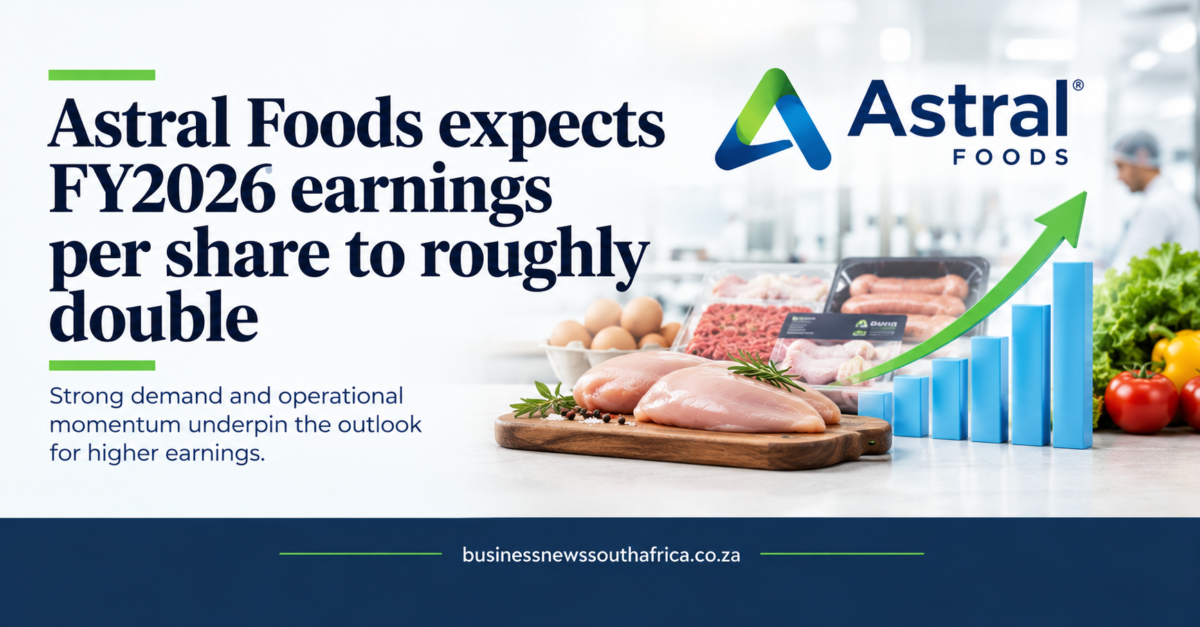
Astral Foods expects its earnings per share for the year to 30 September 2026 to roughly double, according to a trading statement the poultry producer published on the JSE’s Stock Exchange News Service (SENS) on 29 October 2026. The company said it has a reasonable degree of certainty that earnings per share (EPS) will rise by between 90% and 100%, to between 4,324 cents and 4,552 cents, against 2,276 cents a year earlier. Full results are due on Monday, 23 November 2026.
The figures in the trading statement
Astral’s own trading statement and operational update gives two ranges for the 2026 financial year (FY2026):
- EPS: up 90% to 100%, which works out to 4,324 to 4,552 cents (FY2025: 2,276 cents).
- Headline earnings per share (HEPS): up 95% to 105%, which works out to 4,277 to 4,496 cents (FY2025: 2,193 cents).
The two measures are related but not the same. EPS is the profit attributable to shareholders divided by the number of shares. HEPS adjusts that profit for certain items set out in JSE rules, so it is meant to show the earnings of the underlying business. A trading statement is required under JSE rules once a company is reasonably certain its results will differ by at least 20% from the previous period, and Astral’s earlier statements in the year cite that rule. The company added that the figures have not been reviewed or reported on by its auditors, so they could still move when the audited numbers appear.
Why earnings are up, according to Astral
The company lists five drivers, and the first is the cost of poultry feed:
- Softer maize and soya prices on local and global commodity markets lowered poultry feed costs.
- Internal feed sales rose on higher broiler production volumes, alongside growth in external feed sales.
- Farming efficiencies improved, which together with cheaper feed lowered the cost of producing a live broiler.
- Poultry sales realisations improved, helped by volume growth in higher-margin parts of the sales mix.
- Astral credited its best cost strategy, though the statement gives no detail on what that involved.
The statement does not give a rand figure for profit, revenue, or a breakdown between the poultry and feed divisions. Those numbers will come with the full results.
How the year has built up
The year was flagged early. In a voluntary trading update in March 2026, Astral cited strong demand for poultry products, a recovery in selling prices through 2025 after a prolonged period of price deflation in 2024, and favourable feed costs. It also said the consumer environment remained under pressure, with households facing rising essential costs and constrained disposable income.
A further trading statement on 29 April 2026 put first-half HEPS at between 2,250 and 2,331 cents for the six months to 31 March, up 450% to 470% on 409 cents a year earlier. Those first-half ranges were forecasts, not reported results, but on their face they are close to the 2,193 cents the group earned in all of FY2025. Set against the full-year range of 4,277 to 4,496 cents, the October statement implies a strong second half too, although the company does not give a half-year split in this statement.
That swing follows a difficult stretch. Business Day noted at the time that the March update credited strong demand and higher production, and that the group had completed a change in its finance leadership, with Johan Geel taking over as chief financial officer from Dries Ferreira in March.
What the market did, and who Astral is
BusinessTech reported that Astral’s shares closed at 20,284 cents on 28 October and were up about 1.3% at 20,548 cents by 11am on 29 October, and put its market value at about R8.8 billion. We have not verified the market value independently. Astral describes itself as the largest integrated poultry producer in South Africa, and its brands include County Fair, Festive and Mountain Valley, and its site also lists Meadow Feeds, Tiger Animal Feeds and Ross Poultry Breeders.
What to watch in the full results
For investors, the 23 November results should show how much of the gain came from cheaper feed, which can reverse, and how much from volume and pricing. For consumers, the sector’s improved margins sit alongside household budgets that Astral itself describes as stretched. Our reporting on braai basket inflation and on chicken’s place in fast-food demand gives more of the demand picture, and our guide to agro-processing covers the sector’s incentives and risks. More listed-company news is in our Markets & Finance section.
Detail on how the earnings forecast was reported by BusinessTech is available there, and Business Day’s earlier coverage of the interim update is at Business Day.