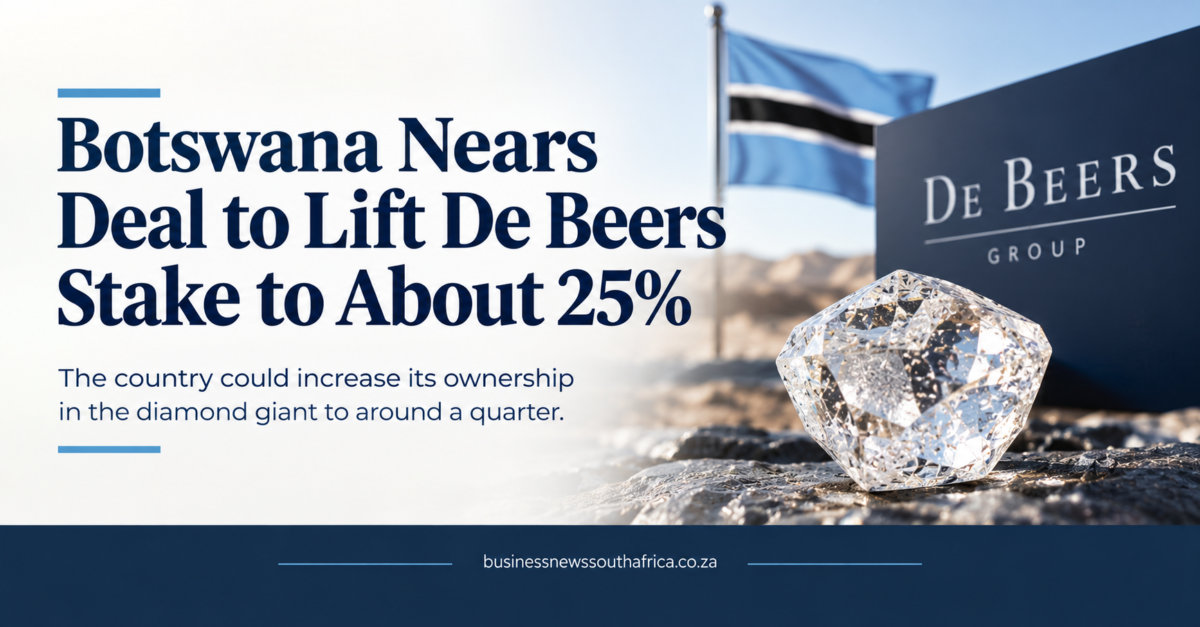
Botswana and a consortium led by former De Beers chief Gareth Penny are close to agreeing how much of De Beers each will own, and Botswana’s stake would probably rise from 15% to about 25%, according to a Bloomberg report published by Moneyweb. Talks are continuing and no agreement has been finalised.
Anglo American, which owns the other 85% of De Beers, declined to comment, as did the consortium and Botswana’s presidential office. The report says an agreement with Botswana would clear one of the final obstacles to a sale that has dragged on for more than two years and been stalled by the diamond market crisis.
Who is buying
The Global Diamond Consortium emerged as Anglo’s preferred bidder in July 2026. It is headed by Penny and also includes Namibia and Angola, Moneyweb reports.
In July, Botswana’s minister Moeti Mohwasa told parliament that Anglo had run a competitive process among three shortlisted bidders and had chosen a preferred one, Miningmx reported, citing Reuters. Mohwasa did not name the consortium’s members but said its plan to bring in Angola and Namibia was positive. He said the government wanted an experienced operator with stable, long-term backing and a credible turnaround plan, and he expected the deal to close by the fourth quarter of 2026, subject to conditions including Botswana’s approval.
Anglo said at the time that it was “progressing the competitive sale process with a number of bidders” and would provide updates at the appropriate time.
The price and the value
Bloomberg reported in July that Anglo had discussed selling De Beers for about $1 billion, a fraction of what the business was once worth. Anglo has recognised three impairments (writedowns of the value at which an asset is carried in its books) in three years, which cut the carrying value of the unit to $2.3 billion in February, according to the Moneyweb report.
The gap is wide. In November 2025, MarketScreener, relaying Reuters, reported that Anglo valued De Beers at around $4.9 billion, though any sale price would depend on market conditions. Anglo chief executive Duncan Wanblad said in February that the sale process was “relatively far advanced” and that the preferred buyer was “probably a consortium” of government and private entities, the Miningmx summary of his Financial Times interview shows. The sale is part of Anglo’s restructuring after it rejected an approach from BHP in 2024.
What Botswana wants
Botswana President Duma Boko had earlier said the country wanted majority control. Vice President Ndaba Gaolathe later said that whatever the final figure, Botswana’s stake would be more than 15%, Moneyweb reports.
Boko said in his State of the Nation address that Botswana was exploring a larger stake and called De Beers a “strategic national asset”. He did not give the structure, the valuation method or a timetable.
The money is a constraint. Speaking at a Chatham House event in London in September, Gaolathe said Botswana would not weaken its finances to raise its stake. “I can assure you that Botswana as a government, the Ministry of Finance, is not reckless and careless,” he said, adding: “We have no choice to diversify or we perish.” Miningmx, reporting Bloomberg’s account, said rough diamonds account for most of Botswana’s foreign currency earnings and roughly a third of state revenue, and that the economy has entered recession because of the downturn.
In July, James Campbell, managing director of Botswana Minerals, told Miningmx that the government was finding it hard to raise funds, and that Botswana had said it wanted to “diversify away from diamonds”, which more investment in De Beers would cut against.
Control and the market
If the deal proceeds on these terms, Botswana, Angola and Namibia together would hold less than 50% of De Beers, so the company would stay under private investor control. Moneyweb describes that as a key condition for some of the consortium’s backers.
Botswana also holds 50% of Debswana, its joint venture with De Beers, which supplies about 70% of the company’s annual rough diamond output, according to the MarketScreener report. That is why Botswana’s position carries so much weight in any sale.
The diamond industry is in a deep and prolonged slump, with lower prices, weaker Chinese demand for luxury goods, the rise of synthetic stones and trade tensions all cited. Moneyweb notes some recent signs of recovery, and says post-completion payments tied to the business’s performance have also been reported.
Still unknown are the final size of each party’s stake, the price, how Botswana would pay for its larger holding and when the deal would be signed. Anglo, the consortium and Botswana’s presidential office have not commented on the reported terms.