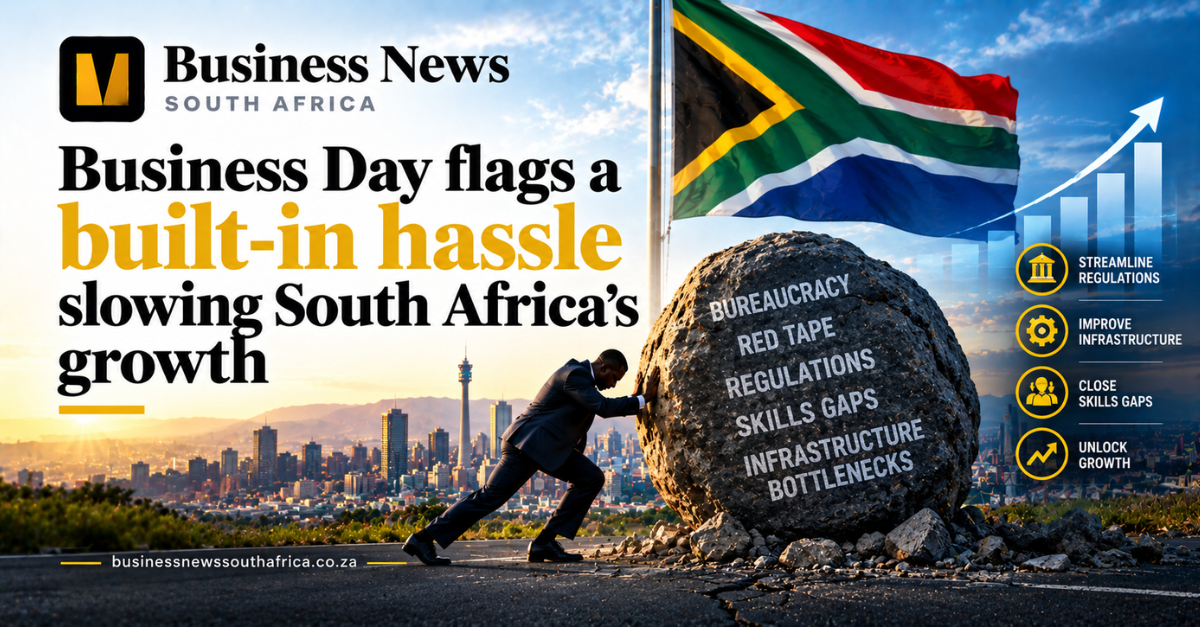
The Business Day column by Luncedo Mtwentwe, titled “The built-in hassle that’s holding South Africa back”, argues that the country’s productivity problem lies less in how hard people work than in the environment around them. Commuting, unreliable utilities, poor logistics and slow municipal processes, he says, waste time and raise costs for every business.
“Productivity is not just about how hard someone works between 8am and 5pm,” the column says, and it adds that the problem is not a lack of willingness to work.
The commute as an economic cost
Mtwentwe treats lost time on the road as an economic cost and not only a transport issue. He cites OECD research giving average commuting times of 107 minutes by train, 84 minutes by bus and 63 minutes by minibus-taxi, while private car users average 44 minutes. He also cites Statistics South Africa data showing that an average household spends about R3,000 a month on transport, making it the third-largest household expense after housing and groceries.
Hidden losses that do not show on a balance sheet
The column lists power cuts, water interruptions, internet outages, road-related delays and slow approvals as cumulative losses that rarely appear on a balance sheet. Large firms can absorb them with generators, backup connectivity and extra staff, he argues, while smaller businesses on thin margins often cannot.
That cost, he says, also undermines localisation goals. Producing locally costs more when electricity, transport and other infrastructure are expensive, so buyers turn to cheaper foreign platforms such as Shein and Temu. The column ties this to jobs: it cites unemployment of 33.6%, with 8.5 million people out of work, and says the infrastructure conversation is, in effect, a jobs conversation.
What the column points to
Mtwentwe notes that National Treasury has acknowledged that the infrastructure deficit limits productivity and raises business costs, naming transport bottlenecks, water insecurity and uneven municipal service delivery. He also refers to Transport Minister Barbara Creecy’s plans for more affordable vehicle finance and better licensing and testing for the minibus-taxi industry.
As a positive example, he points to Morocco, whose domestic economy he says grew an estimated 4.9% in 2025, its strongest growth in a decade, which the column credits to heavy infrastructure investment and digital transformation. In South Africa, he cites Volkswagen’s Kariega plant in the Eastern Cape, which he says has received more than R10 billion in investment since 2011 and supports about 50,000 indirect jobs through its supplier network.
What it means for business owners
This is an opinion column, so its figures are the author’s, attributed to the sources named above. The practical point for business owners is that these frictions are rarely a single line item. They show up as slower deliveries, backup power and connectivity costs, staff arriving late or tired, and delays waiting for approvals, and the column’s argument is that they are as much a drag on growth as any headline policy.