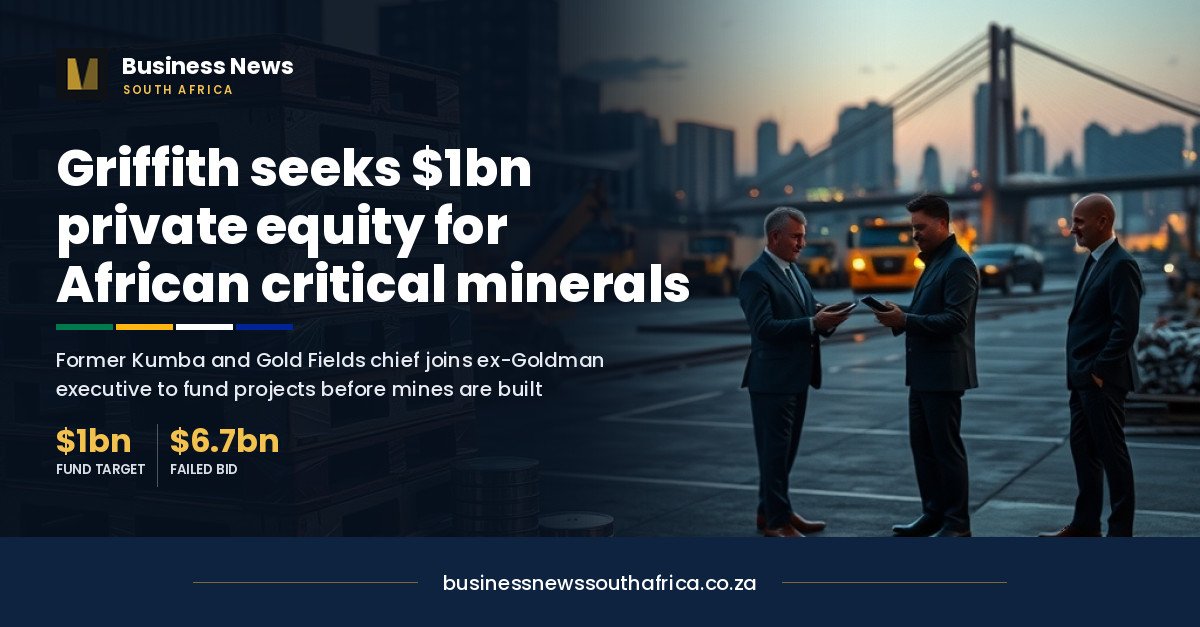
Chris Griffith has run three of the biggest mining businesses on the JSE, and left the last two on his own terms, or at least on terms he was not willing to change. Now he is trying something that has no shareholders to argue with yet. “I’m part of a private equity team now, seeking to raise a billion dollars to invest in African critical minerals,” Griffith told Business Day, in an interview published on 23 September.
The fundraising is at an early stage. Griffith is working with Colin Coleman, the former head of Goldman Sachs in sub-Saharan Africa, and Sam Jonah, the Ghanaian mining executive, along with colleagues in Ghana and South Africa. No fund name, investor list, closing date or target country has been disclosed.
A career spent at the top of the JSE’s mining board
Griffith is a University of Pretoria mining engineer who joined Anglo American in 1990. He ran Kumba Iron Ore from 2008 to 2012, then Anglo American Platinum from September 2012 to April 2020, a tenure that included the five-month AMCU platinum strike of 2014 and the mechanisation drive that followed it. He became chief executive of Gold Fields on 1 April 2021, succeeding Nick Holland, according to the company’s announcement in January that year.
The Gold Fields chapter ended over a deal. In 2022 he led a $6.7 billion all-share bid for Canada’s Yamana Gold, which major Gold Fields shareholders opposed. The deal collapsed and Griffith stepped down in December 2022, with Martin Preece named interim chief executive.
He did not stay out of mining for long. In September 2023 Vedanta Resources made him chief executive of its Base Metals division and president of its international businesses, a role covering its zinc operations in South Africa and Namibia, its iron ore business in Liberia and its copper portfolio, including Konkola Copper Mines in Zambia, Miningmx reported. He resigned in July 2025, in the same weeks that short seller Viceroy Research published a report questioning Vedanta’s debt. Vedanta rejected the report and said Griffith had told it of his plans to leave “a while back”, as Miningmx also reported.
The team around him
The two named partners bring different kinds of weight. Coleman spent about two decades at Goldman Sachs, heading its South African office from 2000 and later its investment banking division for sub-Saharan Africa, before retiring as chief executive for the region at the end of 2019. Jonah ran Ashanti Goldfields from 1986 to 2004, turning a single Ghanaian mine into a multinational, and became executive president of AngloGold Ashanti when the two companies merged in 2004. One knows where the capital sits. The other knows what it takes to build an African mining company that the capital will trust.
Why private equity, and why now
“Critical minerals” has no single definition, but it usually means the metals that energy storage, electric vehicles, power grids and electronics depend on: copper, cobalt, lithium, graphite, manganese, nickel and the rare earths among them. Africa holds large shares of several, and governments that want those supply chains, the United States, the European Union and China above all, are now competing for access. That competition is showing up in policy. Mining Weekly reported on 22 September that the Democratic Republic of Congo plans a centralised mining investment agency under a deal with the US.
A private equity vehicle suits that moment in a way a listed miner does not. Listed mining companies are judged every quarter on dividends and production, which makes it hard for them to fund early-stage projects that will not pay back for years. A private fund raises its capital once, locks it up for a fixed term, and can back a project from exploration through to construction before selling it on. That patience is what many African critical minerals projects lack, and it is also where the risk sits. The same funding question every business owner faces, whether to give up equity or take on debt, simply arrives with more zeros and a longer wait for the answer.
Local mining finance is not standing still either. Harmony Gold, for example, recently arranged a $1.25bn sustainability-linked financing with Nedbank’s help. Griffith’s fund would sit at a different point in the cycle: before a mine exists, rather than after it is producing.
What is still unknown
This is a plan in the fundraising stage, described by one of the people raising the money. There is no public information yet on who the investors are, which minerals and countries the fund will target, how the capital will be split between exploration, development and producing assets, or when a first close is expected. Raising $1bn for a first-time private equity fund is hard in any sector. Griffith’s track record includes a Kumba share scheme that paid R2.665bn to more than 6 000 workers and a takeover bid his own shareholders refused, so he will know better than most that investors are not a formality.
What is clear is the direction of travel. One of the country’s best-known mining executives has looked at the critical minerals race and decided the best seat is not in a boardroom answering to shareholders, but in the one that picks which projects get built at all.