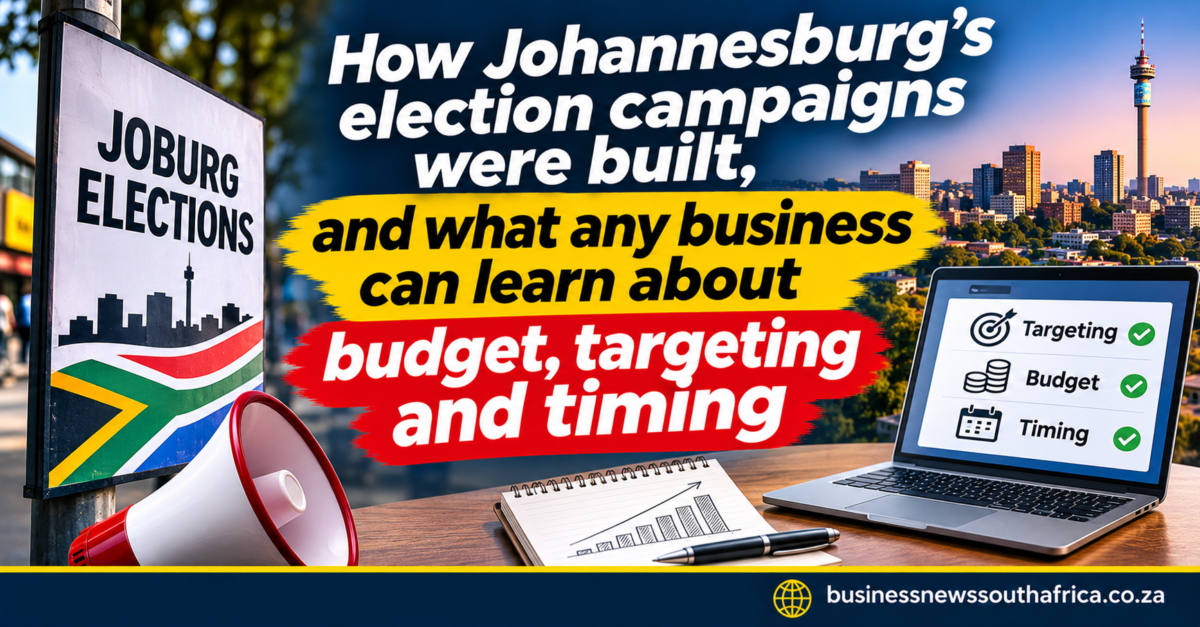
Johannesburg voted on 4 November 2026, and the count was still under way when we wrote this, so this is not a story about who won. It is about how the main campaigns were built, and what any business owner can borrow from them. Everything below was read on 5 November 2026.
Start from the number you need
The DA’s Johannesburg campaign was built backwards from a vote target. According to a Daily Maverick interview, campaign manager Nicole van Dyk named 2016 as the benchmark, when the party got 490,000 votes in the city. Helen Zille said earlier the party needed 470,000 votes to win, and told Daily Maverick the aim was to be the largest party after the poll. In a 702 interview published on 30 October, reported by EWN, she said the DA was targeting an outright majority of 136 of 270 council seats. That is a measurable goal, set months ahead, that every decision can be tested against. The same interview says 2.349 million people were registered.
Where the money came from
The DA has not published a budget for its Johannesburg campaign that we could find, and neither have the other parties. What is public is party funding. Under the Political Party Funding Act, donations above a threshold are declared to the IEC. Daily Maverick reported in May, citing the IEC, that the DA declared about R122 million for the 2025/26 year, including R57.3 million in the January to March quarter. ActionSA declared R11.6 million for the year, and the IEC said the ANC received at least R21 million, with late declarations still being explained. SABC News reported on 27 August that four parties declared R116.8 million for April to June 2026, with the DA above R104 million, ActionSA R5.5 million, the Labour Party R5 million and RISE Mzansi R2.25 million. The IEC excluded R15.27 million of ANC donations from the compliant total because the submissions did not meet disclosure requirements.
These are donations to whole parties, nationally, across all contests. They are not what any party spent in Johannesburg, and nobody should read them that way.
The incumbent’s different budget
The governing side had a different resource: the city’s own capital programme. Daily Maverick reported on 1 October, from a recording of a 17 September mayoral committee meeting, that Mayor Dada Morero urged leaders to finish unfinished projects before the vote and to “control and own the political narrative”. It also reported that the finance MMC said city entities were asked to identify projects over 90% complete for handover ceremonies, and that the city expected a short term R3 billion facility from Standard Bank. The mayor’s spokesperson denied election driven spending, said no financial decision is taken at a political meeting, and conceded that the timing invites scrutiny. The DA caucus leader asked for an investigation. We take no side in that dispute. The business point is narrower: timing an announcement is a marketing method.
Targeting: the voters who decide the outcome
Daily Maverick’s September analysis described a two part DA plan: win new voters in Soweto, and get wealthier suburban supporters to the polls. Analyst Wayne Sussman called Soweto “extremely decisive”, noting it holds nearly 30% of the city’s wards. The same article reported that the DA took 4.1% of Soweto ward ballots in 2021, so the party was starting from a low base there. Zille’s team spent a registration drive at a Soweto civic centre in August and, according to the campaign’s Q&A, more time in townships than suburbs. The lesson is to know which segment decides your result and spend accordingly, including on customers you already have but who may not come back.
Message discipline and stunts
The campaigns chose concrete, visible messages. The DA used stunts such as rowing a rubber duck on a flooded Soweto road and themed issue pushes, with City Power the theme ahead of winter. IOL reported that ActionSA launched its 2026 campaign by having Mashaba help repair a pothole in Alexandra, under a “fix local government” message. Each message was short and tied to something a resident could see. Businesses that repeat one message for months are copying that.
Timing and measuring
Timing ran through everything: launches in 2025, a registration drive in August 2026, projects pushed to finish before late October, and public meetings planned for every ward by the end of October. Campaigns lean on polls, and pollsters often disagree, which is a reminder to test any single measurement against a second one. Measure what you can act on, such as cost per enquiry or repeat purchase, not just the one headline number.
What this means for a business budget
- Set a target in units you can count (customers, orders, enquiries) and work backwards to the spend.
- Put the money where the deciding group is, not where it is most comfortable to spend.
- Keep one message and repeat it with something visible behind it.
- Time launches to when customers decide, and check results against more than one measure.
Going big without going smart is expensive, and going smart on a budget too small to reach the audience is slow. Suppliers should also read what businesses that deal with municipalities should check after the elections and the tender guide.
What we could not confirm
- Any party’s actual Johannesburg campaign budget. None was published that we could find.
- How much of the donations declared to the IEC was spent in Johannesburg.
- The status, terms and purpose of the R3 billion Standard Bank facility, which the city’s spokesperson said still needed confirmation.
- Whether any campaign method influenced the outcome. We have left results out until the IEC declares them.