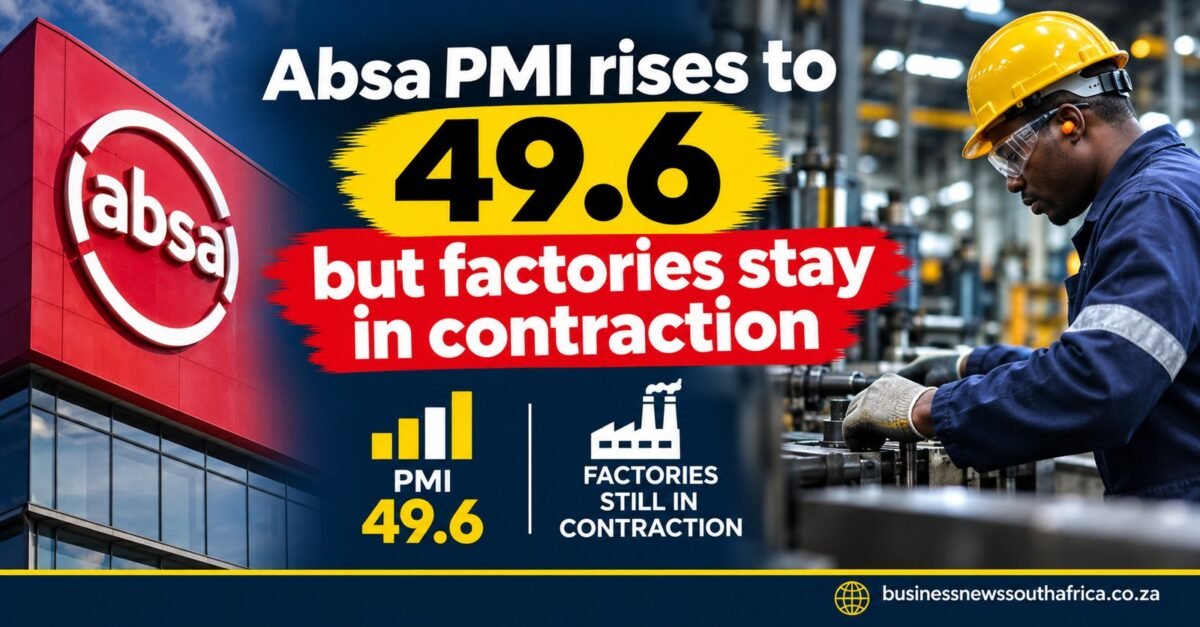
South Africa’s manufacturers are still reporting contraction, but the pace is easing. The seasonally adjusted Absa Purchasing Managers’ Index (PMI) rose by 0.9 points to 49.6 in October 2026 from a revised 48.7 in September, according to the Bureau for Economic Research (BER), which compiles the survey for Absa, released on 2 November. A reading below 50 means more purchasing managers reported falling than rising activity, and the revised series shows October was the fifth month in a row below that mark.
What it means for your business
Manufacturing demand is recovering slowly, not rebounding, and input costs are rising faster than activity. If you buy from or sell to factories, expect tight margins, firm supplier prices and delivery delays. The temporary fuel-levy relief that starts on 4 November may take some pressure off freight costs in the short term, but the BER says it does not signal easing underlying price pressure.
Which index this is
This is the Absa PMI, a monthly survey of purchasing managers in the South African manufacturing sector. The BER conducts it and Absa sponsors it. Managers say whether activity such as new orders increased, decreased or stayed the same, and a value of 50 indicates no change. The headline PMI is a weighted average of business activity, new orders, employment, supplier deliveries and inventories, each with a weight of 0.20.
A revised September, and why “fifth month”
The BER says the seasonal adjustment factors were updated in its usual annual review, which revised the historical series. September’s headline was originally published on 1 October as 50.7, above the neutral mark. It is now 48.7. In the revised history data published on the BER website, the headline PMI reads 51.4 in May, then 47.7 in June, 46.6 in July, 46.0 in August, 48.7 in September and 49.6 in October. That is five consecutive readings below 50.
What improved, and what did not
All five components of the headline index increased in October, according to the BER’s October release. Business activity edged up to 48.6 from 47.7, and new sales orders rose for a second month to 46.8 from 45.4. Both remain below 50, which the BER says means production and demand are still under pressure. Export sales also rose, to their best level since early 2025, almost reaching the neutral mark, though the BER says that does not yet signal an outright increase in export orders.
Employment improved only slightly, from 42.8 to 44.2, and the BER describes it as particularly weak: manufacturers remain reluctant to hire with production and demand this subdued. Inventories rose marginally above neutral to 50.4, and order backlogs increased slightly from a low level. The BER says these movements, together with weak new orders, offer limited evidence of a sustained improvement in production demand.
Costs and logistics
The purchasing prices index rose to 73.7 from 71.1 in September, which the BER attributes to sharply higher fuel costs at the start of October and a somewhat weaker rand against the dollar. The supplier deliveries index was virtually unchanged at 58.1. A reading above 50 on that index means delivery times lengthened. According to the release, respondents’ comments suggest ongoing logistics disruptions, particularly at the Durban harbour, remain a key factor, and some firms reported shortages of imported inputs and production interruptions. We have reported on the Durban terminal delays separately.
The fuel levy relief
The BER release notes that manufacturers should get relief in November from the temporary fuel-levy reductions announced in the Medium-Term Budget Policy Statement. Based on under-recovery data to 28 October, it says diesel prices could fall by around R1.60 per litre, with more modest declines in petrol, but that the reductions reflect the levy relief rather than an easing in underlying fuel-price pressures. Finance Minister Enoch Godongwana said the levy would be cut by R3 per litre for diesel and R1.50 per litre for petrol from 4 November to 1 December 2026, then by R1.50 and R1 until 5 January 2027, SAnews reported. Our own report covers how the relief steps down.
The outlook
The index of expected business conditions in six months fell to 51.7 from 55.3, still marginally above neutral. The BER says the decline suggests purchasing managers remain cautious. Respondents highlighted uncertainty around the upcoming local government elections, persistent logistics and infrastructure constraints, and pressure on domestic demand.
What to do
- Lock in or review supplier pricing, since the purchasing prices index is at 73.7.
- If you run a fleet or buy freight, pass on or bank the diesel saving while it lasts, and plan for the step-down on 2 December.
- Build extra lead time for imported inputs that move through Durban.
- Treat export orders as the one improving area, but do not budget on it yet.