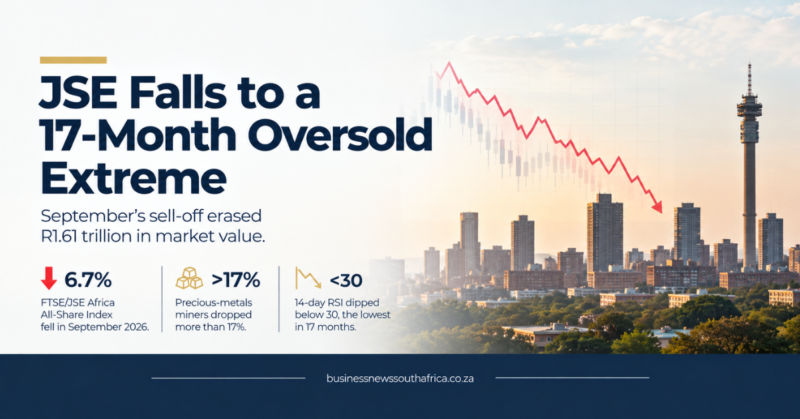
The Johannesburg Stock Exchange (JSE) All Share Index (Alsi) is down almost 7% for the first three quarters of 2026, according to a Moneyweb report. The index rose 11% from roughly 116 000 points in early January to a peak of just under 128 500 points at the end of February, before a sharp fall on 28 February when the United States and Israel attacked Iran. Since that session the index has moved lower, losing 3% in Q1, 5.6% in Q2 and 7% by the end of September.
Anchor Capital’s global fund manager Peter Little said the biggest drag came from precious-metal miners. Gold stocks fell 15% and platinum miners slipped 7%, together accounting for more than 3% of the index’s September performance. He added that investment conglomerates Naspers and Prosus also hurt the market, dropping 12% and 8% month-on-month respectively, which translated into a 1% hit to the Alsi and a negative 4% contribution to the year-to-date result. Their largest underlying holding, Chinese internet giant Tencent, was down 5% in September and has lost over a quarter of its value since the start of the year.
Local shares and sectoral trends
Shares of companies focused on the domestic economy did not fare much better. Among financials, only insurers Discovery (+1.6%) and Old Mutual (+3%) posted gains in September. General retailers were a rare bright spot, with Shoprite up 6% and Boxer up 3.6%, putting them 22% and 15% higher than in January. Other retailers such as Clicks and Spar saw modest relief after a tough year.
Consumer-oriented groups suffered the steepest declines. Woolworths fell 27% over the three-month period, while Truworths, Astral and Italtile each slipped 23%. The Foschini Group, Pepkor, AVI, WeBuyCars, Sun International, Dis-Chem and MTN all lost at least 16%.
Some stocks rose sharply for special reasons. Sebata Holdings surged 153% after the JSE lifted a trading suspension and the company reported better interim results. Property developer Acsion jumped 110% following a special scrip dividend, and Montauk Renewables rallied on improved earnings and outlook. Randgold Mining & Exploration added 68% over the quarter, extending a six-month gain of more than 270% after progress in a long-running court case over misappropriated shares. Education group Stadio Holdings rose 39% after being added to the JSE Top 40 Index.
Overall, 166 of the 271 listed companies either stayed flat or fell, while only 105 managed any gain and just 68 rose more than 5%.
Fund managers continue to argue that the market still offers value. Piet Viljoen, founder and CEO of RECM, described the JSE as “a value play” and listed several stocks he believes are trading well below fair value.
For small-business owners and entrepreneurs, a weak equity market can tighten access to capital. When the index falls, investor sentiment cools and the cost of raising funds through equity or debt can rise. Companies that rely on public markets for growth capital may face higher financing costs, which can ripple through supply chains and affect credit terms for SMEs. Conversely, the pronounced under-performance of certain sectors may create buying opportunities for long-term investors, but the volatility also underscores the need for diversified financing strategies.
Investors and business owners should monitor upcoming earnings releases and any policy signals from the Reserve Bank or the Competition Commission that could influence market dynamics. While the JSE’s recent trajectory is disappointing, the broader economic outlook remains shaped by commodity prices, consumer confidence and global geopolitical developments.
Read the full story on Moneyweb and see the latest index data on the JSE website. For more analysis of market trends, visit our Markets & Finance section.
The Alsi’s trajectory this year follows a stark reversal from the previous twelve months, when the index climbed roughly 39% in 2025. That strong start was driven by a broad rally across both local and international constituents, propelling the benchmark to near-record levels before the February shock. The subsequent 11% surge from about 116 000 points to just under 128 500 points in February was the high-water mark for the year, after which the index has slipped steadily to a 7% deficit by September. This swing underscores how quickly momentum can evaporate when geopolitical events intersect with domestic market sentiment.
Resource-focused equities provided a rare bright spot amid the overall downturn. Shares of Sasol, Copper 360, Southern Palladium, Sappi, Hulamin, South32 and Thungela Resources all posted gains during the quarter, with several gold stocks rebounding from earlier losses. Their performance helped temper the broader market decline, though the uplift was insufficient to offset the heavy weighting of struggling consumer and tech-related holdings. The resilience of these commodity names reflects continued investor interest in South Africa’s mining and manufacturing base, even as precious-metal miners dragged the index lower.
The Alsi is calculated on a market-cap weighted basis, meaning each constituent’s influence corresponds to its total equity value on the exchange. Consequently, large-cap stocks such as Naspers, Prosus and the major precious-metal miners can move the index by several percentage points in a single month. When gold fell 15% and platinum slipped 7%, the combined effect shaved more than 3% off the benchmark in September. Likewise, the 12% and 8% drops in Naspers and Prosus respectively accounted for a full 1% of the index’s monthly performance, illustrating how shifts in a handful of heavyweight shares dominate overall results.
Special corporate actions have repeatedly sparked sharp price spikes during the quarter. The JSE’s decision to lift the trading suspension on Sebata Holdings unlocked a 153% rally, while Acsion’s issuance of a special scrip dividend propelled its shares up 110%. Inclusion in the JSE Top 40 Index triggered Stadio Holdings to jump from below R13 to R18.50 within two days, a 39% rise that highlights the premium investors place on index membership. These events demonstrate how regulatory approvals, dividend structures and index reclassifications can instantly reshape market valuations, independent of underlying earnings trends.