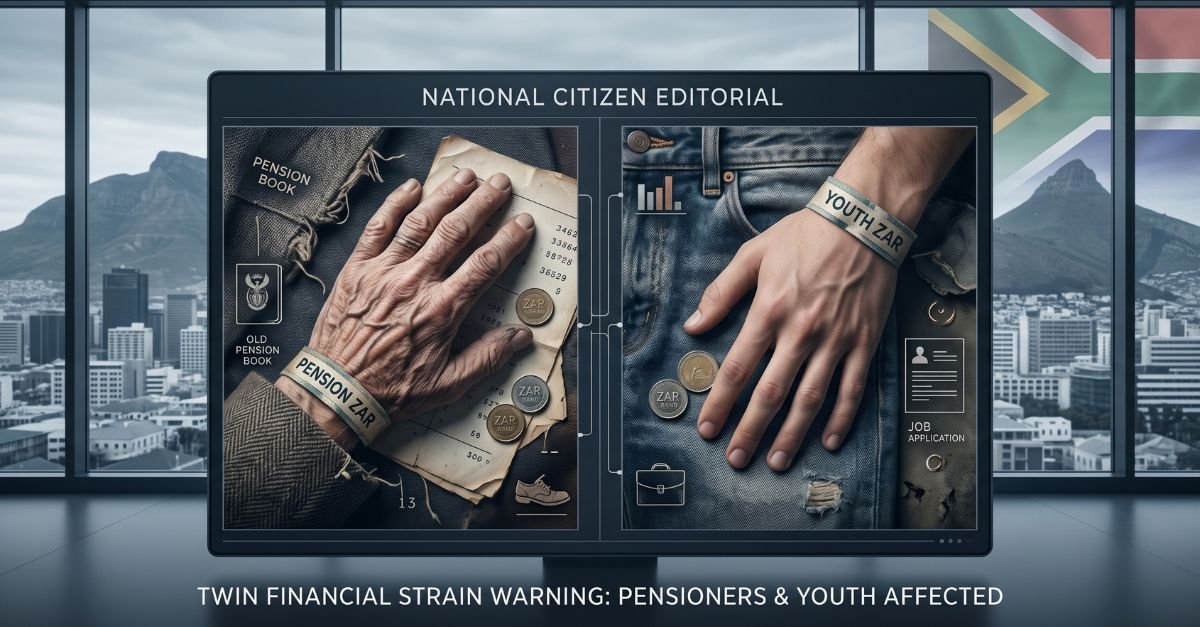
An editorial in National Citizen, written by Carlo Small and published on 26 August 2026, argues that South Africa faces what it calls a dual crisis: a growing sense of betrayal among the elderly, and deepening despair among the youth, two groups that rarely share a headline but, in the editorial’s telling, have been failed by the same government.
The piece argues that the promise of dignity and security that the anti-apartheid generation fought for has not been delivered to either group. It describes older South Africans facing poor healthcare, water and electricity problems and pensions that barely cover food, and young people facing joblessness and mental-health strain.
The numbers the editorial cites
The editorial leans on several statistics. According to Statistics South Africa, as cited in the piece, 68.5% of older persons rely directly on public healthcare facilities. It also says that over 35% of South African households experience dysfunctional water supply services, without naming a source for that figure.
On young people, the editorial says Statistics South Africa’s first-quarter 2026 data puts the official youth unemployment rate for ages 15 to 24 at 60.9%, and that 45.6% of people aged 15 to 34 are not in employment, education or training, known as NEET. It names no source for the NEET figure. These are the editorial’s own citations and have not been independently checked here.
For a business owner, the relevance is indirect but real. When large numbers of young people cannot find work, the pool of future customers, employees and entrepreneurs shrinks, and the tax base that funds public services is narrower. A population that depends heavily on public clinics and on social grants that barely cover food also has little room in its household budget for discretionary spending, which weighs on consumer-facing sectors.
What the editorial calls for
The editorial is a call to civic action rather than a policy paper. It urges young people to turn frustration into organised civic action and to link their fight for economic inclusion to their elders’ struggle for pensions and dignity. It asks communities to defend local infrastructure, hold ward councillors accountable and join marches for pension redress and better public services, and it argues that citizens cannot wait for political leadership and must take ownership of change.
The editorial also links youth hopelessness to rising depression, anxiety, substance abuse and suicide, but gives no figures for these.
This is an opinion piece, not a data release. Its claims about generational hardship should be checked against Statistics South Africa’s own releases, and its conclusions about government failure are the author’s argument. How policymakers respond to warnings like this one remains open.
Statistics South Africa’s own demographic and labour market data is the primary source against which a claim about generational hardship like this one should be checked. For related coverage of a specific labour-market barrier facing one of those groups, see this site’s report on women’s unemployment and childcare access.