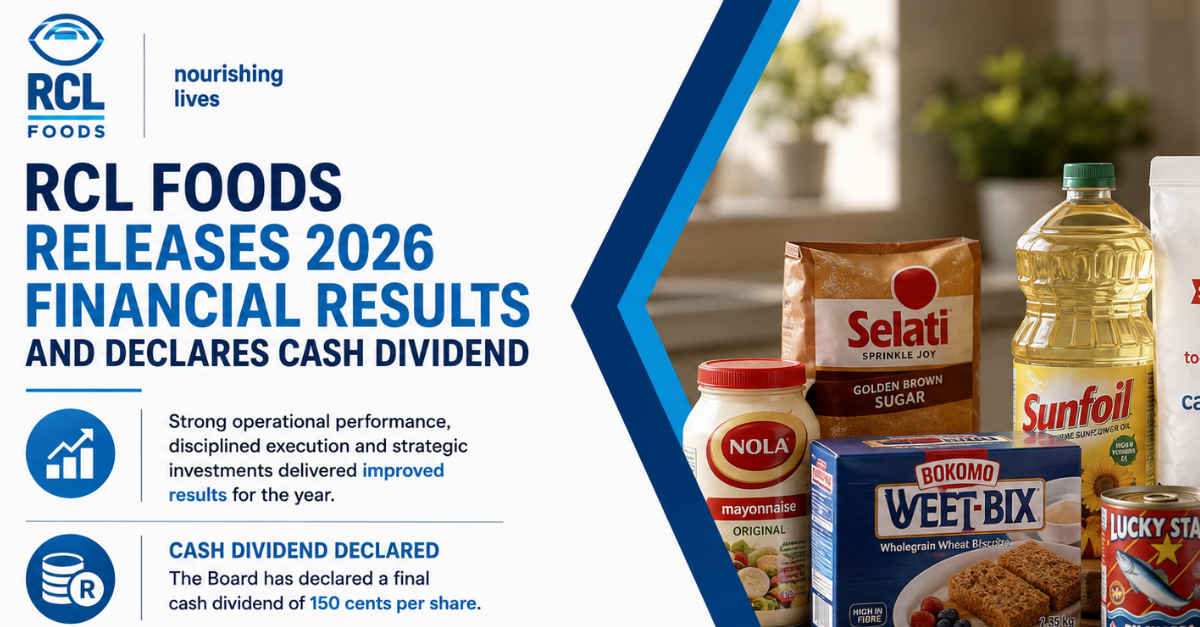
RCL Foods has told the market its financial year is done and shareholders will see some of that year’s profit in cash, in a press release spare enough that it says almost nothing beyond those two facts. According to Moneyweb, the company has finalised its group financial results for the year ended June 2026 and confirmed a cash dividend will be paid, without disclosing the size of the profit, earnings per share, or the dividend amount, all of which remain for the fuller results still to come later this month.
RCL Foods is one of South Africa’s largest food manufacturers, listed on the JSE and supplying grocery retailers, foodservice operators and independent stores through well-known brands spanning poultry, beef, pork and ready-to-eat meals. For the small and medium enterprises sitting in its supply chain, grain growers, packaging firms and everyone between them, the company’s health genuinely matters: a profitable year tends to mean steadier orders and on-time payments, while a dividend payout signals RCL retained enough cash after covering its own operating needs to justify sharing some of it.
What suppliers should actually be watching for
For an SME owner in that supply chain, the real question is whether RCL’s financial position shapes credit terms, volume commitments or pricing negotiations once the fuller numbers land. A strong bottom line in the full results could give suppliers real leverage to negotiate larger contracts or better payment windows; a more modest profit could just as easily tighten RCL’s own cash flow and prompt tighter procurement policies that squeeze margins for the partners depending on it.
South Africa’s broader food sector has been navigating higher input costs, fluctuating exchange rates and intermittent load shedding all at once, and RCL’s ability to generate cash and still return a dividend suggests it has managed those pressures at least somewhat better than some peers, though without the detailed numbers, that resilience cannot yet be confirmed with any real precision.
What this announcement confirms is simply that RCL has completed its 2026 financial reporting cycle and will pay a cash dividend. What remains unknown, the exact profit figures, the dividend amount, any guidance on future performance, will shape how suppliers, lenders and investors actually read the company’s outlook once the fuller picture finally arrives.
Poultry specifically has been one of the more volatile inputs in RCL’s own cost base in recent years, with feed costs, disease outbreaks and import competition all capable of moving margins in a single reporting period regardless of how well the rest of the group is performing. A supplier reading this announcement for reassurance would do well to look specifically at how the poultry division performed once the fuller results land, rather than assuming a group-level dividend confirmation says anything definitive about the health of that one, historically more volatile, part of the business. A strong beef or ready-to-eat performance can just as easily be papering over a genuinely difficult year in poultry specifically, which is exactly the kind of nuance that only shows up once the segment-level breakdown is actually published rather than inferred from a group-level headline. Until then, the honest read is that RCL has cleared its own annual reporting hurdle and judged itself financially sound enough to reward shareholders, a fact worth noting even before the more granular numbers are available to properly stress-test it, and one the market will treat as a reasonable working assumption until proven otherwise. For the small businesses feeding into RCL’s supply chain, that is, at minimum, one fewer thing to worry about this reporting season, even while the specific numbers that would confirm or complicate the picture remain a few weeks away.