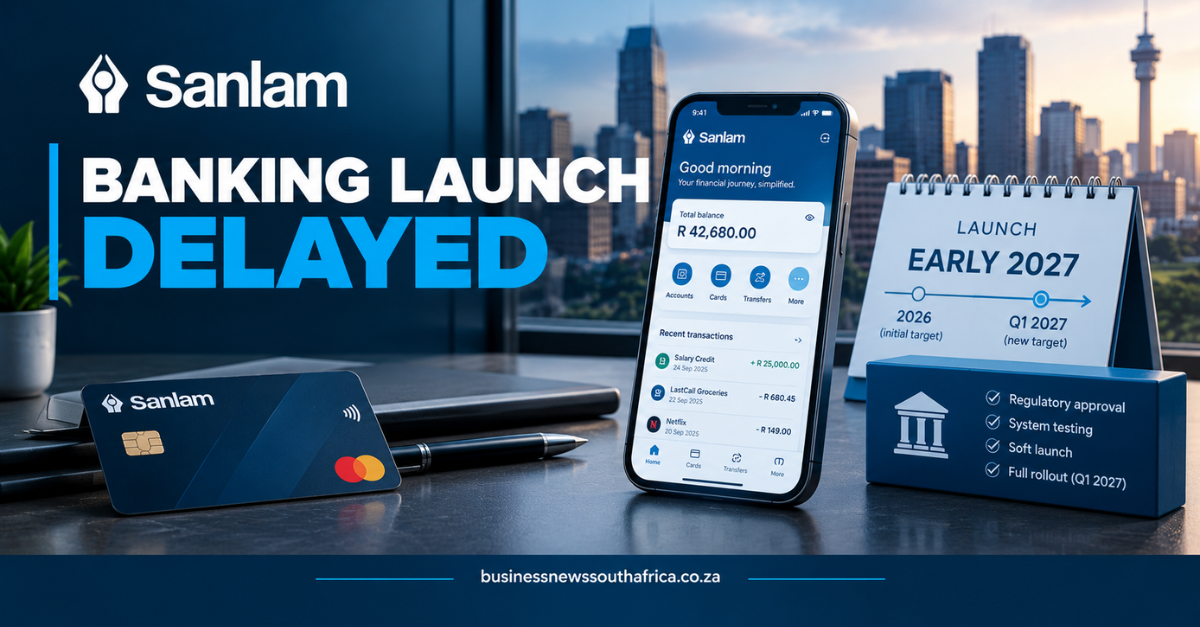
Sanlam told investors that its retail banking offering, built with GoTyme Bank, will not be available to customers until the first quarter of 2027. The partnership leverages a shared shareholder, Patrice Motsepe, and aims to sell banking services to Sanlam’s more than 10 million South African clients.
According to CEO Paul Hanratty, the lower operating costs of GoTyme will let the joint venture offer higher interest rates on savings accounts. He added that the group will also push credit products such as loans and credit cards, and will bundle them with the Sanlam Reality rewards programme, a narrow version of the Vitality model.
Sanlam’s timeline puts it almost eight years behind Discovery Bank, which entered the market in 2019, and roughly two years later than Old Mutual’s banking arm. By contrast, Pepkor’s Plus B bank is slated to launch in April 2024, and the ten established banks in South Africa collectively serve 86 million accounts, a figure larger than the country’s population.
The insurer has not disclosed detailed capital-expenditure or operating-expense budgets for the banking venture, nor any break-even targets. However, it reported that corporate expenses and other costs rose to R374 million in the first half of the fiscal year, driven by “higher business enablement costs in setting up the group’s banking proposition, technology and modernisation initiatives”. The newly created ‘credit, banking and rewards’ segment posted a loss of R179 million over the same period, while total operating profit excluding investment variances was R6.7 billion.
Sanlam is expanding its physical presence, counting 156 outlets at the end of June and targeting 200 by year-end. The plan is to use this branch network, together with its existing distribution channels, to market the banking product to its insurance and investment customers.
If the venture can attract around one million transactional banking customers at low cost, Sanlam could add a modest profit stream and increase customer stickiness, meaning clients would be less likely to shop for insurance or investment products elsewhere. The upside is therefore tied to scale and differentiation.
The risk, as the article notes, is that the offering may not be sufficiently distinct from GoTyme, Capitec or other low-cost banks. Past attempts by Pick n Pay with Nedbank, Bidvest, Grindrod and Sasfin to enter retail banking have ended in sales, abandonment or wind-down. Without a clear competitive edge, Sanlam could become an also-ran and eventually divest the business.
For more detail, see the original Moneyweb article.
Related coverage can be found in the Markets & Finance section.
After a “soft launch” to staff and intermediaries in November, the joint venture will remain in a testing phase until the first quarter of 2027, meaning the public rollout is still more than a year away from the anticipated April debut of Pepkor’s Plus B bank. The early exposure to internal users is intended to fine-tune the digital platform and align back-office processes before a full market entry, a step that many new entrants in South Africa’s crowded retail banking sector have found essential for regulatory compliance and operational stability.
The ten banks operating in the retail space collectively serve 86 million clients, a figure that exceeds the nation’s population and reflects significant overlap, with many South Africans holding accounts at two or three institutions. This duplication suggests a sizable portion of the market is dormant or under-utilised, creating an environment where a new entrant must persuade customers to shift primary banking relationships rather than simply add a secondary account.
Capitec is widely regarded as the primary bank for a large share of Sanlam’s existing client base, meaning the new offering will need to differentiate beyond marginally higher savings rates. While GoTyme’s lower operating costs enable more attractive interest on deposits, the source material points out that this alone is insufficient to drive migration, as competitors such as African Bank already provide comparable rates.
Sanlam’s investment in the banking venture is measured in the hundreds of millions of rand, markedly lower than the billions spent by Old Mutual and Discovery on their respective launches. This more modest capital outlay reflects a strategy of leveraging existing branch infrastructure and distribution channels rather than building a standalone banking ecosystem from scratch.
Regulatory approval for a new retail banking licence in South Africa typically involves a submission of a detailed business plan, risk assessments and capital adequacy documentation to the Prudential Authority, followed by a review period that can span several months. Once the licence is granted, the entity must complete system integration, staff training and final compliance checks before the commercial launch, aligning with the timeline that places the public offering in the first quarter of 2027.