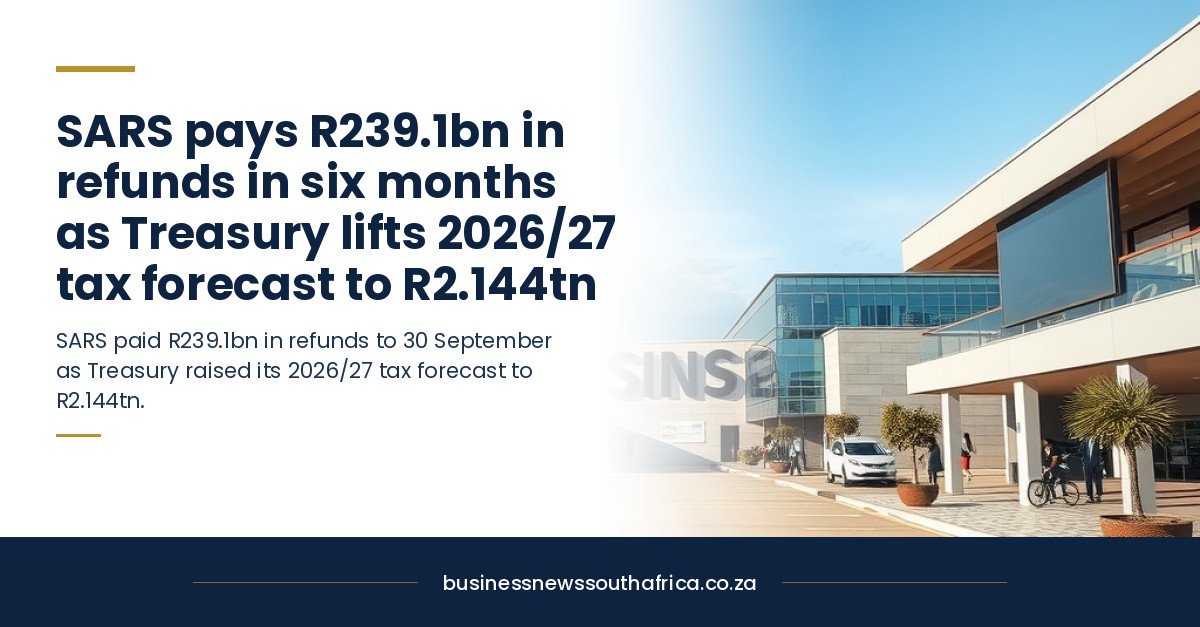
The South African Revenue Service (SARS) says it had paid R239.1 billion in refunds to taxpayers by 30 September 2026, the halfway mark of the 2026/27 financial year, as Finance Minister Enoch Godongwana lifted the year’s tax revenue forecast in the Medium-Term Budget Policy Statement (MTBPS) on 21 October. According to SARS’s own media release, the revised estimate is R2.144 trillion, R17.1 billion above the R2.127 trillion in the February 2026 Budget.
What the R239.1bn actually measures
The refund figure is not a separate payout programme. SARS reports that net revenue for the six months to 30 September was R992.2 billion. That is gross collections of R1.231 trillion minus refund payments of R239.1 billion. SARS says net revenue was R15.5 billion, or 1.6%, above the February Budget estimate and R67.4 billion, or 7.3%, higher than the same period a year earlier.
So the R239bn covers six months, not a full year, and it is money that came in and went back out. SARS attributes the first-half performance to stronger corporate income tax, domestic VAT and PAYE collections, together with lower-than-estimated VAT refund payments.
Where the R2.144tn target comes from
In his MTBPS speech, Godongwana said the revenue outlook for 2026/27 is stronger than expected because of higher collections from corporate tax, dividends tax and VAT, and that gross tax revenue has been revised up by R17.1 billion from the February estimate. The speech gives the figure only as R2.14 trillion this year, rising to R2.53 trillion in 2029/30. The precise R2.144 trillion appears in SARS’s release and in Business Day’s report, which also says mineral and petroleum royalties were revised up by R6.8 billion.
Sources differ on how to label it. Business Day and the speech call it gross tax revenue. SAnews also calls it a gross tax revenue forecast, but compares it with the R2.01 trillion of net revenue SARS collected in 2025/26. Because the first-half numbers above are net of refunds, they should not be set directly against the full-year forecast without checking the definitions in the MTBPS tables.
Commodity prices, not new taxes, drive the upgrade
The minister said a large portion of the improvement is due to higher commodity prices and that those gains are expected to dissipate over the medium term. Business Day reports that provisional corporate tax grew 17.4% over the first six months compared with the same period of 2025/26, with mining the largest contributor, and puts the 2026/27 corporate tax estimate at R398.5 billion against R364.3 billion in the Budget. Net VAT is projected at R533.9 billion (Budget: R521.4 billion).
The Treasury also said the extra revenue allows government to raise 2026/27 spending by R45.5 billion compared with February. The only new levy mentioned in the speech was the National Online Gambling Tax, whose final design is due in the February 2027 Budget, as covered in our online gambling tax report. The speech announced no new general taxes. It did announce temporary fuel levy relief of R3 per litre on diesel and R1.50 on petrol from 4 November 2026 to 1 December 2026, at a cost of R10 billion in forgone revenue. SARS notes the revenue outlook excludes that relief.
The second half has to deliver more
SARS expects second-half revenue to rise by R66.3 billion (6.1%), driven mainly by PAYE, corporate income tax and domestic VAT. The MTBPS second-half estimate was revised up to R1.15 trillion, R1.6 billion (0.1%) higher, largely because corporate income tax, including interest, is R11.7 billion higher. SARS links that to company profitability, measured by gross operating surplus, which it projects will grow from 3.5% to 5.4%, based on first-half growth of 10.7% and 7.0% in the first two quarters. It also lifted domestic VAT by R2.5 billion on faster household spending growth (from 5.1% to 6.2%) and customs duties by R2.2 billion on an import growth outlook raised from 6.5% to 11.0%.
Commissioner Johnstone Makhubu said the revenue estimate “presents a challenge to SARS”, and that reaching it will take sustained collection and compliance effort. Compliance interventions secured a preliminary R137.7 billion in the first six months: R76.3 billion in direct cash collections and R61.3 billion in prevented revenue leakage. Makhubu said the Minister has challenged all 14 500 SARS employees to make every effort to collect the resources needed.
The upward revision came as the Treasury cut its 2026 growth forecast to 1.2% from 1.6%. SARS cited improved electricity reliability as supporting activity, while logistics and infrastructure constraints continue to hinder growth. That electricity comment is SARS’s, not the Treasury’s explanation for the higher revenue.
One economist: the tax take is rising without higher rates
Efficient Wealth chief economist Dawie Roodt, speaking to Alec Hogg on Biznews as reported by BusinessTech, argued that the burden has risen even without new rates. “Tax rates are not going up, but the tax take is going up because of a stronger SARS,” he said, adding that higher commodity prices had handed government a windfall. He also said: “You are reducing the fiscal deficit not by spending less, but by taking more out of the economy.” That is Roodt’s opinion. The Treasury’s position is that the deficit is narrowing against the February forecast (published speech texts differ on the exact figures, as we reported in our medium-term budget story), and SARS’s is that recovering unpaid tax protects honest taxpayers.
What it means for business
For companies, the refund total reflects ordinary VAT and other refund flows, and SARS says VAT refunds were lower than it had estimated, so firms should not read it as a looser refund regime. The compliance push is real, and SARS says it will keep strengthening it. Businesses with open queries can see how verification works in our guide on how SARS checks bank deposits. Investors can find the wider fiscal numbers in our medium-term budget debt report.
What is not yet known is how much of the commodity-driven corporate tax will persist, since the Treasury itself expects those gains to fade. The February 2027 Budget will show whether the R2.144 trillion held and whether spending or taxes shift in response.