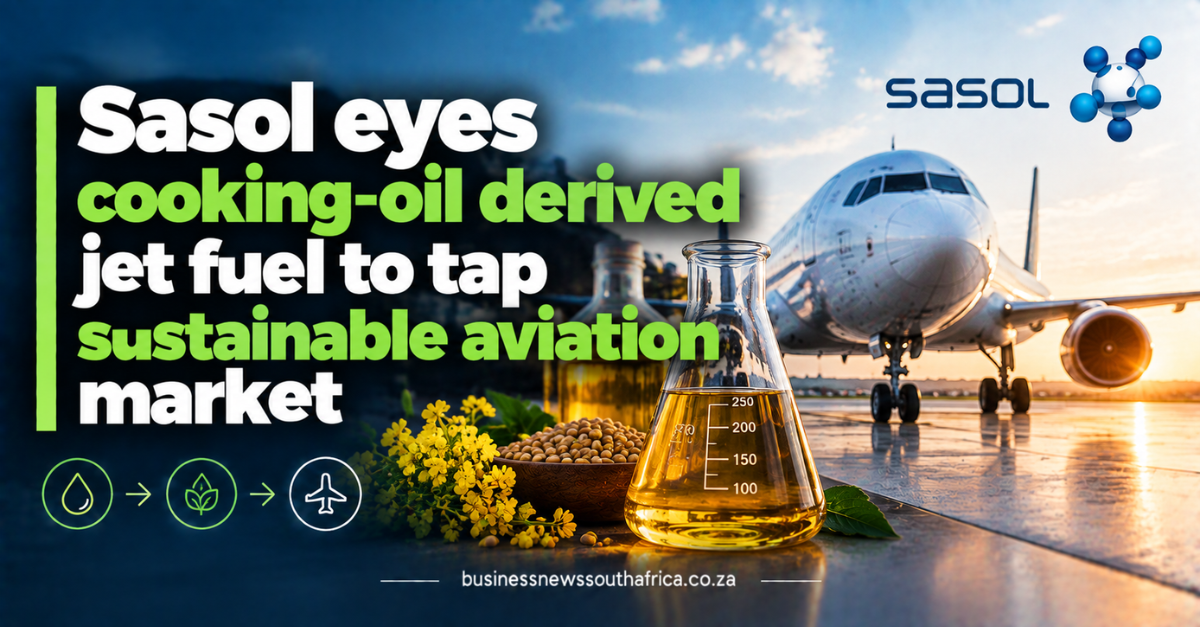
Imagine a commercial jet rolling into a South African airport, its fuel tanks being topped up not with the familiar brown diesel-like liquid but with a lighter, greener blend derived from used kitchen oil. That is the picture Danie Cronje, senior vice-president for Business Development at Sasol, painted in a recent Moneyweb interview.
According to Cronje, Sasol’s plan is to convert waste cooking oil, the greasy residue that restaurants discard, into sustainable aviation fuel (SAF). SAF is a drop-in replacement for conventional jet fuel, meaning it can be used in existing aircraft engines without modification. The process involves cleaning the oil, removing impurities, and chemically upgrading it to meet the strict specifications of aviation fuel.
Why the move matters for South Africa
For airlines operating out of Johannesburg, Cape Town and other hubs, SAF offers a way to meet international carbon-reduction commitments without overhauling fleets. The International Air Transport Association (IATA) estimates that SAF could cut lifecycle CO₂ emissions by up to 80 % compared with conventional kerosene. If Sasol can produce SAF locally, South African carriers could reduce reliance on imported jet fuel, hedge against price volatility, and claim greener credentials to attract environmentally conscious passengers.
From a business perspective, the venture also opens a new revenue stream for Sasol. The company, best known for its synthetic fuels and chemicals, has been diversifying into low-carbon products. A successful SAF operation would align with the government’s Renewable Energy Independent Power Producer Procurement Programme (REIPPPP) and the broader push for a circular economy, where waste streams become feedstock for high-value products.
However, the plan is still in the development stage. Cronje stressed that Sasol is conducting feasibility studies, securing feedstock agreements with restaurant chains, and engaging with the Civil Aviation Authority to obtain the necessary certifications. No commercial-scale production date has been announced, and the financial size of the project remains a company claim rather than an independently verified figure.
For South African SMEs in the food-service sector, the initiative could create a new market for used-oil collection, turning a disposal cost into a revenue source. Yet the logistics of gathering, transporting and storing oil at scale present challenges that will need clear contracts and possibly government-backed incentives.
While the global SAF market is still nascent, the International Energy Agency notes that SAF accounted for less than 0.1 % of total jet fuel in 2023, demand is expected to rise as airlines commit to net-zero targets. Sasol’s entry could position South Africa as an early-stage supplier in a market that is projected to be worth billions of dollars within the next decade.
Readers interested in the regulatory side can follow updates from the South African Civil Aviation Authority. For a broader view of how fuel price trends affect corporate finance, see our Markets & Finance coverage.
How used cooking oil becomes jet fuel
The process Sasol is exploring, converting used cooking oil into sustainable aviation fuel, is already commercially proven internationally: several major biofuel producers in Europe and the United States operate hydroprocessing plants that treat waste oils and fats to remove impurities and restructure the molecules into a fuel that meets strict aviation specifications, known as hydroprocessed esters and fatty acids (HEFA). South Africa’s advantage in pursuing this locally is a well-established restaurant and food-service sector that already generates a steady, largely uncollected supply of used cooking oil, rather than needing to grow a dedicated feedstock crop from scratch.
The global aviation industry has committed to net-zero carbon emissions by 2050 under a framework agreed through the International Civil Aviation Organization, which is the underlying demand driver behind Sasol’s interest: airlines will need a reliable, scalable supply of sustainable aviation fuel well before that deadline to meet interim targets, and a local producer would save South African carriers the cost and complexity of importing SAF from Europe or the Middle East.