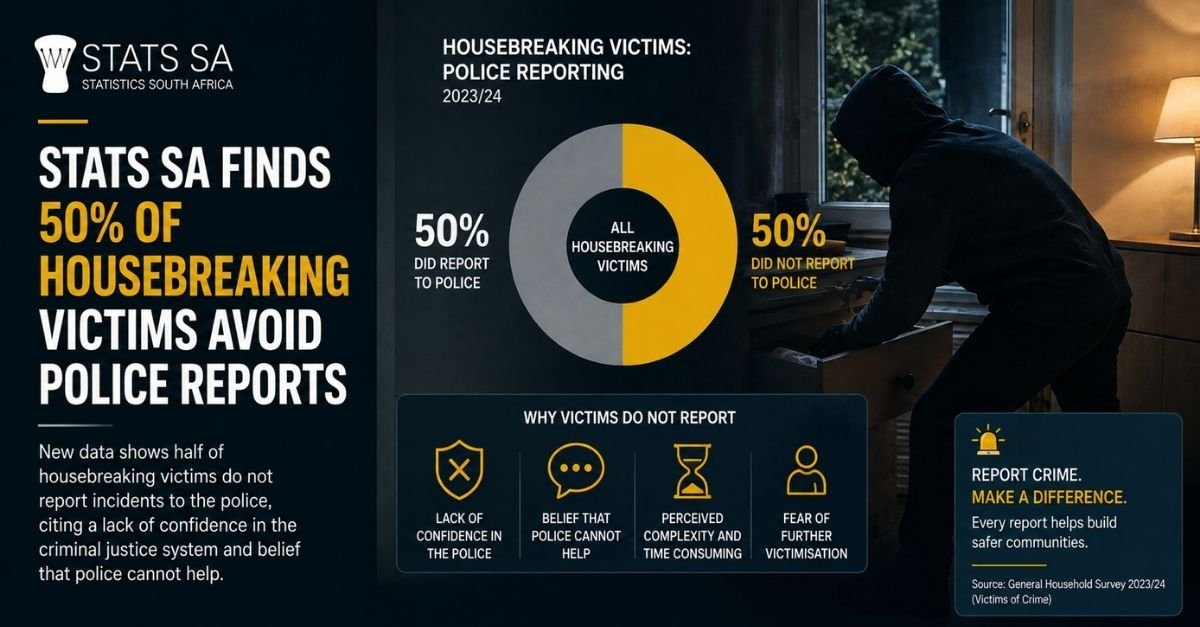
When a home is broken into, the immediate concern is the loss of personal items and the feeling of vulnerability. For many South Africans, the next step, calling the police, is skipped. According to Statistics South Africa (Stats SA), half of people who experience a housebreaking do not report the incident because they believe the police will not take any action.
Stats SA defines housebreaking as the unlawful entry into a dwelling with the intent to steal or cause damage. The agency’s latest household crime survey reveals that 50% of respondents who suffered a housebreaking chose not to involve the police. The reason given most often was a lack of confidence that the police would respond effectively.
This finding matters most to households and small-business owners who rely on police reports to claim insurance, to obtain a police clearance for rental agreements, or simply to have a record of crime in their neighbourhood. Without a report, insurers may deny claims, landlords may be reluctant to rent, and local authorities miss data that could justify more patrols.
The claim comes directly from Stats SA, which collects data through household interviews and aggregates the responses. The agency has not provided an independent verification of the respondents’ perceptions of police effectiveness, so the figure reflects public sentiment rather than an audit of police performance.
South Africa has long struggled with high rates of property crime. The South African Police Service (SAPS) reports thousands of burglaries each year, but the exact number is difficult to pin down because many incidents go unreported. Under-reporting creates a feedback loop: lower reported numbers can lead to fewer resources being allocated to crime-prevention initiatives, which in turn may reduce public confidence further.
For small-scale retailers and informal traders, the impact can be even more pronounced. A burglary can wipe out a day’s worth of stock, and without a police report, the loss may not be covered by insurance. This adds a hidden cost to operating a business in high-risk areas, potentially discouraging entrepreneurship in those communities.
Why the distrust?
Several factors contribute to the perception that police will not act. Past surveys have highlighted slow response times, limited visibility of officers in certain neighbourhoods, and a backlog of cases that never reach court. While SAPS has launched initiatives to improve community policing, the statistical gap highlighted by Stats SA suggests that these efforts have not yet shifted public opinion.
Experts note that improving reporting rates requires both better police performance and clearer communication to the public about what to expect when a crime is reported. When victims see tangible outcomes, such as arrests, prosecutions, or the return of stolen goods, confidence can be rebuilt.
The measurement problem this creates
There is a second-order effect worth spelling out, because it shapes how much any published crime figure can be trusted. If half of housebreakings never enter the official record, then the official record is not a count of crime, it is a count of reported crime, and the gap between the two is not fixed. A rise in reported burglaries could mean more burglaries, or it could mean improved confidence in reporting them; a fall could mean the opposite. Survey data of the kind Stats SA collects here is the only way to see the shape of what the police numbers are missing, which is precisely why household surveys are run alongside charge-office statistics rather than instead of them.
In the meantime, the under-reporting of housebreaking incidents means that policymakers are working with an incomplete picture of crime trends. This can affect budgeting for law enforcement, the design of crime-prevention programmes, and even the calculation of risk premiums by insurers.
For business owners, the practical takeaway is to review insurance policies and ensure they understand the documentation required for a claim. Even if the police are not called, keeping a detailed inventory and photographic evidence can support a claim, though insurers may still request a police report.
The Stats SA data point is a reminder that crime statistics are only as reliable as the willingness of victims to come forward. Bridging the trust gap between the public and police will be essential if South Africa hopes to reduce the true burden of housebreaking on households and small businesses alike.