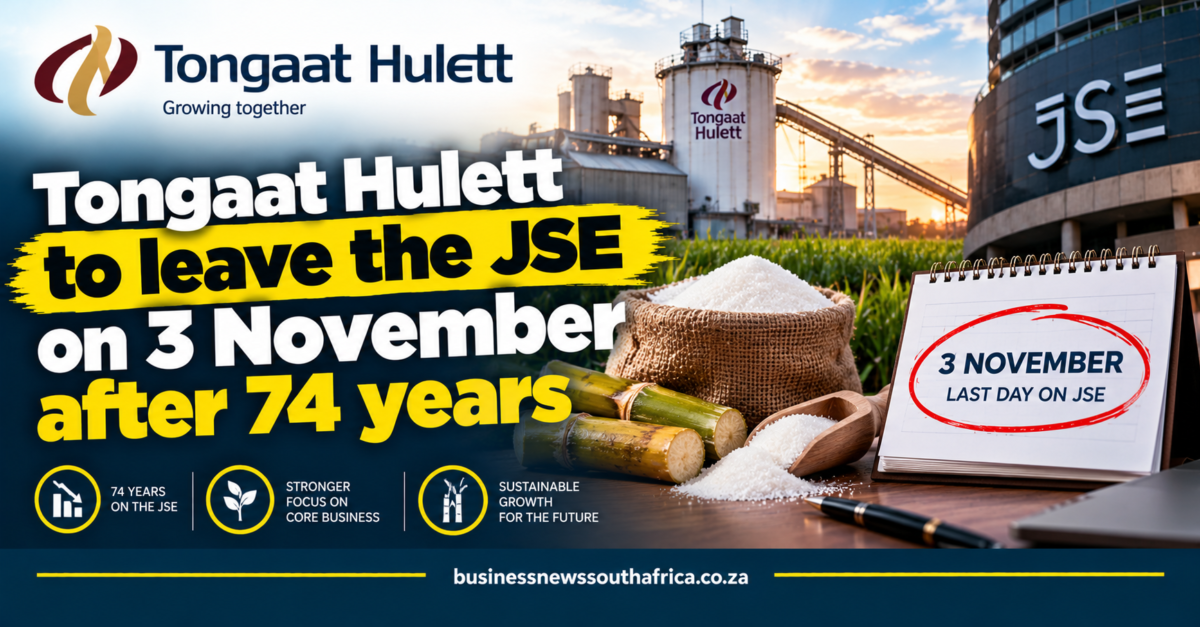
Tongaat Hulett will leave the JSE on 3 November 2026 after the sugar producer decided not to challenge the exchange’s move to delist it, Moneyweb reports. The company confirmed the date to investors on Monday 12 October through the JSE’s stock news service. Its shares have not traded since July 2022, and the business rescue practitioners say no value is expected for shareholders.
How the delisting came about
The JSE suspended Tongaat’s shares on 20 July 2022 after the company failed to publish its annual financial results. According to Moneyweb, the exchange had grown increasingly frustrated that no audited financial statements had appeared since 2022. A few days before the announcement, the JSE told Tongaat it intended to remove the listing, gave its reasons and asked the company to show cause why it should not be delisted.
Tongaat’s answer, as relayed by Moneyweb, was that it could not produce financial statements while its restructuring plan, which ultimately seeks to dispose of the company’s assets, was under way. The company said it could not conclude that the going concern basis (the assumption that a business will keep operating) still applied, because that depended on the rescue plan. It also believed that publishing unaudited numbers would risk misleading the market more than admitting it could not publish reliable ones. In the end it chose not to fight. Tongaat has been listed since 1952, Daily Investor notes, when it traded as J L Hulett and Sons. Tongaat Hulett was formed in 1982 through a merger of two connected companies.
Daily Investor lists three grounds for the delisting: Tongaat cannot meet the obligations of a listed company, such as having non-executive directors and producing audited financial statements, it has no auditable statements, and its shares have not traded for four years, so the market has no basis to value them.
What shareholders get
Moneyweb reports that the business rescue practitioners say the rescue plan will leave Tongaat as a shell, with no value expected for shareholders, and that the delisting therefore makes sense. After the delisting, the company will continue to be restructured as a private company. Its shares become unlisted certificated shares held by Computershare, the company’s transfer agent. Shareholders still own their shares and will receive a share statement within six business days of the delisting date.
The Citizen, which saw the shareholder notice, reports that no offer or payment is being made in connection with the delisting: “no payment will be made to shareholders in respect thereof.” The company says “no value is expected to accrue to shareholders” once business rescue ends, and shareholders should not expect later distributions. The Citizen adds that the delisting does not end the rescue process.
The rescue so far
Tongaat entered voluntary business rescue on 27 October 2022. Business rescue is a court-supervised process in which practitioners take control of a financially distressed company to try to save it or get creditors a better return than liquidation. Moneyweb says all of Tongaat’s non-executive directors resigned on 2 November 2022, leaving the practitioners in control, and that although several offers for the business were received, nothing concrete materialised for a long time.
According to The Citizen, in January 2024 some 98.5% of creditors backed a plan from the Vision consortium, which had bought debt claims from lenders owed more than R8 billion. That plan would have cut existing shareholders’ stake to 2.7%. Shareholders rejected it at a general meeting on 8 August 2024, which triggered an alternative plan to sell the group’s assets to Vision.
In February 2026, the practitioners started a provisional liquidation application after Vision and the Industrial Development Corporation (IDC) could not agree on funding timelines, Moneyweb reported in June. On 17 June 2026, the day the liquidation hearing was due to begin in the High Court in Durban, the practitioners, the IDC and Vision Group signed a binding agreement, and the application was withdrawn. Under it, the IDC converts its post-commencement finance (funding provided after the rescue began) into an equity stake and extended its facility to the end of September 2026. Vision will provide the capital to settle outstanding creditor claims, including long-standing obligations to the South African Sugar Association. Vision had already bought R11.7 billion of Tongaat’s debt from lenders, Moneyweb said. The parties said the deal aims to protect an estimated 250 000 jobs across the southern African sugar value chain. The Citizen puts the IDC’s rescue funding at R2.5 billion.
Under the plan, the practitioners are obliged to sell all of Tongaat’s assets and businesses as going concerns to the Vision consortium. Vision is led by Robert Gumede, Moneyweb said, and the group has said it plans to repair Tongaat’s milling infrastructure and support independent growers. Final sale agreements, which would transfer the South African operations and interests in Zimbabwe, Mozambique and Botswana, are still to be concluded, according to the June report.
The scandal and the people affected
Tongaat’s troubles trace back to 2019, when irregular accounting practices emerged. Moneyweb says a PwC forensic investigation found the practices “undesirable” because profits were overstated, under management led by former chief executive Peter Staude. Daily Investor puts the resulting write-down in the company’s value at R12 billion.
Tongaat directly employed more than 2 500 people and supported more than 25 000 indirect jobs in South Africa, according to Moneyweb. KwaZulu-Natal accounts for roughly 77% of national sugar industry revenue, and Tongaat itself held an estimated 30% to 35% of the national market.
The reports reviewed do not say what Tongaat’s remaining debts total, and none states that the final sale to Vision has been completed.