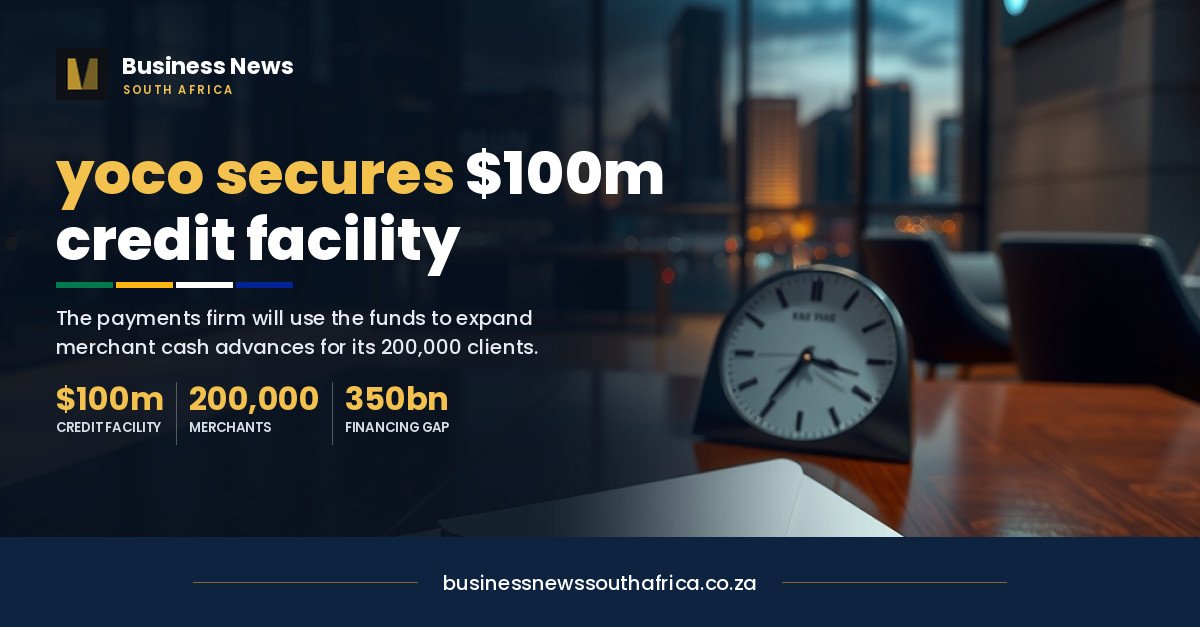
South African payments company Yoco has secured a US$100 million credit facility from Victory Park Capital (VPC), a Chicago-based private credit and asset-backed finance firm. According to the press release published on VPC’s website on 9 November 2026, the money will back Yoco Capital, the company’s embedded finance arm, which provides cash advances to the businesses that use its payment terminals and software.
What the facility is for
The release says the facility will fund merchant cash advances through Yoco Capital. The company describes the raise as one of the largest dedicated merchant cash advance facilities in Africa. That is the company’s own characterisation and we have not been able to test it against other deals.
A merchant cash advance is not a conventional loan. As the release describes the Yoco product, businesses are pre-approved on the strength of their card sales data, there is no application, and no collateral is required. Funds are paid out instantly, and repayment happens through an automatic deduction from daily takings rather than a fixed monthly instalment. Advances range from R2,000 to R1.5 million. The company says merchants typically use the money to hire staff, buy stock, upgrade equipment or open new branches.
Who provides what
Victory Park provides the capital. Yoco provides the merchant relationships, the sales data used to pre-approve advances, and the Yoco Capital product that sits on top. Until now, Yoco has largely worked through outside lenders. The release says that since 2018 the company has disbursed more than R6.5 billion to over 40,000 merchants, largely through partner lenders. It adds that Yoco has never recorded an unprofitable cohort, including through the Covid-19 period. Both are claims made by the company.
Yoco chief executive Carsten Holtkemeyer is quoted as saying: “Financing was the one layer we didn’t fully control.” Jason Brown, a senior partner at Victory Park, says Yoco “has a proven track record of supporting the operating needs of small and independent businesses.” The release also quotes Aubrey Williams, owner of Karoo Creations, who calls the offer “a real safety net” for him and his team.
Technology outlet WeeTracker reports that the deal marks Yoco’s first direct entry into the debt market, and that Yoco says it serves around 200,000 merchants. The same report notes the company previously raised US$83 million in a Series C round. The release says Yoco will keep working with other funders where that suits a particular product or market, and plans to extend Yoco Capital to more of its merchants across retail, hospitality and services.
The rand value
Headlines have carried a figure of about R1.6 billion. That is a conversion, not a number in the release, which states the facility in US dollars. WeeTracker’s own article does not convert it either. At recent exchange rates the figure is in the region of R1.6 billion to R1.7 billion, but the actual rand amount will depend on the rate used and on when funds are drawn. We have treated the dollar figure as the only confirmed amount.
The market context
The release cites a 2025 report by FinFind and African Bank that puts South Africa’s small business financing gap at about R350 billion. It also says small businesses receive around 13% of bank lending, against 51% for large corporations. These are the report’s and the company’s figures, and we have not independently checked them. For a payments firm, the case for the product is straightforward: it already sees a merchant’s daily takings, so it can judge risk with more data than a bank looking at an application form. Our guide to business bank accounts, cards and payment terminals and our overview of what business funding is open right now cover the alternatives.
The release adds that Yoco says it has cut merchant fees by R250 million a year and recently acquired Dyner. Neither claim bears directly on the facility, and we mention them only as part of the company’s account of its own momentum.
Why it matters beyond Yoco
Private credit firms have been providing funding to payments and lending platforms in several markets, and Victory Park describes itself as having invested more than US$12 billion across about 260 investments since its founding in 2007. It became a majority-owned affiliate of Janus Henderson Group in 2024, according to the release. For South African businesses that take card payments, the practical question is whether cheaper or more plentiful funding for Yoco translates into better advance pricing. Nothing in the release addresses that. Yoco also features in our ranking of the biggest startup funding rounds in South Africa.
What we could not confirm
- The interest rate, fees or effective cost of the facility, and the pricing Yoco will charge merchants on advances.
- The tenor, maturity date, repayment schedule or covenants of the facility.
- Whether the facility is fully drawn or will be drawn in stages.
- Whether the facility is secured against the advances book or against other assets.
- The exact rand value of the facility, which is not stated by either company in the documents we read.
- Claims of the company’s track record, such as no unprofitable cohort and the “one of the largest” description, which are the company’s own and unaudited in the material we read.
- Yoco’s own newsroom version of the announcement, which we could not access, so we relied on the release as published by Victory Park.