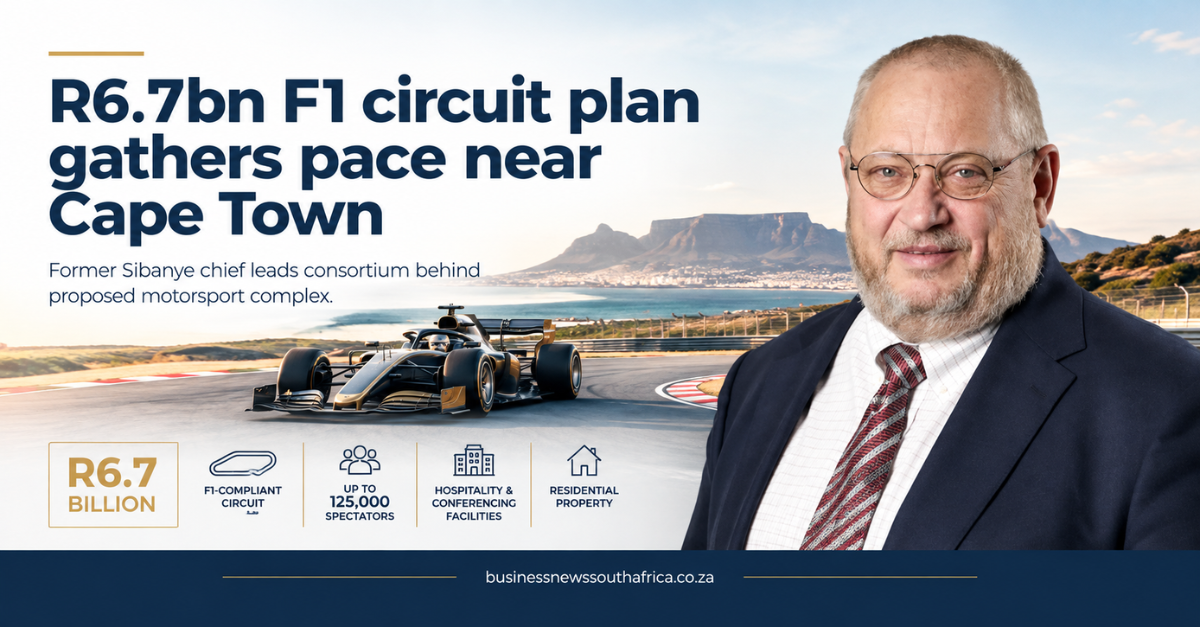
In the wheat-strewn Swartland region north of Cape Town, a group of investors is sketching a plan that could reshape the local economy. The consortium, headed by former Sibanye-Stillwater chief executive Neal Froneman, wants to spend R6.7 billion on a motorsport complex that would host a Formula One Grand Prix and accommodate up to 125 000 spectators.
Alongside Froneman, mining veteran Srinivasan Venkatakrishnan and lawyer Robert Appelbaum of Webber Wentzel are shaping the business and financing structure, while the financial adviser Rothschild & Co is helping the group meet the sport’s commercial and technical requirements. The proposal, seen by Bloomberg, also calls for conference facilities, hospitality suites and residential units, turning the site into a mixed-use destination.
According to Bob Hartslief, a businessman in the consortium, the project is designed to avoid any reliance on taxpayer money. Instead, the group is courting Africa’s largest corporations to sponsor the event and underwrite the licence fee that Formula One charges each host venue. The consortium has already submitted a response to the Fédération Internationale de l’Automobile (FIA), the sport’s governing body, and expects an evaluation period of 12 to 15 months.
The stakes extend beyond the racetrack. Tourism contributed roughly ten percent of South Africa’s gross domestic product before the pandemic, and major international events are seen as a way to revive visitor numbers. A successful Grand Prix could generate jobs in construction, hospitality and retail, and give local businesses a new stream of customers during race weekends.
However, the plan remains a claim until the FIA grants approval and the financing is fully secured. The consortium must still prove that the circuit meets the technical standards required for a Formula One race, and it will need to lock in corporate partners willing to fund the licence fee, which runs into the tens of millions of dollars.
South Africa last hosted a Formula One race at Kyalami intermittently between 1967 and 1993. A separate bid by Porsche South Africa chief executive Toby Venter to rent Kyalami is also under consideration, meaning the country could see competing proposals for the same calendar slot.
For entrepreneurs watching the development, the project illustrates how large-scale sport can be packaged as a catalyst for broader economic activity, but it also highlights the long lead-times and regulatory hurdles that accompany such ambitions.
Read the original announcement here. More about the FIA’s event approval process can be found on the FIA website. For a deeper look at how major events affect local markets, visit our Retail & Consumer section.
Why the Swartland site and not Kyalami
The consortium’s choice to build a new circuit in the Swartland rather than pursue Kyalami, which last hosted a Formula One race in 1993 and is separately being pitched by Porsche South Africa chief executive Toby Venter, reflects Formula One’s own modern technical and commercial requirements: current-generation F1 circuits need purpose-built paddock, medical and broadcast infrastructure, plus the spectator capacity and hospitality footprint the sport’s sponsors now expect, standards an upgraded legacy circuit can struggle to meet as cost-effectively as a ground-up build.
For South African businesses in construction, hospitality, events and logistics, a project of this scale, if it clears FIA approval and secures its financing, represents a multi-year pipeline of contracting opportunity well before a single race is run: circuit construction alone typically requires years of civil works, while the surrounding conference, hospitality and residential components the consortium has proposed would extend the build programme further. The 12 to 15 month FIA evaluation period is the first of several gates the project must clear before any of that work begins.
Whether Blue Mountain Racing or Toby Venter’s Kyalami bid ultimately wins the FIA’s approval, or whether South Africa ends up without a race at all, will not be clear until that evaluation period concludes.