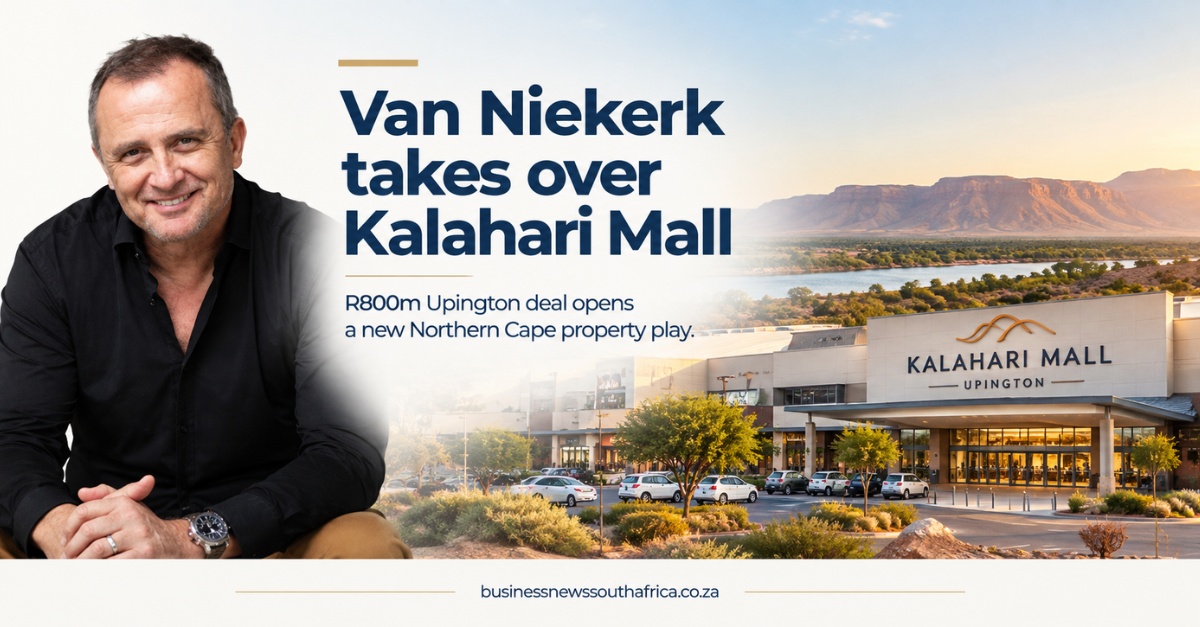
Property investor Japie van Niekerk’s New Africa Developments (NAD) has closed its acquisition of Kalahari Mall in Upington, one of the largest shopping centre transactions ever concluded in the Northern Cape. The deal received unconditional clearance from the Competition Tribunal in June 2026, and NAD has now finalised the purchase, marking the company’s first entry into the province. Neither side has disclosed the purchase price.
Kalahari Mall is an established shopping destination serving Upington, the surrounding farming towns of the ||Khara Hais municipal area, and cross-border shoppers from neighbouring Namibia and Botswana who travel into the town for retail. The centre carries a strong national tenant mix and what NAD describes as a loyal, consistent customer base, the kind of trading history that makes a regional mall attractive to a buyer even in a province most institutional property investors overlook.
Why a Northern Cape mall, and why now
The Northern Cape is South Africa’s largest province by land area and its smallest by population and economic output, a combination that has historically kept large-format retail investment concentrated in Gauteng, the Western Cape and KwaZulu-Natal. A dominant regional mall in a low-competition market like Upington behaves differently to a shopping centre in a saturated metro: it faces less pressure from rival centres and can command loyalty simply by being the only credible option for a wide catchment area, provided it is kept well maintained and relevant to local shoppers’ needs.
NAD has said it intends a substantial capital investment in Kalahari Mall over the next year, covering an extensive refurbishment, reconfiguration of several tenant premises, and a possible expansion of the centre’s gross lettable area. That combination, a mall already generating stable income being bought specifically to be upgraded rather than simply held, is a common private property investment strategy: buy an under-invested asset with a captive market, spend on the physical space and tenant mix, then capture the resulting increase in trading density and rental value.
What a mall refurbishment means for Upington’s small businesses
For the retailers, restaurants and service providers already trading inside Kalahari Mall, an announced refurbishment cuts both ways. Reconfigured premises and a broader tenant mix generally follow a period of higher foot traffic once complete, which is the entire commercial case for the investment. In the shorter term, however, construction activity around an occupied centre typically means temporary disruption, from restricted parking and access to a period of reduced footfall while work is underway, costs existing tenants bear without necessarily seeing an immediate corresponding uplift in trade.
For businesses in Upington and the wider ||Khara Hais area considering whether to open a store or relocate into Kalahari Mall once the upgrade is complete, the calculation is more straightforward: a professionally managed, recently refurbished regional mall with an expanded footprint is generally a stronger long-term location bet than an ageing centre, provided the rental increases that typically accompany a refurbishment do not outpace the additional foot traffic a tenant can expect to capture.
A wider pattern in South African regional retail
NAD’s move into the Northern Cape fits a broader trend of property investors looking beyond South Africa’s saturated metro retail markets toward regional and secondary-city shopping centres, where competition for prime assets is lower and yields can be more attractive relative to purchase price. Kalahari Mall’s cross-border catchment, drawing shoppers from Namibia and Botswana as well as the surrounding Northern Cape towns, gives it a somewhat unusual demand profile compared to a typical single-town regional mall, a factor that likely featured in NAD’s own investment case even though neither party has disclosed the specific terms.
Businesses operating in or considering the Northern Cape retail market should watch for NAD’s own announcements on the refurbishment timeline and any changes to the centre’s tenant mix over the coming months, since those details, not the acquisition itself, will determine the practical impact on the ground in Upington.