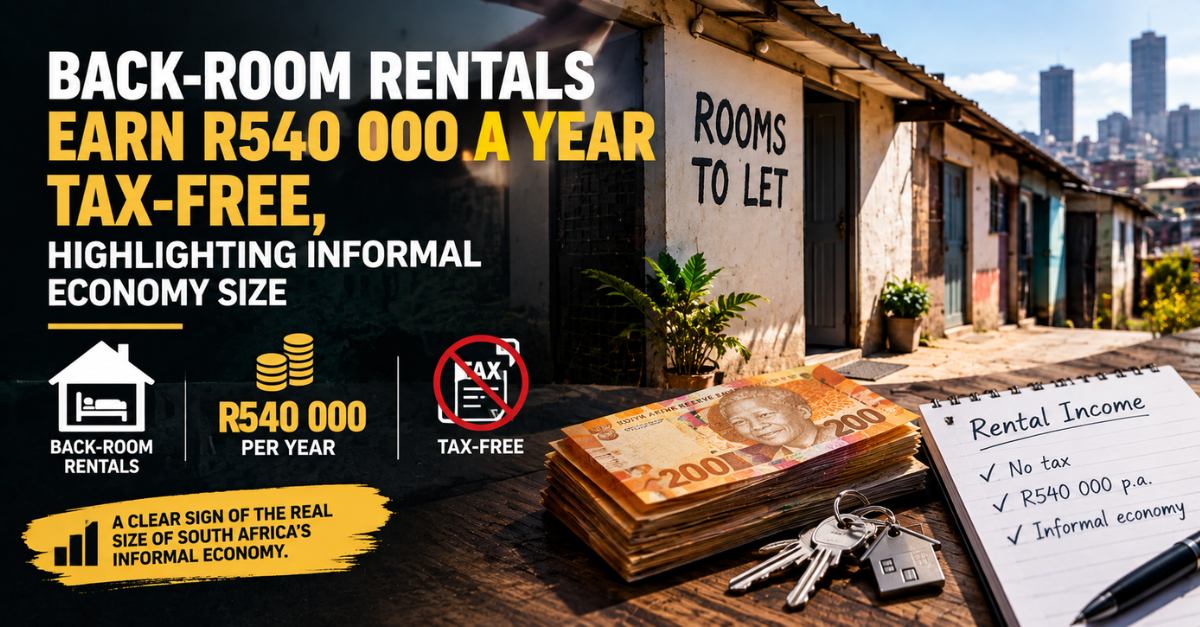
In a modest township house, fifteen extra rooms, known locally as amarum, are rented out for R3 000 each. The owner, a woman who used her formal retirement pension to build the rooms, now pulls in R45 000 a month, or R540 000 a year, without paying income tax.
The example was shared by informal-economy specialist GG Alcock during a conversation on Standard Bank Talks. Alcock said the woman “took her formal retirement pension from working her whole life and built 15 amarum”. He estimated that back-room rentals across South Africa generate roughly R30 billion a year, a figure that many find hard to believe.
Why the informal sector matters to small businesses
The informal economy stretches from roadside amagwinya sellers to spaza shops in suburbs. Spaza shops, small neighbourhood stores, alone account for more than R200 billion in annual turnover. Although many operate outside the tax system, they still contribute indirectly. Most are not VAT-registered, meaning they pay value-added tax on purchases but cannot claim it back, creating a net benefit to the fiscus of about R85 billion a year, according to Alcock.
Other informal segments are similarly large. The taxi industry, for example, brings in over R50 billion in revenue, and its drivers collectively pay R6 billion each year in fuel levies. These numbers show that informal activity is not a fringe phenomenon; it is a substantial part of the economy that touches many small-business owners.
Government response
Finance Minister Enoch Godongwana told Parliament that SARS (South African Revenue Service) has identified the informal economy as a source of untapped tax revenue. The department is rolling out an Informal Economy Response Strategy aimed at gradually bringing unregistered businesses into the formal system. The plan includes help with registration, understanding tax obligations, filing returns and paying what is due.
Since the start of the 2024/25 fiscal year, SARS data triggers have led to the registration of 21 890 previously informal taxpayers, generating R314 million in additional revenue. The programme is set to expand, with priority given to spaza shops, informal retailers, food services, personal services, construction and digital micro-enterprises.
For township homeowners like the woman in Alcock’s story, the strategy could mean future tax liabilities if the rentals are formally registered. However, it also offers a route to access formal financing, legal protection and business support, tools that many informal operators lack.
Small-business owners who operate informally can start by checking their registration status on the SARS website and using the Compliance Document Generator to prepare the necessary paperwork.
The back-room rental story underscores a broader reality: informal enterprises generate billions, create jobs and feed the formal supply chain, yet they sit on the edge of the tax net. As the government tightens its focus, owners will need to decide whether to stay under the radar or move into the formal economy and reap the associated benefits.
BusinessTech reported that Alcock said the informal economy stretches from townships and rural areas to suburbs and city centres, covering everything from roadside amagwinya sellers to established rural butcheries. He explained that executives often dismiss the sector until they hear traders describe it, noting “they might know of a bakery here or a trader there, but they never add it all up.” Alcove’s comment that “one thing they don’t get is the scale of it” underscores how the aggregated turnover remains hidden from many decision-makers, even though the activity is widespread across the country.
Back-room rentals like the fifteen rooms described operate outside the formal tax system because the owner has not registered the income with SARS. Registration would require the landlord to submit a tax return, declare the rental receipts and pay income tax at the applicable marginal rate. For a South African business owner, formalising such income creates a clear record that banks can use when assessing loan applications, and it also opens the door to legal protections such as eviction processes and tenancy agreements. Owners should therefore weigh the immediate cost of tax against the longer-term benefits of access to finance and dispute resolution.
BusinessTech reported that Alcock added “If I try to convince executives about this, they say it is impossible,” highlighting the difficulty of communicating the sector’s magnitude. He also pointed out that the woman in the story used her formal retirement pension to fund the construction of the fifteen rooms, showing how informal entrepreneurs can mobilise personal savings to create cash-generating assets without relying on formal credit. This example illustrates the blend of formal capital and informal operation that characterises many small-scale South African enterprises.
The Informal Economy Response Strategy will continue to roll out data-triggered registrations, meaning more landlords and traders will receive notices from SARS to formalise. Business owners should monitor the SARS website for alerts and keep records of all income and expenses, as future triggers may target additional sectors such as food services or construction. By staying ahead of registration requirements, owners can secure access to formal financing, benefit from government support programmes, and avoid sudden tax liabilities that could disrupt cash flow.