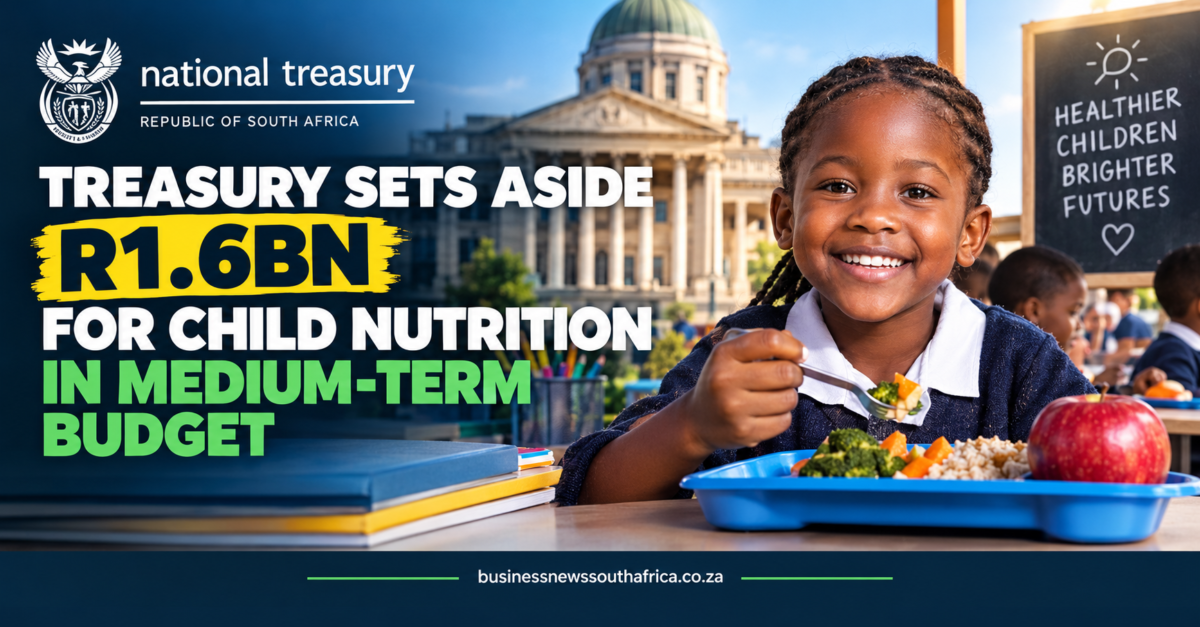
Finance Minister Enoch Godongwana has set aside R1.6 billion over the medium term for child nutrition, with the money aimed at pre-birth care and the first 1 000 days of a child’s life. He announced the allocation in the 2026 Medium Term Budget Policy Statement on 21 October. National Treasury says the funds will reach provincial health departments over three years, mainly to deliver nutrition services at clinics.
The wording in the Treasury speech as published by Parliament is short. The minister said that “stunting and malnutrition denies our children from fully reaching their growth and learning potential,” and that, “focusing on prebirth care and the first 1000 days of life, R1.6 billion is allocated over the medium term.”
Where the money goes and where it comes from
According to GroundUp, which put questions to Treasury, the R1.6 billion will be channelled to provincial health departments through the District Health Programmes Grant. It is meant to fund nutrition services, including micronutrient supplements for pregnant and breastfeeding women and for children at primary healthcare facilities. GroundUp quotes Treasury as saying that no funding has been set aside for a maternal support grant.
The first 1 000 days run from conception to a child’s second birthday. Stunting means a child is too short for their age because of prolonged poor nutrition, and it affects learning and health. The reporting does not give a year-by-year split. Spread evenly over three years the amount would be about R533 million a year, but that is our arithmetic, not a Treasury figure.
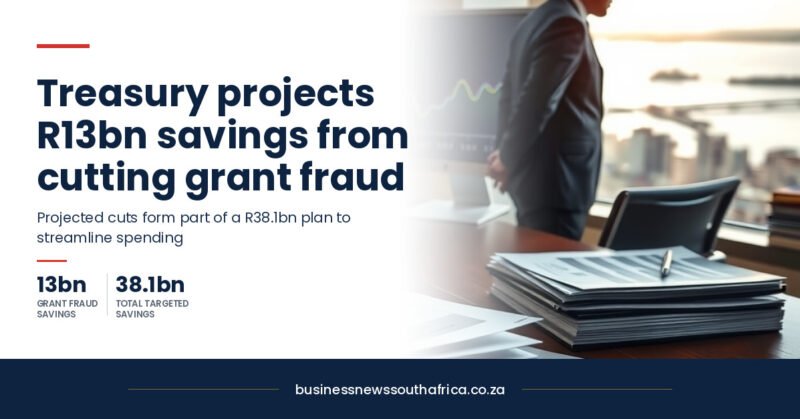
The funding is paid for by reprioritising savings rather than by new revenue. Daily Maverick reported that the MTBPS says savings from tighter verification of social grant recipients will be redirected to gender-based violence and femicide prevention and to child malnutrition and stunting. In the same speech, Godongwana said a further R38.1 billion in savings had been identified over the 2027 spending period, including R13 billion from reducing fraud in social grants. We covered that plan in our report on the R13bn grant fraud saving, and in our earlier look at the SASSA suspension of more than 56 000 grants.
The social wage around it
The nutrition line sits inside the speech’s section on protecting the social wage. Godongwana said social wage spending, which covers health, education, social development and shelter for low-income households, makes up 60% of non-interest expenditure. It includes free basic water, sanitation, electricity and solid waste services for more than 11 million households.
The budget also funds subsidised basic education for more than 77% of school-going children, who receive meals through the National School Nutrition Programme. A social safety net of old-age, disability, child support and other grants reaches 18.1 million beneficiaries. The R1.6 billion is aimed at an earlier stage than school meals, from pregnancy to age two.
The wider budget context is set out in our report on how debt stabilises at 78.4% in the same statement.
Why it follows the President’s stunting pledge
In February’s State of the Nation Address, President Cyril Ramaphosa committed to ending child stunting by 2030. Daily Maverick reported that he said about one in four children under five is stunted, and that he named the first 1 000 days and the Child Support Grant as a base for targeted support to pregnant women and low-birth-weight babies. He did not explicitly commit to a maternal support grant, which advocates had been seeking.
That grant was the subject of a statement by the DG Murray Trust and the Maternal Support Grant Advocacy Coalition on 16 October. It said the grant would cost about R2 billion a year, or 0.1% of government spending, and be linked to the R580 monthly Child Support Grant. The coalition also wants antenatal care to move from iron and folic acid alone to multiple micronutrient supplements. The Trust says about one in seven babies is born with low birth weight each year.
GroundUp quotes Trust chief executive David Harrison calling the R1.6 billion “a foot in the door”. He said the sum needed is much larger, but that it is the first time the focus has shifted to pregnancy. The Trust plans to ask private donors to match the R1.6 billion within three months.
What is still unclear
Treasury and the Department of Health have not yet said how the money will be divided between provinces, whether it will strengthen existing nutrition services or fund new ones, or how progress on stunting will be measured. GroundUp also notes that the R1.6 billion is separate from an early childhood development nutrition pilot announced in May by Basic Education Minister Siviwe Gwarube, which the minister’s speech did not mention.
Advocacy group Real Reform for ECD, quoted by Lifestyle and Tech, called the statement a missed opportunity for children because it announced no increase in the Child Support Grant. The group says the grant is 33% below a food poverty line of R868 and asked the government to show that falling grant numbers reflect lower birth rates and not administrative barriers. Those are the group’s claims. Treasury’s Ulrike Britton, according to Daily Maverick, attributed part of the savings on child grants to falling birth rates.