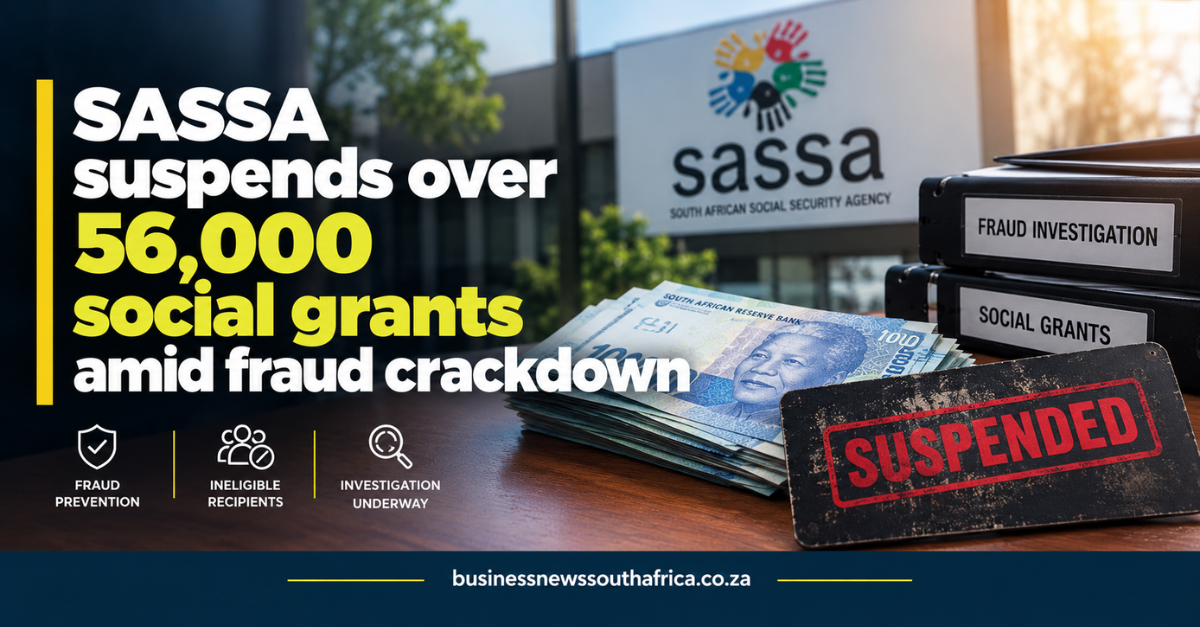
According to BusinessTech, the South African Social Security Agency (SASSA) suspended the social grants of 56,807 beneficiaries between April and June 2026. The agency said the action is part of a wider effort to identify irregular payments and curb fraud in the social assistance system.
SASSA spokesperson Paseka Letsatsi explained that the agency placed 105,600 beneficiaries under review during the first three months of the 2026/27 financial year. A review means the department checks whether a person still meets the eligibility criteria for a grant and whether the financial information they provided matches what can be seen in bank statements, credit-bureau records and other government databases.
When a beneficiary applies for a grant, SASSA asks for a three-month bank statement to confirm that no regular salary or other income is being received. Letsatsi said the agency then cross-checks those statements against data from credit bureaus and other departments. If a beneficiary later applies for credit and shows a flow of income that was not disclosed in the original grant application, the case is flagged for further investigation.
Letsatsi stressed that a discrepancy does not automatically prove intentional fraud. Money may appear in a grant holder’s account for legitimate reasons, for example, a family member sending funds for a medical expense or a one-off home-renovation cost. The agency therefore gives affected individuals a chance to explain the transactions before any permanent cancellation.
For small-business owners, the suspension of a large number of grants can have a knock-on effect. Many low-income households rely on grant payments for everyday purchases at local shops, informal traders and service providers. A sudden interruption in cash flow can reduce foot traffic and sales for businesses that depend on that spending, especially in townships and rural areas.
The crackdown follows a series of high-profile fraud cases. In July 2026, officials at SASSA’s Nebo Local Office in Sekhukhune were dismissed after an internal audit uncovered a syndicate that manipulated databases to siphon R33 million in fraudulent payments. The agency also reported paying R50 million to deceased recipients in the 2022/23 financial year and R31 million in 2023/24. Earlier, in February 2026, an operation by the South African Police Service led to arrests linked to alleged fraudulent payouts totalling R4.9 million.
Despite the aggressive review process, Letsatsi said SASSA does not automatically cancel grants when irregularities are found. Beneficiaries receive notices, are given time to respond and can provide supporting documents. Payment delays are introduced over successive months, allowing people to notice the interruption and contact the agency to resolve the issue.
Beneficiaries are urged to keep their contact details up to date and to reply promptly to any official request for information. The agency’s stated goal is to ensure that assistance reaches only those who continue to meet the eligibility requirements while protecting public funds from misuse.
For entrepreneurs and small-business owners, the situation underscores the importance of diversifying customer bases and monitoring local economic signals. While the grant suspension is a regulatory measure, its ripple effects can be felt in retail corridors, informal markets and service-provider networks that rely on steady grant income.
Read more about the regulatory environment in our Regulatory & Policy coverage.
In addition to cross-checking bank statements, SASSA consults Home Affairs to confirm whether a grant holder is still alive, allowing the agency to act swiftly when a death is recorded, Letsatsi explained. This inter-departmental link helps prevent payments from continuing to deceased recipients, a problem highlighted by the R50 million paid out in 2022/23 and the R31 million in 2023/24. By accessing the national death registry, SASSA can flag accounts for immediate review, reducing the risk of funds being misappropriated after a beneficiary’s passing.
The review timetable incorporates staged payment delays, meaning that once a discrepancy is flagged, the next instalment may be postponed for a month, with a further postponement possible the following month if the issue remains unresolved. This graduated approach gives recipients a clear window to notice the interruption, contact the agency and submit explanations before any permanent suspension is considered. The method also spreads the administrative load, allowing SASSA staff to focus on cases that persist beyond the initial delay.
Discrepancies often surface when a beneficiary’s three-month bank statement shows no regular income, yet the same individual later applies for credit and presents evidence of incoming funds. SASSA’s system matches the bank data against credit-bureau records, and any mismatch triggers an alert that moves the case into the review queue. The agency then reaches out to the grant holder for clarification, asking for supporting documentation such as receipts or letters that could justify the new income flow.
Beneficiaries placed under review receive formal notices outlining the specific concerns and the documentation required to resolve them. After the notice, they have a prescribed period to respond; if they comply, SASSA reassesses eligibility and may reinstate payments in the next cycle. Should the beneficiary fail to reply or provide insufficient evidence, the agency proceeds with a suspension, which can be appealed through the established grievance channel. This structured pathway ensures that each case follows a transparent sequence from identification to final decision.