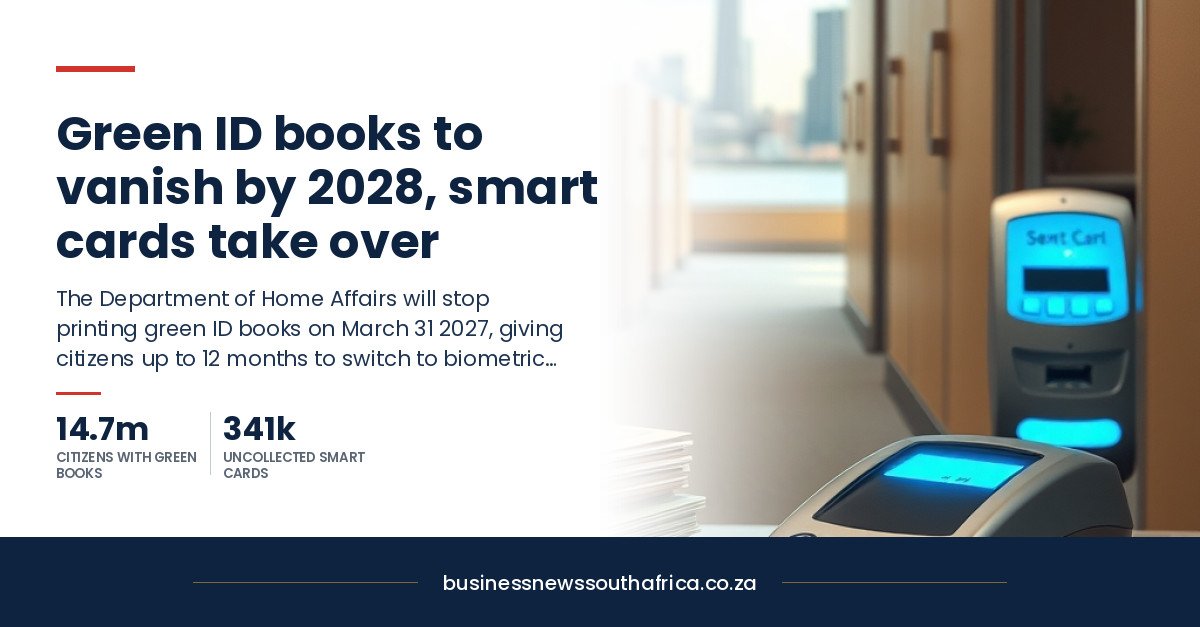
Home Affairs Minister Leon Schreiber announced that the green ID book will cease to be a valid identity document after 31 March 2028.
The Department of Home Affairs will stop producing the paper green books on 31 March 2027 and will shut down the printing machines at that time. From that date the only legal form of personal identification will be the smart ID card, a biometric card that stores personal data on a chip.
Approximately 14.7 million South Africans currently hold only a green ID book, according to the minister. Those individuals, including naturalised citizens, permanent residents and citizens living abroad, will have a twelve-month window after the March 2027 shutdown to obtain a smart ID card before the green book loses legal status.
First-time applicants and anyone aged 60 or older will continue to be exempt from the fee for a new smart ID, a policy that the department has kept in place.
For small-business owners and entrepreneurs, the change matters because a valid ID is required for opening bank accounts, registering a company, signing contracts and many other routine transactions. As Deputy Director-General for operations Tulani Mavuso warned, financial institutions will no longer accept the green book for identity verification once it is invalidated.
The shift is part of a broader move towards digital identity to curb fraud and improve service delivery. South Africa introduced the smart ID card in 2004, and the government has been gradually phasing out the older paper format. The deadline gives businesses and individuals time to update their records and avoid disruption.
The department said it will work with embassies and consulates to facilitate the issuance of smart IDs to South Africans abroad before the cut-off date.
Businesses should review their client onboarding procedures now to ensure that they can accept the smart ID as proof of identity and to inform customers of the upcoming deadline. Regulatory & Policy
The exact date, finally
We reported in September that Home Affairs had warned a deadline was coming without naming it, saying only that the minister would fix the date later. Schreiber has now done so: production stops 31 March 2027, and the green book stops being valid proof of identity a year later, on 31 March 2028. That earlier warning also said more than 341,000 already-issued smart ID cards sat uncollected, some for nearly a decade, and that participating bank branches had issued about 700,000 cards between March and mid-September alone. The bank-branch rollout is the channel naturalised citizens, permanent residents and South Africans abroad, the groups Schreiber singled out, will likely need to use to close the gap before 2027.
For a small business owner, the practical deadline arrives earlier than 2028. Banks run their FICA identity checks against whatever counts as a legal document at the time, so a bank is likely to stop accepting a green ID book for new accounts, signatory changes or company registration well before the minister’s cut-off, not on the day it arrives. Anyone opening a business account, adding a new signatory or registering a company on a green ID book should treat 2027, not 2028, as the date that matters, and get staff and directors onto a smart ID card well ahead of either deadline.
Schreiber’s department has also leaned on the bank-branch rollout to speed up the switch, rather than relying only on Home Affairs’ own offices, which carry years of backlog on walk-in applications in some areas. For a business with staff who still carry the green book, pairing that bank-branch option with the standard exemption for first-time applicants and anyone over 60 is the fastest route to compliance before either deadline bites.
The 14.7 million figure Schreiber gave covers everyone who still holds only a green book, so it includes a meaningful share of the working-age population a business might employ, bank or contract with. Checking which staff and counterparties still need to make the switch is worth doing now, while there is still more than a year of runway before production even stops.