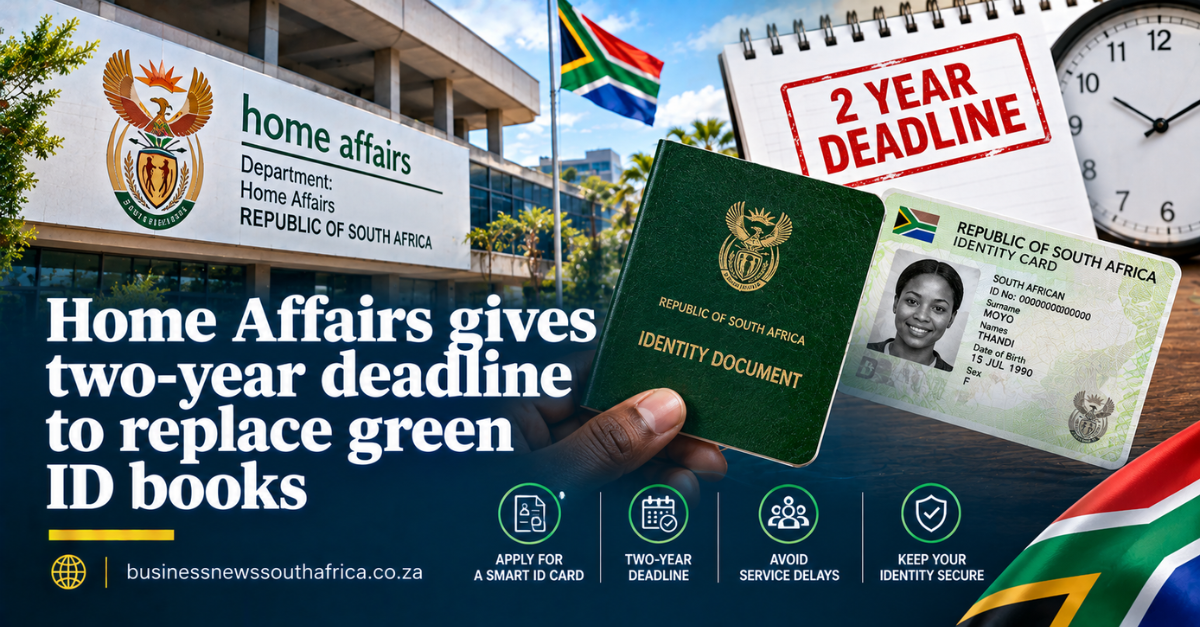
Update, 6 October 2026: The green ID book deadline is now fixed. Home Affairs Minister Leon Schreiber announced on 1 October 2026 that the green ID book will cease to be recognised as a valid form of identification on 31 March 2028, and that the department will stop producing the book by 31 March 2027. The 14.7 million South African citizens and permanent residents who hold only a green ID book have the 12 months between those dates to switch to a smart ID card. This article was first published on 15 September 2026, before a date had been named, and the original report on the two-year warning from Home Affairs follows the update.
The dates Home Affairs has set
Schreiber set out the timeline in a keynote address at Constitution Hill on 1 October 2026, published in full on the government portal as the minister’s Home Affairs Quantum Leap speech. The roadmap has three fixed points:
- By 31 March 2027, Home Affairs will cease production of the green ID book. On that date the machines that produce it will be permanently shut down and decommissioned.
- Before 31 March 2027, the department says it will enable the remaining naturalised citizens and permanent residents, as well as South African citizens abroad, to obtain smart IDs.
- On 31 March 2028, the green ID book will officially cease to be recognised as a valid form of identification in terms of section 25(1)(b) of the Identification Act.
Schreiber said independent research has found the green ID book to be one of the most defrauded documents on the African continent. “The continued use of the Green ID Book is irreconcilable with the functioning of a modern society,” he said.
According to the minister, the number of people whose only form of identification is a green ID book has already fallen from 16 million to 14.7 million. First-time applicants, as well as applicants over 60 years of age, will remain exempt from paying the smart ID application fee.
Where to switch
The deadline rests on a large expansion of where people can apply. Schreiber said no fewer than 515 bank branches now offer biometric services where any South African can walk in without an appointment and apply for a replacement smart ID in about five minutes, with no prior booking or paperwork needed. More than 822 500 people have already used the service. He said it will be available at more than 1 000 service points by the end of 2026, compared with 214 locations that offered smart ID replacements before the government of national unity was formed. Passport applications and first-time smart ID applications are due to be added at these branches shortly.
The department is also building a smartphone-based Digital ID. Schreiber said use of that system will be voluntary and the physical smart ID card will remain available for anyone who chooses to use it. TechCentral’s report on the phase-out carries further detail on the bank branch rollout.
The September warning that came first
On 15 September 2026, BusinessTech reported that Thulani Mavuso, Deputy Director-General for Operations at Home Affairs, had warned in an interview with Newszroom Afrika that green ID book holders had about two years left. “The message is that we have to collect those documents because in the next two years, they will not be able to use their green ID book,” Mavuso said. At the time he said the minister would announce the precise timelines at an appropriate time, and urged South Africans not to wait for the deadline to approach before applying.
Mavuso said the department had issued about 34 million smart ID cards since they were introduced. Around 25 million of those were reissues, and another 9.7 million were new applications from young people becoming eligible for identity documents and voting. More than 341 000 smart ID cards remained uncollected across the country, some for almost 10 years, and many of the uncollected first-time cards belonged to young people who had turned 16. Participating banks had issued about 700 000 smart ID cards between March and the second week of September, he said.
He stressed that the smart ID will become increasingly important for everyday transactions once the green ID book is no longer accepted, describing it as “the only legal document that you can be able to show in terms of the transactions, particularly with financial institutions and others”. For people who have lost or damaged their IDs, Home Affairs can issue a temporary identification certificate while a replacement application is processed, and Mavuso said that certificate can also be used for voting. The department has also introduced measures to make collection easier, including prioritising elderly people, people with disabilities and children.
Steps for employers and anyone who checks ID
The 31 March 2028 date matters wherever a business checks an identity document: hiring and payroll, account opening, credit applications, leases and supplier onboarding. Client verification is already a compliance pressure point for financial institutions, as our report on Capitec’s R28 million fine for anti-money-laundering compliance breaches shows.
Practical steps based on the dates Home Affairs has announced:
- Find out which employees still hold only a green ID book and encourage them to switch now rather than close to the deadline.
- Update HR, onboarding and know-your-customer checklists so that a green ID book is not accepted as proof of identity from 31 March 2028.
- Tell staff that replacement applications can be made at participating bank branches without a booking, and that first-time applicants and people over 60 do not pay the application fee.
- Where an employee has lost or damaged an ID, Home Affairs can issue a temporary identification certificate while the replacement is processed.
Employers who hire foreign nationals face separate document rules, covered in our report on the fines households face for employing foreign domestic workers without valid documents. For more on the minister’s announcement, read our report on green ID books losing legal status from 31 March 2028, and follow further changes in our Regulatory and Policy coverage.