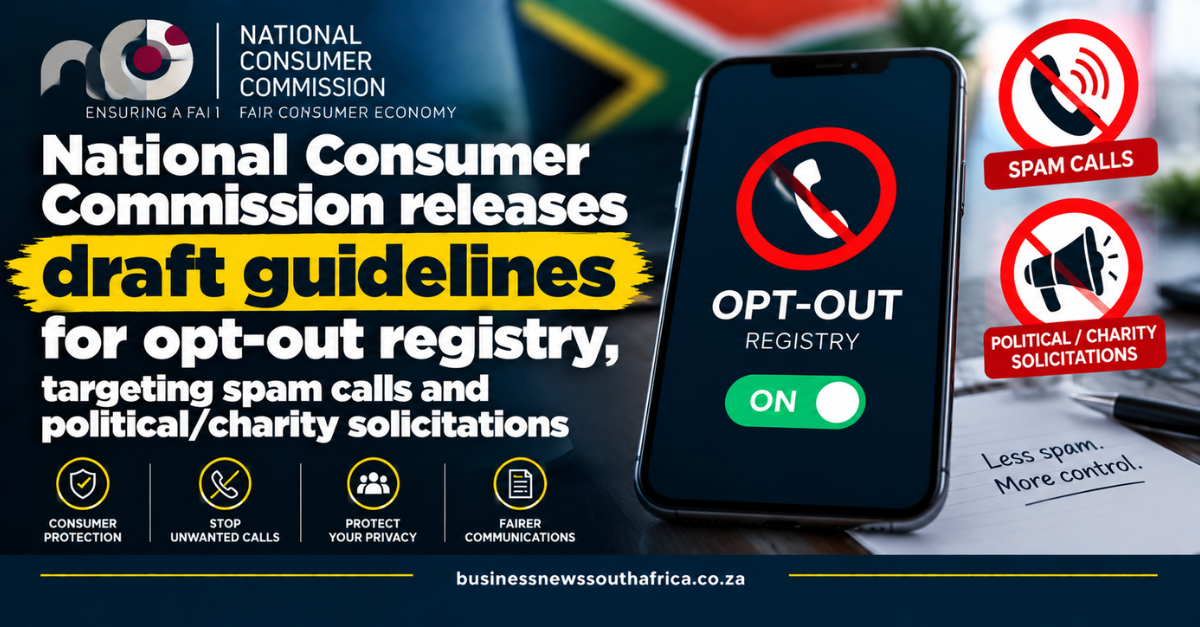
The National Consumer Commission (NCC) published draft Guidelines for Compliance with the Opt-Out Registry Regulations in Government Gazette 55465 on 2 October 2026 (Notice 7981), signed by Acting Commissioner Hardin Ratshisusu. The gazette gave the public 15 days to comment. In a notice dated 13 October 2026, Moonstone reported, the NCC extended the deadline to Friday, 6 November 2026. BusinessTech also reported on the draft.
The draft rests on section 11 of the Consumer Protection Act (CPA), which gives every person the right to avoid or pre-emptively block communications primarily for direct marketing. The 2026 amendments to the regulations add direct marketer registration and renewal, database cleansing, compliance with pre-emptive blocks, identification of marketers and prescribed fees.
What the draft says
- Ordinary business calls: a call to administer an existing transaction, arrange delivery, resolve an account or complaint, or give support is not automatically direct marketing. The draft’s example: a call to resolve an account query may be permissible, but “an unsolicited sales pitch added to that call is direct marketing” and must comply with the CPA, the Opt-Out Regulations and privacy law.
- Call centres and agencies: using a third party does not remove the direct marketer’s responsibility, and compliance responsibility extends to agencies, franchises and branches.
- Registration and cleansing: direct marketers must register before marketing and renew annually. Each month they submit the list they intend to use, pay 12 cents for each person on it who has registered a block, and must remove those people. A cleansed list is valid for 30 days.
- Enforcement: a complaint can lead to an investigation, a compliance notice or a referral to the National Consumer Tribunal for administrative penalties. In serious cases a convicted person may be fined or imprisoned for up to 12 months under the CPA.
Political parties and charities
The draft says campaigning for votes does not ordinarily count as direct marketing. A political organisation that solicits donations may fall within the regime, and a non-profit organisation is not excluded just because it is non-profit: it is a direct marketer when it approaches people to request a donation. A non-profit that only sends administrative, informational, educational or awareness messages generally is not.
The R2 million turnover condition on donation requests is worded inconsistently in the draft. In the political parties answer, the rule applies when donations are solicited from individuals or juristic persons whose annual turnover is “less than R2 000 000”; in the non-profit answer, it applies to requests to those whose turnover is “more than two million”. Because the NCC may change the text after consultation, we cannot say which wording will stand. BusinessTech reported only the “less than R2 million” version.
What it means for a business
A business that phones or messages people to promote its products needs to register on the registry, clean its lists monthly and make sure any agency it uses does the same. Our earlier reports cover the timetable: the registry launches with full enforcement from April 2027 and direct marketers must register by December.
Correction, 1 November 2026: an earlier version of this article said the donation rule applies only when the recipient’s annual turnover is less than R2 million. The NCC’s draft words this differently for political parties and non-profits, and we have set out both. It has been corrected.