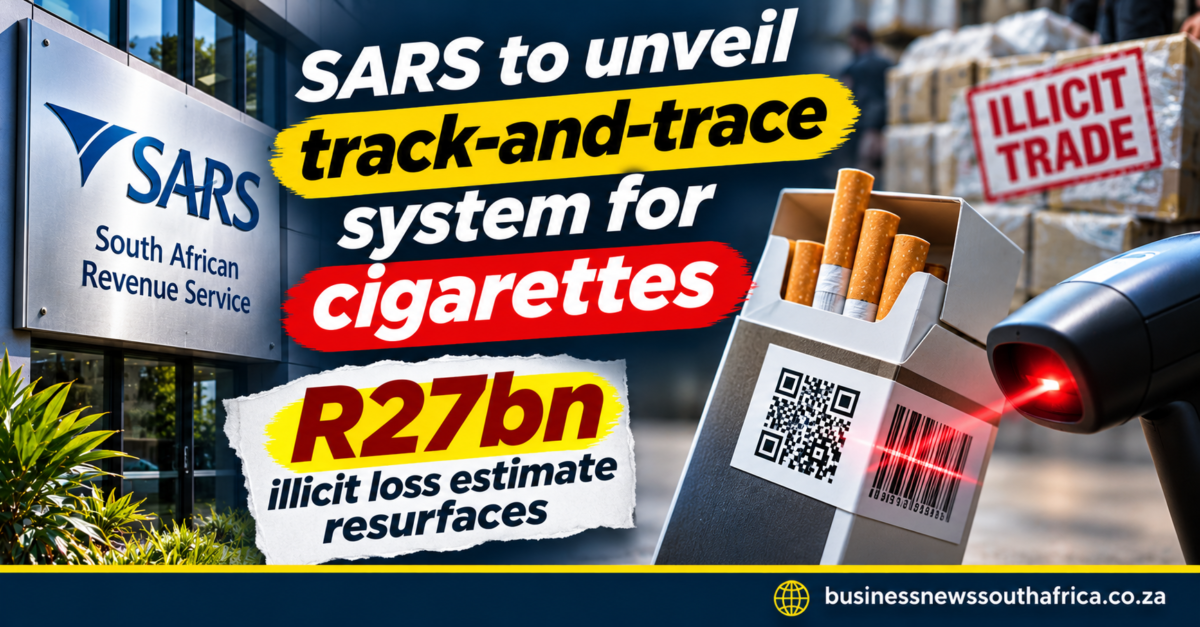
The South African Revenue Service (SARS) says it will publicly introduce a track-and-trace system for excise goods “in the coming weeks”, starting with tobacco, as the state tries to claw back revenue lost to the illicit cigarette trade. The plan was set out in a National Treasury and SARS presentation to Parliament’s Standing Committee on Finance on 14 October 2026, according to Daily Investor, and was repeated in a BusinessTech report on 8 November. The rollout is expected to launch in the second quarter of the 2027/28 financial year, which on the government’s April-to-March year is July to September 2027.
What was said in Parliament, and by whom
The 14 October session was the Treasury and SARS response to submissions on the 2026 draft tax bills, after public hearings on 30 September. Parliament’s media alert for the meeting listed British American Tobacco South Africa, Vaping Saved My Life, South African Breweries and Wine SA among the submitters. According to Daily Investor, the National Treasury told the committee that increases in cigarette excise duty have been capped at inflation since the 2023 Budget, while SARS said it is tackling illicit trade through the National Illicit Economy Disruption Programme announced by President Cyril Ramaphosa in his 2026 State of the Nation Address.
The track-and-trace commitment came from SARS in that presentation, not from a statement by Commissioner Johnstone Makhubu. His only quoted remarks in the coverage are from September. In SARS’s own 14 September media release on the Tax Indaba, the organisation said it “aims to disrupt illicit activities that undermine fair competition, threaten jobs, and weaken economic growth”. The same release says SARS is using technology and coordinated enforcement against fraud, tax evasion and cross-border syndicated financial crime. It does not mention track-and-trace, cigarettes or tobacco.
Where the R27 billion figure comes from
The R27 billion number is an annual estimate of lost tax revenue, and it predates the October presentation. It appears in Finance Minister Enoch Godongwana’s written reply to parliamentary question NW3330 from EFF MP Thapelo Mogale, dated 3 July 2025 and published by the Parliamentary Monitoring Group. The reply says illicit trade is “hard to reliably quantify” and that publicly available estimates suggest up to 70% of cigarettes sold in South Africa are illicit, “resulting in annual tax revenue losses exceeding R27 billion”. The minister did not say who produced the estimate.
The figures differ between sources. BusinessTech writes that up to 75% of cigarettes sold are estimated to be illicit and ties that share to the R27 billion loss. Daily Investor, reporting on the October presentation, says the 75% was the claim of one submission to the committee, while the Treasury’s July 2025 reply used up to 70%. The two shares have been reported side by side, and neither is a SARS measurement. A separate estimate by Oxford Economics, cited in both reports, puts cumulative taxes evaded through the illicit cigarette trade between 2019 and 2022 at R85.6 billion.
Revenue from tobacco has shrunk
The same ministerial reply gives SARS’s own collection data. Revenue from tobacco and cigarette products fell from R13.4 billion in 2015/16 to R9.4 billion in 2024/25, a contraction of R4.0 billion, or 29.6%, with a ten-year compound annual rate of minus 3.8%. The reply attributes a 44.9% year-on-year drop in 2020/21 largely to suppressed consumption during the Covid-19 lockdown. BusinessTech cites Oxford Economics for a different measure, saying excise collected from the tobacco industry fell 36.3% in 2020 to R11 billion. The two numbers cover different periods and bases, and the sources do not reconcile them.
Price gaps explain much of the pressure on legal sellers. Daily Investor reports that submitters told the committee the cheapest illicit pack of 20 cigarettes sells for R5, against about R37 for the cheapest legal pack, and that the minimum collectable tax on a pack of 20 is R27.12. That means the tax alone is higher than the street price of an illicit pack. BusinessTech adds that excise duties now account for more than half the average retail price of a legally sold pack.
How the system is expected to work
SARS has not published a design, supplier or cost for the system, and the presentation itself was not available to us. The Parliamentary Monitoring Group’s report on the meeting sits behind a subscription. The description of the technology comes from Professor Keith Engel, chief executive of the South African Institute of Taxation, who is an outside commentator. In an interview with 702, reported by Daily Investor on 29 October, he described electronic markers applied when products leave the factory that act as digital trackers through every distribution tier. He said the main purpose is to stop round-tripping, where goods are exported and brought back without excise being paid, and to stop illegal factories feeding the formal market.
Engel told 702 that a shopkeeper buying marked stock would see that excise should be charged, and that anyone who resells without it would be liable. He accepted the cost: “It is expensive, but according to research, it results in such a drastic cut in illicit trade that it is worth it.” BusinessTech reports that he pointed to Kenya, Germany and France as countries that have introduced similar tracking, with varying degrees of success, and that the system would shrink rather than end illicit trade. Both outlets say the markers could later extend beyond cigarettes to alcohol, though SARS has said only that tobacco comes first.
What it could mean for business
For manufacturers, wholesalers and retailers of cigarettes, the practical questions are who pays for the markers, how scanning will work at shop level and what liability retailers carry for unmarked stock. None has been answered publicly. Engel’s remarks suggest legitimate sellers would gain protection from cheaper illicit competition, but that is his view and not a SARS commitment. For the fiscus, the gain depends on enforcement as much as technology. Engel also cautioned that recovering lost revenue should be accompanied by closer scrutiny of public spending.
The wider cost of illicit trade has been a recurring theme on this site, including our reporting on the R68 billion annual estimate across several sectors, the British American Tobacco plant closure and Makhubu’s earlier pledge on tax administration. More tax and regulatory coverage is in our Regulatory & Policy section.
What is still unknown
SARS has not said when in the coming weeks it will unveil the system, what it will cost, which firm will supply the markers or how retailers will be expected to verify stock. The reports we read do not give the legal basis for requiring markers or say whether the 2026 draft tax bills contain enabling provisions. The R27 billion estimate also remains unverified by SARS, as the Treasury itself describes illicit trade as hard to quantify.