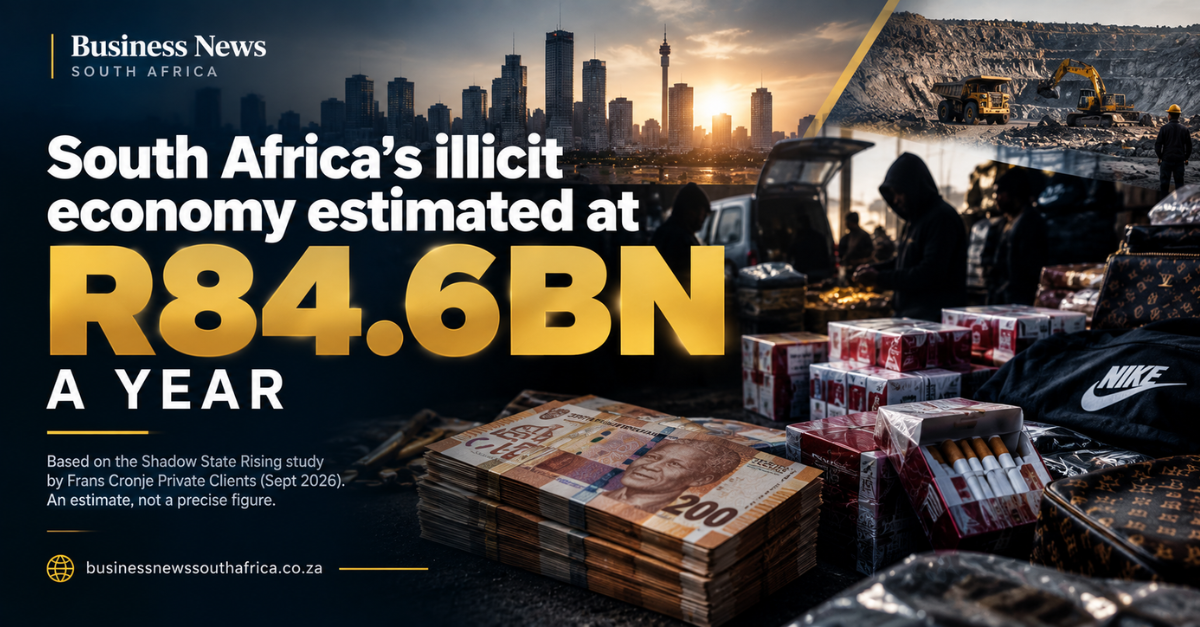
South Africa’s illicit economy costs the fiscus about R84.6 billion a year, according to a study called Shadow State Rising from Frans Cronje Private Clients. BusinessTech reported the figure alongside the country’s latest standing in the Global Organised Crime Index.
## What the study counts
The study defines the illicit economy as a parallel system of production, trade and finance that operates outside legal, tax and regulatory controls. It lists smuggling, customs fraud, trade misinvoicing, money laundering, counterfeit goods, illegal mining, fuel adulteration, illegal fishing and untaxed business activity. Because none of it is taxed, the losses fall directly on the state.
According to the study, as reported by The Common Sense, R84.6 billion equals 1.0% of GDP, 3.9% of state revenue and about 23.0% of the annual budget deficit. Tobacco, illegal mining and alcohol are the largest contributors, together costing the fiscus an estimated R74.3 billion of the total each year. The study summary puts unpaid tobacco excise, VAT and corporate tax at R33.3 billion, illegal mining at R23.5 billion in lost royalties, sales and taxes, and illicit alcohol at R17.5 billion. It says illicit brands now make up 60% to 70% of cigarette sales. The remaining R10.3 billion is spread across the other activities on the list.
Frans Cronje, who leads the firm, described the trade as a shadow state that competes with the legitimate state for money, power and authority. The study argues that these activities are no longer isolated criminal enterprises. In his words, the Johannesburg shooting should be a warning to lawmakers about the scale of the parallel economy. The study also says the networks undercut legitimate businesses, deter investment and corrupt enforcement systems and border control, and that illegal mining in particular involves territorial control exercised through violence.
This is one firm’s estimate, and the study reports the cost to the fiscus rather than a breakdown of turnover by activity.
## Where the country sits on the Organised Crime Index
The Global Organised Crime Index is compiled by the Enact programme, which is funded by the European Union and run by the Institute for Security Studies, Interpol and the Global Initiative Against Transnational Organised Crime. In the 2025 edition South Africa scored 7.43 out of 10 for criminality, according to a Mail & Guardian report on the index. That is the second-highest score in Africa and the highest of the 13 Southern African countries. BusinessTech put the country seventh out of 193 worldwide.
The Global Initiative Against Transnational Organized Crime, one of the partners behind the index, says South Africa has ranked among the ten most criminal countries in every edition since the first index appeared in 2019, citing deeply entrenched illicit markets and persistent problems with governance and law enforcement.
Resilience, the index’s measure of how well a country can withstand and disrupt organised crime, was 5.67. That is the third-highest in Africa, 44th globally and the highest in Southern Africa. The index credits South Africa with a strong legal framework against corruption, money laundering and gang activity, but says the main challenge lies in implementing it. Reported weak points include financial constraints on investigators, corruption inside law-enforcement agencies and governance problems that erode public trust.
## Borders, extortion and the private sector
Border enforcement is a recurring theme. BusinessTech said the index describes the counterfeit market as pervasive, and that seizures of counterfeit clothing, footwear, electronics and pharmaceuticals show its scale. It also says illicit trade in excise goods, tobacco and alcohol in particular, remains significant despite the Border Management Authority’s mandate.
For firms operating in the formal economy, the index draws a direct line to their costs. The Mail & Guardian quoted its finding that extortion has become so common that many businesses now treat it as a regular operating expense. The same profile lists human trafficking, drug distribution, wildlife trafficking, illegal mining and cybercrime among the country’s main criminal markets.
The index singles out Business Against Crime South Africa (BACSA) as a useful go-between for government and industry. The Consumer Goods Council of South Africa has proposed an Anti-Crime Platform building on BACSA’s work, with the aim of delivering “prevention, disruption, enforcement and measurable outcomes”. It is a proposal, so it has no results to measure yet.
More on regulation and enforcement is filed under regulatory and policy news, a related estimate is in the Consumer Goods Council’s R68bn warning, and reporting on the wider economy sits in the markets and finance section.