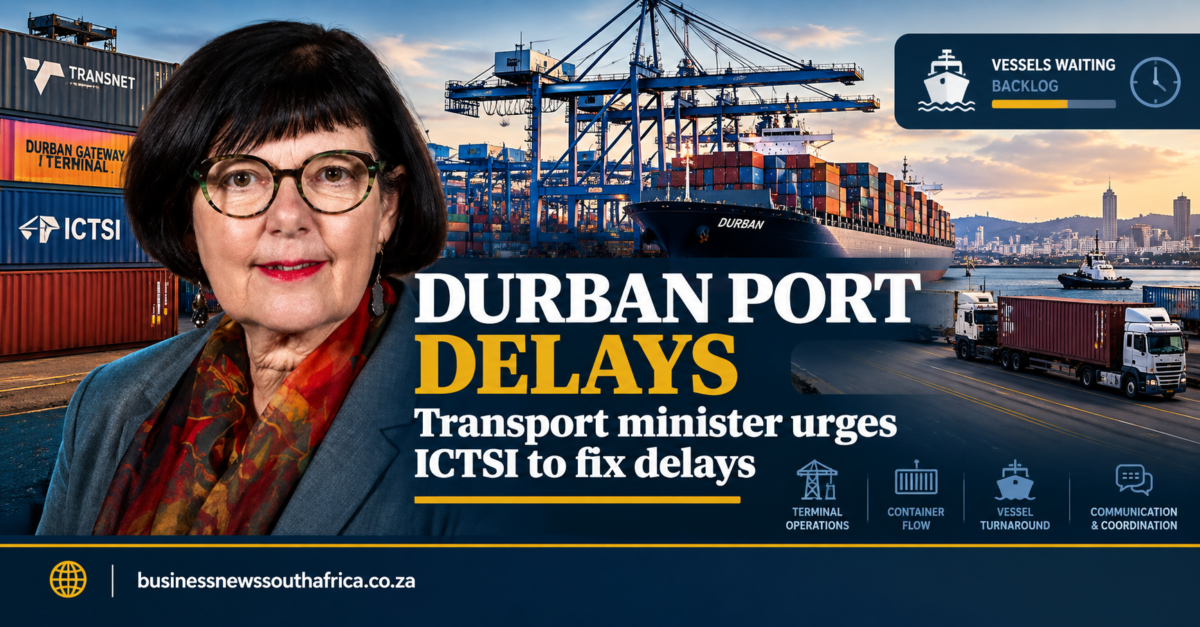
Transport Minister Barbara Creecy met with officials from International Container Terminal Services Inc (ICTSI) to discuss worsening delays at the Durban Gateway Terminal, the country’s busiest container terminal that handles almost half of South Africa’s container traffic.
Creecy told reporters that the average time vessels spend at anchorage has roughly doubled to nearly six days since ICTSI took over operations. She attributed the slowdown largely to the rollout of a new Navis terminal operating system, software that coordinates container movements inside the yard, and to delays in refurbishing or replacing key loading equipment. Navis, a widely used terminal operating system, is intended to improve efficiency but can cause “teething problems” while staff learn the new processes.
ICTSI, a firm led by Filipino billionaire Enrique Razon, was appointed to run the terminal in partnership with state-owned logistics company Transnet. The contract followed a lawsuit by AP Moller-Maersk A/S that challenged the original bidding process.
What the delays mean for traders
According to the Cape Chamber of Commerce, the prolonged anchorage times have forced some ships to bypass Durban, putting pressure on other South African ports and disrupting supply chains. Import-export businesses, including many small and medium-sized enterprises that rely on timely deliveries, face higher freight costs and inventory shortages as a result.
Creecy urged ICTSI to improve its public communication and to respond more quickly to customer concerns. She also noted that ICTSI has committed R737 million (about $44 million) to upgrade equipment, a move aimed at boosting the terminal’s capacity by 40 percent to 2.8 million twenty-foot equivalent units (TEU) by 2030.
What remains unclear are the exact timelines for the equipment upgrades and for stabilising the Navis system. The minister’s remarks signal that Transnet will be watching ICTSI’s progress closely, as the public-private partnership is central to Transnet’s broader strategy of improving national logistics performance.
During a phone interview from Durban on Friday, Minister Creecy highlighted that ICTSI had not returned an email request for comment nor answered a call made to its offices after working hours, a silence that has drawn criticism from traders awaiting clarity on remedial actions. The lack of response was noted as compounding frustration among shipping lines that are already facing extended anchorage periods, and it adds urgency for the operator to engage directly with shipping lines and port users as the terminal seeks to stabilise operations.
Transnet’s broader logistics strategy increasingly relies on public-private partnerships such as the Durban Gateway arrangement, using performance-based contracts that tie operator incentives to measurable service levels. Under this framework, key indicators like vessel turnaround time, equipment utilisation rates and cargo throughput are monitored quarterly, allowing Transnet to assess whether the private partner meets agreed targets and to trigger remedial actions if standards slip.