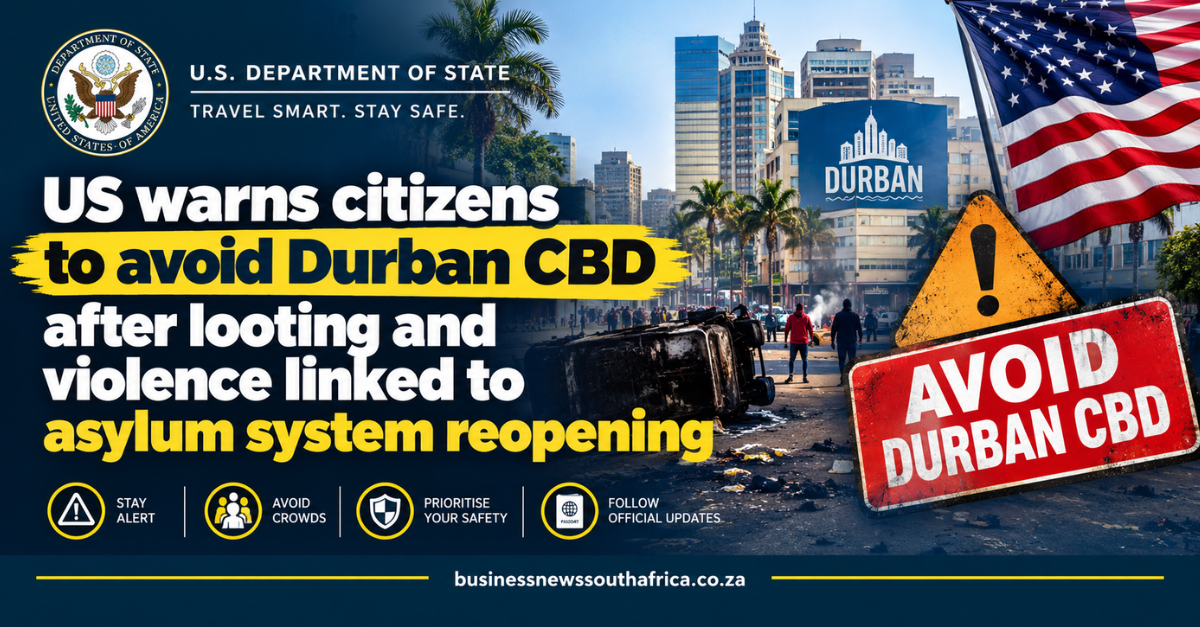
The United States has issued a security warning for its personnel and other foreign nationals in Durban after reports of looting and violence near the Bayside Hotel on Dr Pixley KaSeme Street. The US Embassy and Consulates in South Africa said staff have been instructed to exercise extreme caution and to divert travel until further notice.
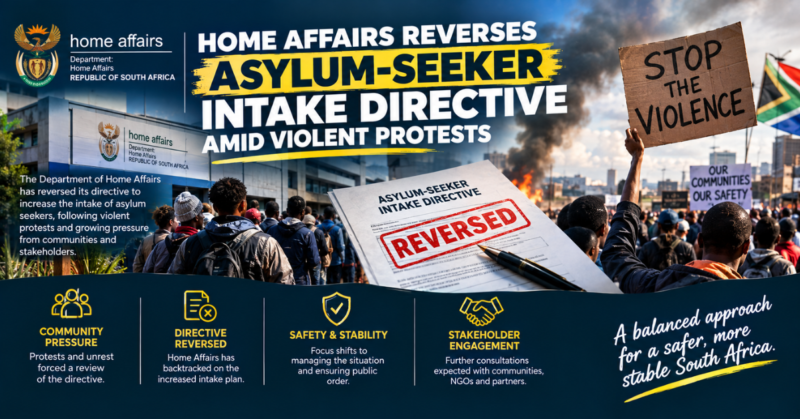
The warning comes after South Africa’s Constitutional Court ordered the asylum system to reopen to new applicants. The court found parts of the Refugees Act unconstitutional and required the Department of Home Affairs to accept asylum applications from all who seek them. This legal change has sparked large gatherings of foreign nationals outside the Durban Refugee Reception Centre, where a queue of about 1,000 people was reported on 7 October.
Anti-illegal immigration groups arrived at the scene armed with sticks and sjamboks, turning the crowd volatile. Nkosikhona “Phakel’umthakathi” Ndabandaba, leader of the group Insizwa Nobunsizwa, said the demonstration was meant to protect both local residents and the foreigners present, while also protesting the court ruling.
The US warning specifically advises people to avoid the area, stay away from crowds and demonstrations, keep a low profile, monitor local media, review personal security plans and contact the South African Police Service on 10111 or 112 from a mobile phone in an emergency.
Migration expert Nicholas Avramis of Beaver Recruitment SA confirmed that the court decision is legally sound, noting that it re-affirms procedural protections for asylum seekers under Section 22 of the Refugees Act. He stressed that access to the asylum process does not guarantee refugee status, permanent residence or citizenship.
ActionSA, a political party, has voiced concerns about the practical impact of the directive. The party warned that allowing undocumented people to apply could lead to temporary legal status for many, stretching state resources while applications are processed. ActionSA proposes the creation of Integration and Repatriation Centres near borders and inland, biometric registration, stricter timelines and clearer distinction between genuine refugees and economic migrants.
For businesses operating in Durban, the warning signals a heightened risk environment. Companies with expatriate staff or foreign clients should review travel policies, consider remote work arrangements for employees in the affected zone, and stay in contact with local security providers.
Further information can be found on the BusinessTech article, the US Embassy in South Africa, the South African Police Service, the Department of Home Affairs, and the Constitutional Court. For broader policy analysis, see our Regulatory & Policy coverage.
The queue that formed along Che Guevara Road on the morning of 7 October stretched for roughly a kilometre, according to eyewitnesses, and included families with children as well as individuals travelling alone. When anti-illegal immigration groups arrived with sticks and sjamboks, the crowd became uneasy and many began to disperse, fearing for their safety. The United States Consulate General in Durban confirmed that the unrest was directly linked to the Home Affairs directive not to turn away asylum seekers, a move that sparked the large gathering outside the refugee reception centre.
Home Affairs officials instructed staff at the Durban Refugee Reception Centre to accept any person who approached the office seeking asylum, regardless of how they entered the country. This operational change follows the Constitutional Court’s finding that Section 22 of the Refugees Act must be applied without discrimination. The directive effectively removes the previous requirement for applicants to present themselves at a port of entry, opening the process to individuals who may have crossed borders informally.
Under South African law, once an asylum seeker submits an application, the Department of Home Affairs must provide a written acknowledgement and schedule a substantive interview within a prescribed period. The applicant is then afforded procedural fairness, including the right to be heard and to receive reasons for any adverse decision. If the claim is rejected, the individual may appeal to the Refugee Appeal Board, and further judicial review is possible through the courts.
ActionSA’s proposal for Integration and Repatriation Centres envisions facilities where asylum seekers would be housed while their identities and claims are verified. The party argues that biometric registration at these centres would streamline the assessment process and help distinguish genuine refugees from economic migrants. It also suggests that stricter timelines be imposed on Home Affairs to prevent prolonged stays in the community while applications are pending.
Security firms operating in Durban have begun to adjust their deployment patterns in response to the US warning. Some have increased patrols around the CBD and the refugee reception centre, while others are advising clients to use alternative routes that bypass Dr Pixley KaSeme Street. The South African Police Service’s emergency numbers, 10111 and 112, remain the primary channels for reporting incidents, and authorities have urged the public to stay informed through local media outlets.