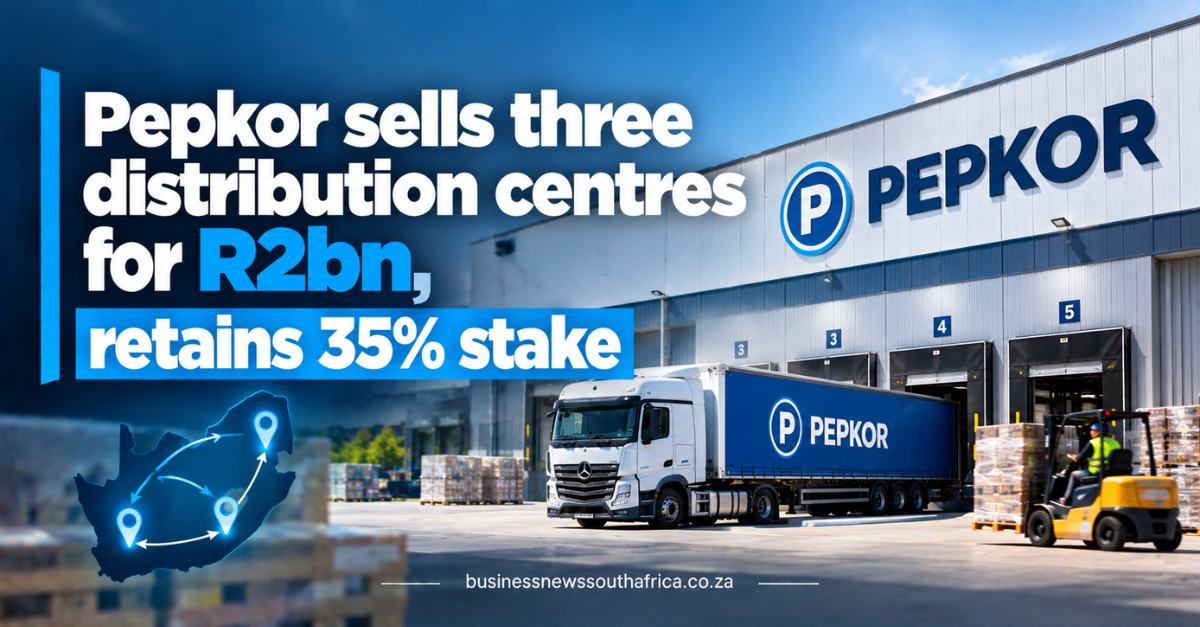
In a quiet warehouse complex on the outskirts of Johannesburg, Pepkor handed over the keys to three massive distribution centres, but the retailer will still be the tenant for the next decade and a half.
The company announced that it has sold the three sites to Badger Properties for roughly R2 billion. Pepkor will retain a 35% minority interest in the properties and has signed 15-year “triple net” lease agreements, a lease structure where the tenant shoulders most operating costs, ensuring the seller’s cash flow remains stable.
According to the statement, two of the centres are operated by Pepkor’s PEP chain and the third by its Ackermans subsidiary. The retailer stressed that daily operations will continue unchanged, meaning suppliers and store managers should see no disruption.
Management said the proceeds will be redeployed to fund “high-yielding growth opportunities” and to reduce net debt, thereby improving overall capital efficiency. The cash boost comes at a time when Pepkor is eyeing a move into South Africa’s banking sector, having secured regulatory approval from the Prudential Authority.
The new banking arm, branded “PlusB”, is slated for launch in the second half of the FY27 financial year. Pepkor capped the build cost at R1 billion and said the investment will not exceed that amount, provided regulatory sign-offs are obtained.
In its latest trading statement, Pepkor warned that earnings for the 2026 financial year will be muted, with headline earnings per share (HEPS, profit per share before one-off items) expected to contract by up to 1% or grow as much as 9%. Normalised HEPS, earnings stripped of the banking investment, are projected to rise 2% to 12% year-on-year.
For small-business owners and suppliers, the deal signals a stronger balance sheet for Pepkor and a potential increase in purchasing power as the retailer expands its store network, 195 new outlets opened in the past ten months, and rolls out banking services that could reshape payment flows in the retail sector.
Read more about similar retail-sector moves in our Retail & Consumer coverage, or explore funding options with our commercial funding suite.
Why a retailer sells its own warehouses
A sale-and-leaseback, the structure Pepkor used here, lets a company convert a property asset into cash immediately while keeping full use of the building under a long-term lease, effectively swapping ownership for a fixed rental cost. It is a common way for retailers to fund expansion or new ventures, in this case Pepkor’s planned PlusB banking business, without raising new debt or diluting shareholders through a rights issue, though it does mean the retailer no longer benefits from any future increase in the property’s value.
Pepkor’s other recent capital moves
The distribution centre sale follows a pattern of Pepkor actively managing its balance sheet ahead of the PlusB banking launch, rather than raising the R1 billion build cost through new debt or a share issue. Retailers moving into banking typically face a capital-intensive build phase before any revenue materialises, since a banking licence itself, once granted by the Prudential Authority, comes with its own minimum capital-adequacy requirements separate from the retail business’s existing funding needs.
The 15-year lease term Pepkor has signed is unusually long by South African commercial property standards, where 5 to 10-year leases are more typical, reflecting how central these three distribution centres remain to the retailer’s core PEP and Ackermans supply chains even after the sale.
PEP and Ackermans remain among South Africa’s most recognisable value-retail brands, so any change to how their goods physically move through the supply chain is watched closely by suppliers and logistics partners alike.
Badger Properties, the buyer, has not disclosed further plans for the sites beyond honouring the existing lease terms.
Source: BusinessTech