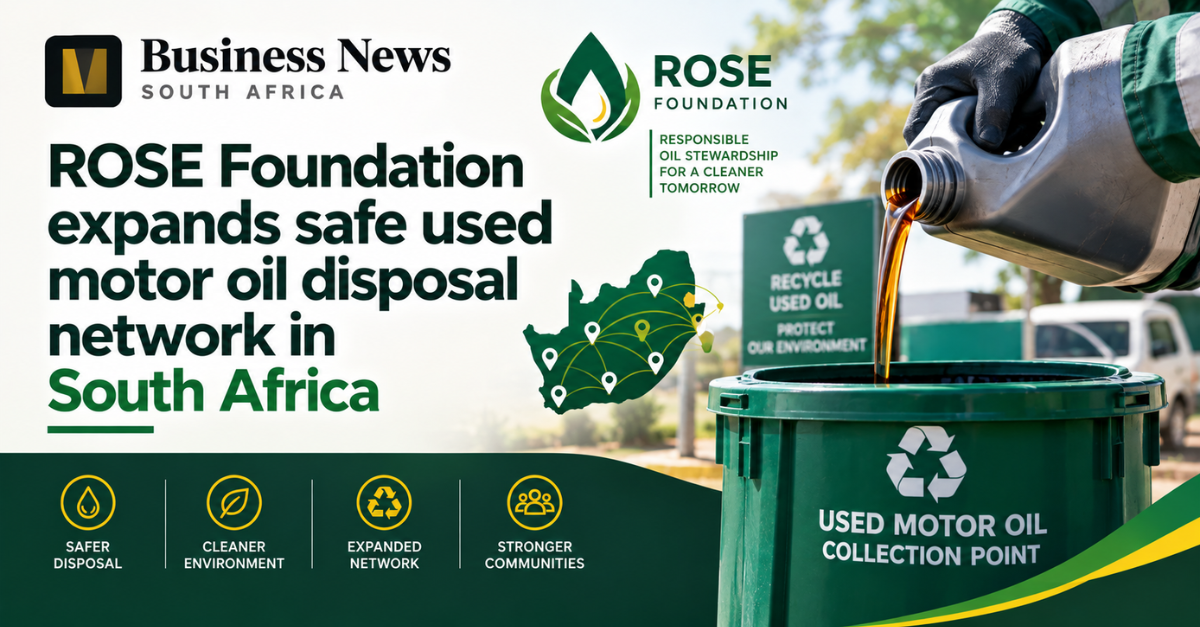
A small workshop in Gauteng fills a metal drum with dark, sludgy oil after a routine service. The owner could have poured it down the drain, but a sign on the wall points to the nearest ROSE Foundation drop-off point, a free option for anyone with used oil.
The real stake is environmental. One litre of used motor oil can pollute up to one million litres of clean water, a serious risk in a country where water scarcity is already a daily reality. Dumping oil into drains, on the ground or into regular waste bins can damage rivers, soil, groundwater and nearby communities. The law also requires proper disposal, so non-compliance can lead to fines.
How the system works
The ROSE Foundation (the Foundation) has built a national infrastructure of accredited collectors and drop-off points. Licensed collectors are trained and certified to handle hazardous oil and can provide on-site pickups for workshops, trucking fleets, service centres and industrial facilities. The collected oil is then transported to approved processors that clean, treat and recycle it.
Through partnerships with industry leaders such as AutoZone, the Foundation has set up drop-off points where motorists can bring used oil at no cost. Every collection is documented and businesses receive official certificates confirming that the oil has been handled in line with environmental regulations, a useful tool for compliance reporting.
The Foundation also invests in public education, running community campaigns, training initiatives and working with government bodies to strengthen environmental protection. A small action, dropping off a few litres of oil, prevents serious harm and recovers valuable resources.
For a DIY mechanic, a small garage or a large engineering firm, the message is clear: use the ROSE network to dispose of oil responsibly and protect South Africa’s water future.
Why used oil is worth recovering, not just disposing of safely
Used motor oil does not wear out chemically the way it becomes contaminated with dirt, metal particles and combustion by-products, which means a re-refining process can strip those contaminants back out and return the base oil to a usable, sellable product, a genuinely circular alternative to the two options most workshops default to: illegal dumping or costly incineration. That distinction is why a network like ROSE’s has commercial as well as environmental logic behind it: the businesses that end up processing collected oil are recovering a raw material with real resale value, not simply performing a costly public service, which is part of why this kind of collection infrastructure has proven more durable over time than purely donation-funded environmental programmes.
For a small workshop owner, the compliance certificate ROSE issues on each collection is worth treating as more than paperwork: environmental compliance documentation of exactly this kind is increasingly what larger corporate clients and government tenders require from smaller subcontractors and suppliers before awarding work, meaning proper oil disposal records can function as a genuine, if unglamorous, competitive advantage when bidding against workshops that cannot produce the same evidence.
South Africa’s water scarcity gives this specific waste stream an urgency that used-oil disposal programmes in wetter countries do not carry to the same degree: a single litre reaching a water source in a country already managing chronic supply shortfalls represents a proportionally larger share of an already strained resource than the identical spill would in a country with abundant fresh water, which is part of why ROSE’s model, free collection plus a paper trail proving proper handling, has become the default compliance route for workshops rather than a niche environmental add-on.
The compliance risk cuts both ways for a workshop owner: dumping used oil is not merely an environmental lapse, it is a specific offence under South Africa’s National Environmental Management Act, and inspectors increasingly treat improper hazardous-waste disposal as a straightforward enforcement target precisely because, unlike many pollution sources, it is easy to trace back to a specific business once oil turns up somewhere it should not be.