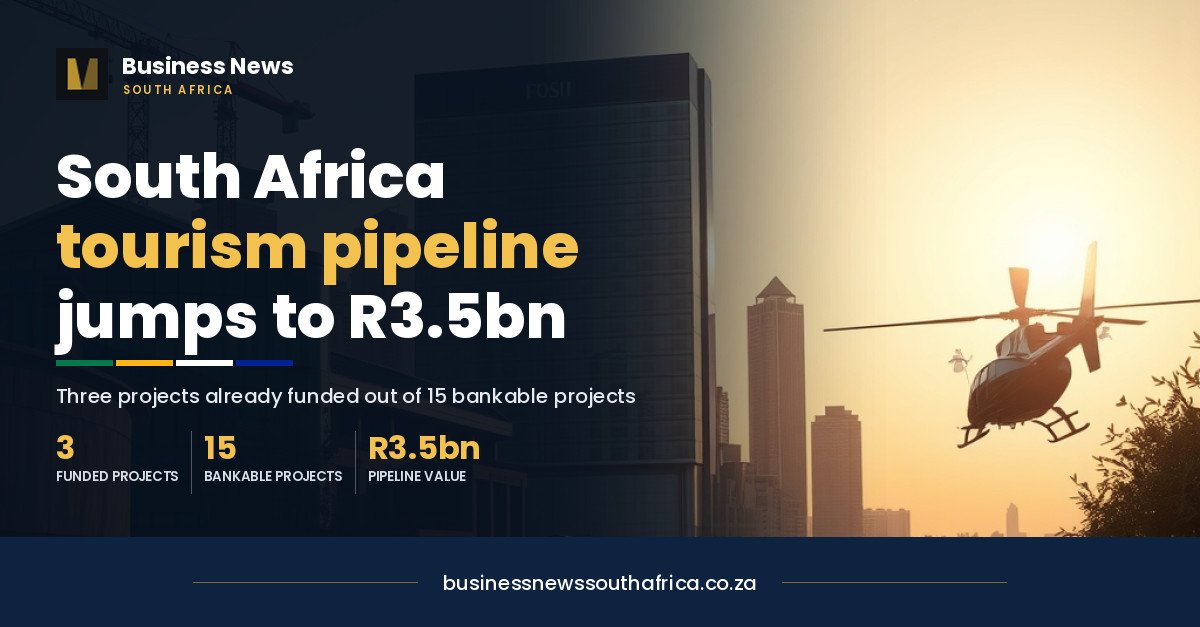
South Africa’s pipeline of investable tourism projects has grown from eight projects worth R1 billion to 15 worth R3.5 billion, and three have already secured funding commitments, Tourism Minister Patricia de Lille told the South African Tourism Infrastructure Investment Summit (SATIS) in Johannesburg on 1 October. “We started with 8 bankable projects valued at R1 billion and the pipeline has now grown to 15 projects valued at R3,5 billion, 3 projects already secured funding commitments,” she said, according to the text of her keynote published by government.
The summit’s purpose, De Lille said, is to bring together government, project owners, investors and financiers to mobilise capital for investment-ready projects.
What it means for business
The pipeline is where projects become something a financier can assess. Provinces are feeding it: the North West’s MEC for Economic Development, Conservation, Environment and Tourism, Bitsa Lenkopane, submitted 11 tourism projects valued at R1.2bn, which will now go through a screening process before being included in the investment booklet, Bizcommunity reported. The minister did not name the three funded projects or say who the funders are.
Tourism as economic policy
De Lille said she had just returned from Geneva, where she co-chaired the inaugural Beyond Tourism Day at the World Economic Forum, and where the World Bank’s work identified tourism among five sectors with significant potential to create jobs at scale. “Tourism policy is Economic policy,” she said. She noted that in August President Cyril Ramaphosa named tourism, alongside mining, infrastructure, and agriculture and agro-processing, as one of four key sectors under Phase Three of the Government-Business Partnership.
She cited Stats SA figures showing tourism directly employed 953,981 people in 2024, or 5.7% of total employment, with a direct contribution to GDP of 4.9%, ahead of agriculture, utilities and construction. On a direct, indirect and induced basis, the World Travel and Tourism Council puts the sector’s contribution at 10% of GDP, she said.
In 2025, domestic overnight trips reached 44.7 million with spending of R111.6 billion, and South Africa received a record 10.5 million international arrivals, who spent R102.2 billion. Between January and August 2026, international arrivals passed 7.5 million, up 11.7% on the same period in 2025. We reported that August alone brought more than a million international tourists.
Access and routes
De Lille pointed to the Electronic Travel Authorisation digital visa, launched by the President in August and now live in more than 30 countries, and to government’s R6.5 million investment in the Cabinet-approved Tourism Route Development Marketing Plan, which she said is meant to coordinate route development between government, provinces and the private sector.
Juan Gómez García, senior investment specialist at UN Tourism, told the summit that projects must also benefit the communities around them. “Tourism Infrastructure investments must go beyond assets and empower communities by creating economic opportunities,” he said. He added that bankable tourism investments depend on bankable destinations.
Rules for accommodation businesses are changing too: Cape Town plans to charge Airbnb hosts commercial rates.
Correction, 26 October 2026: an earlier version of this article said the North West was the single largest contributor to the tourism investment pipeline, which the sources did not say. It has been corrected.