They gave him 45 minutes, Vusi Thembekwayo told the room, and he arrived with 92 slides. What followed, in a talk posted to the Traffic Sales and Profit with Lamar Tyler YouTube channel, was a fast tour of one argument: that most people who call themselves entrepreneurs are really something smaller, and that the difference is whether the business can outlive them. Thembekwayo, a South African investor and the founder and chief executive of MyGrowthFund Venture Partners, calls the gap the one between a business owner and a founder.
Five levels
He built the talk on five levels. The first is the professional, who has the skills to do the work. His test for it is blunt: “When you are a professional, your business can’t survive one day without you.” Next comes the self-employed person, who takes the work and puts it into a system. “The word I love is code,” he said, and the owner’s job becomes monitoring what the enterprise delivers rather than delivering it.
The business owner sits above that, and he says the shift is about complexity: instead of one channel there are several, and each needs its own code. Above the business owner is the entrepreneur, who scales the work into other products and markets. At the top is the founder, a word he likes because it recognises that “there is a time when the thing I found will exist outside of me.”
The comfortable trap
Thembekwayo thinks most people stop at level three. “Most of us who say we are entrepreneurs in truth are either self-employed or business owners,” he said, and he described that life as a very nice one. Business owners tend not to raise outside capital, so the person they answer to for their profits and cash flow is themselves, and the business takes them to the edge of the lifestyle they want: the car, the house, the medical aid, the school fees, two holidays a year. (Weighing outside capital against your own is a real trade-off, and our equity versus debt calculator puts numbers on it.)
The cost, he argued, is that “you’ve not created a multi-generational institution, which means when you die, and believe me, you will, it will die.” His own grandfather was, he said, an enterprising man loved by everyone in the place where he grew up, whose businesses died with him. That was not because his children or grandchildren lacked the means or the ability to carry them on, he said, but because they were not built on a foundation that could be handed down.
How solid is the claim?
He put the wider problem in terms of his own community: “every single generation has to go through the traction and the friction of creating new value because the older generations couldn’t capture that value and pass it to the next generation.” He offered no data for that in the talk, and it is his opinion rather than a measured fact.
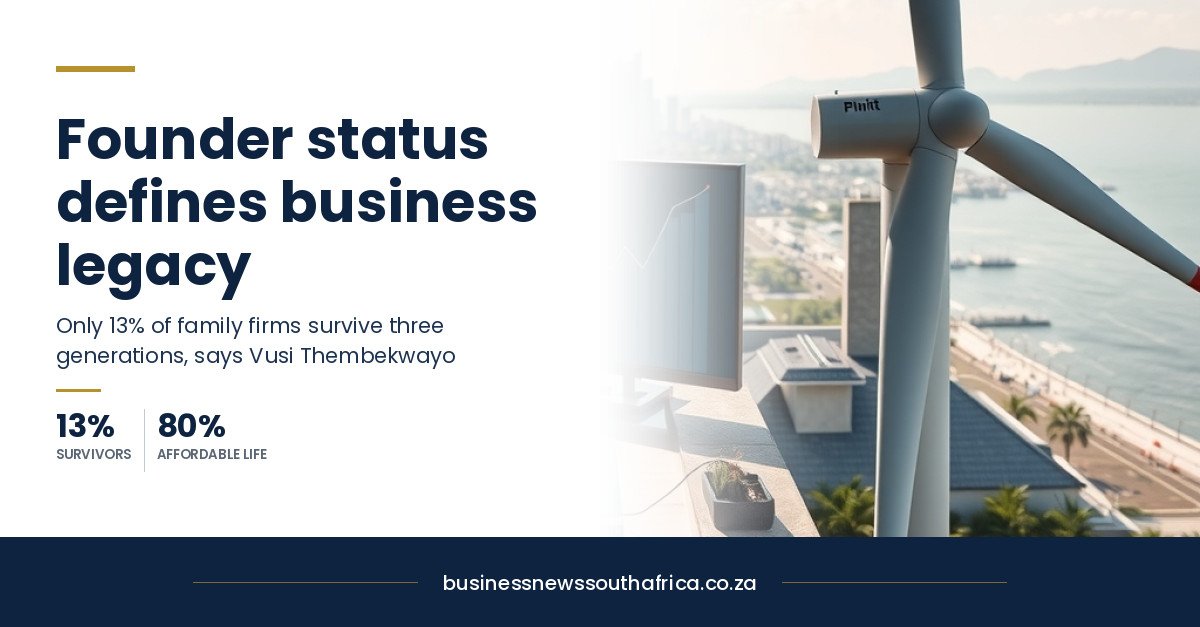
The number most often used to back this kind of claim is that only a small minority of family businesses survive to the third generation. Family Business Magazine traces it to John Ward’s 1987 study of 200 Illinois manufacturers between 1924 and 1984, which found that only 13% of successful family businesses lasted through three generations. It points out that the study is often misquoted, that it covered a narrow group of Midwest manufacturers, and that a business sold or merged at a profit is counted as a failure even though it may be sound family wealth planning. Later research it cites found families controlling 3.4 companies at a time but 6.1 across their history, which suggests that families often keep building wealth through a changing set of businesses rather than one firm. Thembekwayo’s point about legacy survives that, but the statistic behind it is thinner than the sound bite.
Eighty per cent of what you can afford
What he wants from founders is a change of mindset. “I’m okay living a life at 80% of what I can afford,” he said, “because that 20% is going to pay for the next 100% of the next generation.” The vision, in his words, is “not just for a good life. It’s for a good legacy.” He tries to practise it at home by putting his children to work in the group’s accounts, debtors, creditors and logistics, and on reception, so they understand what a client, a conversation and three months of work behind a payment look like. He described the group as spanning media, publishing, investment, venture, real estate and energy businesses.
Being a founder, he added, is not the same as running everything: “Founders can found a vision, but they need drivers to drive the vision.” He drew on his faith to make the point about leadership structure, noting that there were three closest disciples, then twelve, then seventy-two sent out ahead of Jesus, and asked the room how many disciples they had.
A little bit of faith
He closed with a story about meeting Nelson Mandela at 17, after a public speaking victory. His own website describes that result as winning the South African championship in 2002, followed by taking part in the world championship in England; in the talk he called it the world championship. We could not independently confirm details of the meeting, which is his account. He said he asked Mandela what his hope for humanity was. The answer, as Thembekwayo tells it: “We need a little bit of faith.” Faith, Mandela went on, is the ability “to see the invisible, to believe in the impossible.” Thembekwayo left the room with the same wish for their businesses.