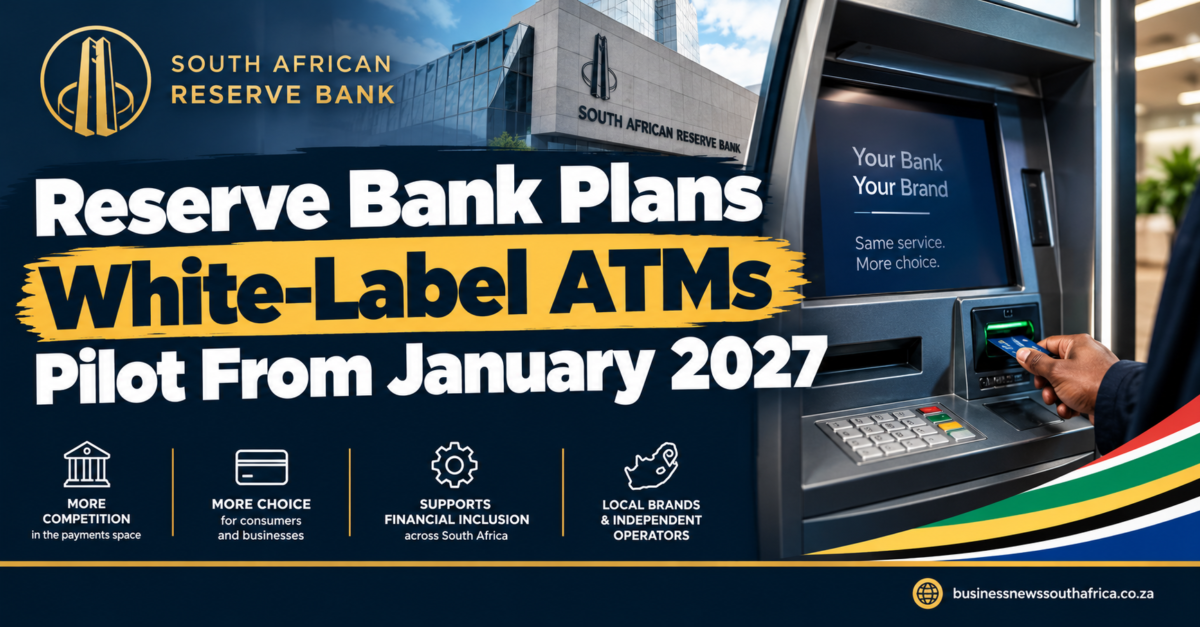
The South African Reserve Bank (SARB) plans to start piloting white-label ATMs in January 2027 and to establish a national cash utility by March 2027, as part of its Cash Smart strategy, according to what Pradeep Maharaj, executive director of the SARB’s Payments Ecosystem Modernisation programme, told a media briefing in October 2026. “We are asking banks to white-label all ATMs,” he said. The SARB’s plan would turn the country’s roughly 30,600 ATMs into a shared, unbranded network in which transactions below a set amount are free.
For business owners, the practical stake is cost and access: the SARB’s own study puts the economic cost of cash at R88.5 billion a year, and the plan is aimed at cutting duplicated infrastructure. The free-transaction threshold, the pilot sites and the final fee structure have not been set, so nothing changes at the till or the ATM yet.
What the SARB wants from ATMs
Under the Cash Smart strategy, the SARB wants white-label ATMs to operate as shared infrastructure rather than as machines tied to individual banks, so that customers of any bank can transact. Law firm ENS, which has analysed the proposal for banks, notes that about 9,200 of the roughly 30,600 ATMs are run by independent deployers, that transactions below a prescribed threshold are meant to be free, and that the threshold and detailed pricing are not yet finalised. The idea is not new: MyBroadband reported on 24 June 2026 that an SARB position paper proposed independently owned ATMs not tied to any bank. That paper is not binding, and the SARB said it would set up a regulatory framework covering deployment, funding and operations.
The national cash utility
The SARB says the utility would coordinate wholesale cash operations, with an integrated cash management system and a regulatory framework to govern it. It aims to establish the utility by March 2027, with existing cash centres and ATM infrastructure moving across in stages. ENS notes that the model would require clarity on infrastructure access, operational standards, the safeguarding of cash, fees and liability when transactions fail. The SARB’s reported thinking on ownership has varied, and the final structure may change.
The cost of cash
The SARB’s Cost of Cash Research Study, which used 2024 as its base year, estimates the total annual economic cost of cash at about R88.5 billion, or about 1.2% of GDP. Direct costs, such as withdrawal and deposit fees and the cost of travelling to get cash, come to about R43.5 billion (49%) and indirect costs such as time spent travelling and queuing, crime and forgone interest to about R44.9 billion (51%). Cash still accounts for about 56% of consumer transactions by volume.
The SARB’s argument is that as digital payments grow, the fixed costs of ATMs, vehicles and cash handling are spread over fewer transactions, and that outside big cities cash is hard to access, so people travel long distances for it.
What is still open
Banks have put forward their own models, and Maharaj said the talks with them are continuing, so the design may change. We have not seen the free-transaction threshold, pilot locations or who would own the machines. We could not open the SARB’s study PDF ourselves; the figures above are as the SARB and others have reported them. Related coverage: the Reserve Bank’s plan to open the payments system to non-bank operators from mid-2027, and South Africans lost R2.4 billion to digital banking fraud in 2025. More in our Tech and Telco section.