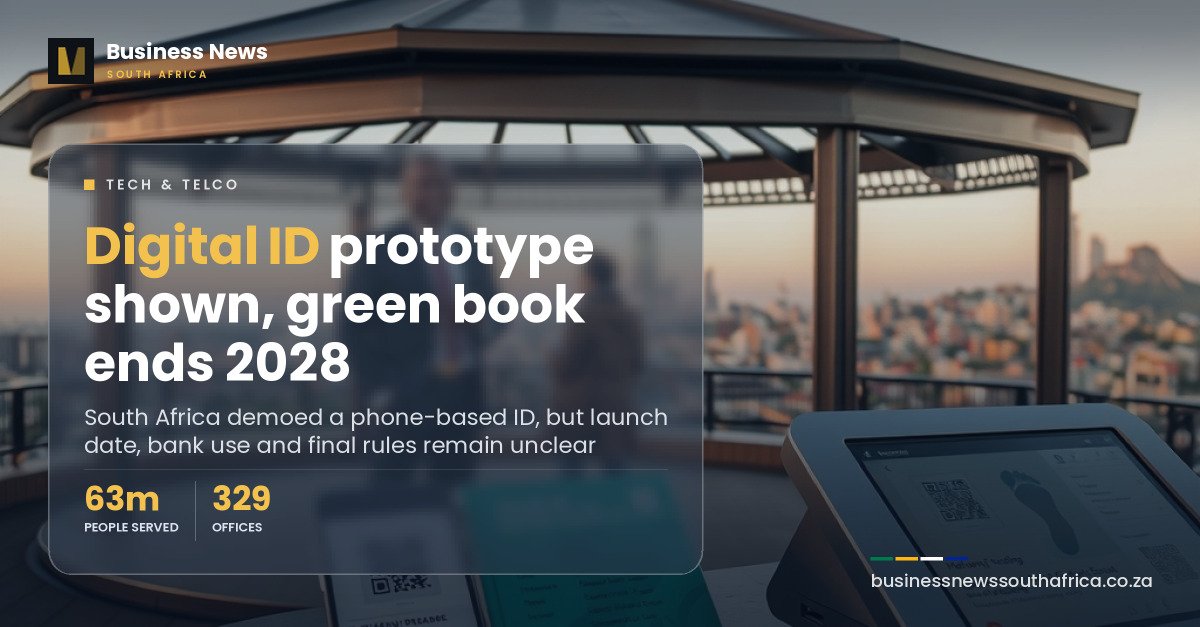
South Africa’s national digital identity system has moved from policy paper to working prototype, but it is not yet open to the public. Home Affairs Minister Leon Schreiber demonstrated the first working digital ID on his own smartphone at Constitution Hill in Johannesburg on 1 October 2026, and the green ID book stops being valid on 31 March 2028. No public launch date has been set, the final regulations are still being processed, and nothing has been published on how banks will use the credential in customer checks.
For any business that onboards customers, verifies staff or deals with the state, the project matters because it is designed to become the main way South Africans prove who they are remotely. A Daily Maverick feature published on 21 October sets out how it is meant to work.
What was shown on 1 October
According to TechCentral, Schreiber used a credential issued from the population register and bound to his phone’s chip, although the wallet screen shown on stage was a mock-up. When a verifier asked for his details, he approved the request but withheld his ID number, sharing other fields such as nationality. When he declined a second request, access was refused. He described the digital ID as a remote verification tool tied to biometrics rather than a photo of a card.
EWN reported that verification worked by scanning a QR code or using a near field reader, with biometrics confirming the holder, and that birth certificates and other Home Affairs documents are planned for the wallet later. Schreiber said the department serves 63 million people through only 329 offices.
Daily Maverick quotes Lohan Spies, founder of identity firm DIDx, who explains that Home Affairs issues a verifiable credential in the mDoc format, stored on the phone with its keys protected by the device’s secure hardware and shareable phone to phone over Bluetooth.
Decided, proposed and still open
Decided: the green ID book deadline. EWN reports that production of green ID books stops on 31 March 2027 and that the book will no longer be recognised from 31 March 2028. Daily Maverick says Schreiber linked the deadline to section 251B of the Identification Act.
Proposed: the legal basis for the digital credential. In May 2026 Schreiber gazetted draft amended regulations under the Identification Act, with comments due by 6 June. The draft would recognise digital credentials as an additional valid form of identity, set rules for enrolment, biometric capture and identity assurance, and allow identity information to be shared with accredited institutions under the Identification Act, the Promotion of Access to Information Act and POPIA. Use would be optional and the Smart ID card would remain.
Still open: the public launch. TechCentral reports that Home Affairs’ annual performance plan targets completing the hosting infrastructure, being built inside SARS’s IT environment, by 31 March 2027, with citizens receiving credentials through a mobile wallet in the 2027/28 financial year. None of the sources we reviewed publish costs, a budget or vendor contracts.
Where it fits in the state’s digital plan
The digital ID is the first of four initiatives in the Roadmap for the Digital Transformation of Government, launched in May 2025 by Communications and Digital Technologies Minister Solly Malatsi under Operation Vulindlela Phase II, run by the Presidency and National Treasury. The others are a data exchange framework, a digital payments system and a single digital services platform. A Digital Service Unit in the Presidency, led by Melvyn Lubega, coordinates the work.
The project is behind its original schedule. Biometric Update, citing the Vulindlela progress report for the first quarter of 2026/27, noted that nationwide rollout had earlier been previewed for April 2025. The report set November targets for testing digital payment credentials, wallet features and a trust framework for government use.
What it means for banks, employers and payments
Banks are already part of the physical rollout. EWN reports that 515 bank branches now handle smart ID replacements, and TechCentral says passport and first time smart ID applications will follow at branches. Schreiber has said digital IDs allow paperless processing for banking, work visas and business registrations, according to Daily Maverick. None of the sources explain how banks would use the credential for know your customer checks, or what employers verifying new hires would need.
The roadmap’s payments track also runs alongside the Reserve Bank’s separate plan to open the national payments system to non-bank operators from mid 2027. How the two will connect has not been published.
Privacy questions remain unresolved
Schreiber has said the final regulations will place hard limits on data use and that users will see each time their data is accessed, TechCentral reports. Critics have questioned the use of 2D selfies for liveness checks.
Research ICT Africa, in a 1 June submission, argued that Home Affairs had not met its POPIA obligations, that data should not move to other systems without privacy impact assessments and security audits, and that the regulations run ahead of a Digital Identity Policy and the National Identification and Registration Bill. It called for the draft to be suspended and for the Information Regulator to take a deeper oversight role. We found no published position from the Regulator.
Daily Maverick’s author, Lindsey Schutters, calls the project a revolutionary leap. That is his view. The official record so far is a prototype, draft rules and a 2028 deadline for the green book.