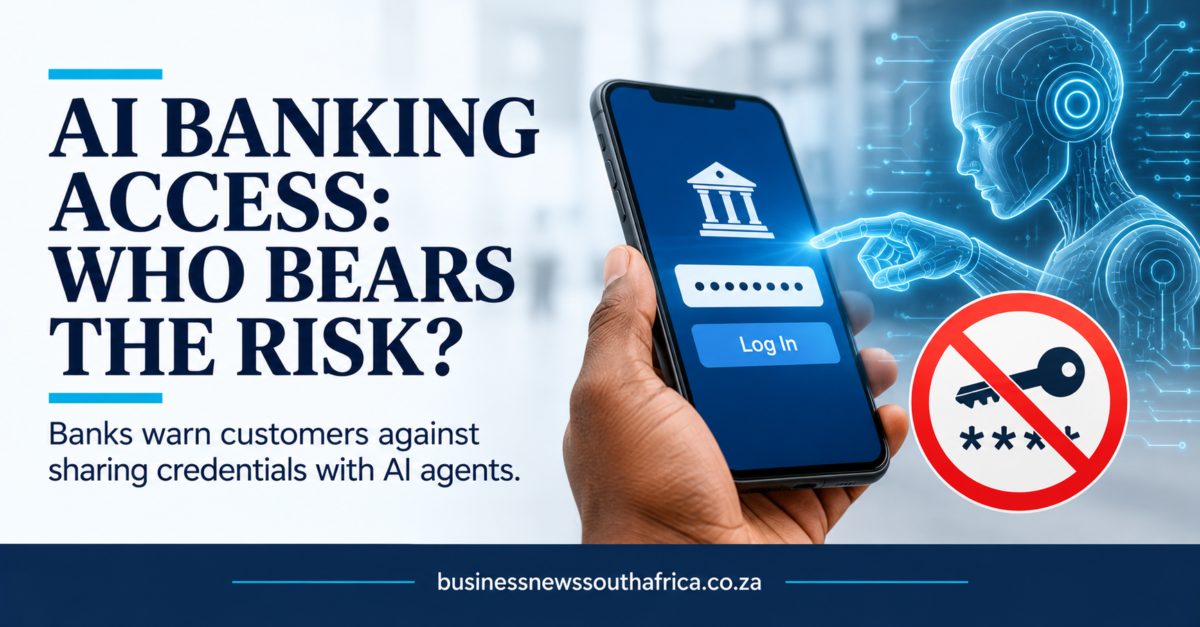
South African banking customers who give an AI agent their login details could be left carrying the loss if something goes wrong, according to Absa. In responses to questions from TechCentral, published on 26 October 2026, Absa said customers who voluntarily share credentials may be held liable for losses, while FNB, Discovery Bank and Capitec said they do not allow third-party AI agents into customer accounts at all. The banks were responding after a US report, published about a week earlier, that major American lenders had found outside AI agents operating inside customer accounts.
What each bank said
Absa did not announce a ban. Jochem Melis, chief information officer of Absa’s engineering, services and platforms office, told TechCentral: “At Absa, we do not use AI agents to access customer accounts, and we strongly discourage customers from sharing their banking credentials with any third-party AI agents.” He said the main concern is not the technology but the sharing of credentials, which is “no different from sharing them with any other third party”. Melis also said agents “do not independently gain access to customer accounts” and that access is only possible when an authorised customer provides credentials or permissions.
FNB said it “does not currently allow third-party AI agents to access customer accounts or make transactions for customers”, according to Dané Liebenberg, its AI executive for retail and business banking. The bank is building a framework for approved AI assistants to connect in future. Liebenberg said customers would give “explicit consent for every action”, with identity checks always happening on FNB’s own platforms and every interaction monitored and recorded. FNB would start with information services and expand only once protections are in place.
Capitec was the most categorical. It told TechCentral it does not permit third-party AI agents to access client accounts, “and that includes screen-scraping tools”, and that an account can only be accessed by the client through the bank’s own secure channels. Discovery Bank said it does not currently allow outside agents to access accounts or start transactions, and is building its own tools through Discovery AI, in which a client prepares a payment in the app using natural language or an image of an invoice and must approve it before it is processed. Standard Bank and Nedbank had not responded by the time TechCentral published.
Who pays if an agent goes wrong
All four banks said they would look at losses case by case. Melis said that where a customer voluntarily shares such information and a financial loss follows, the customer may be held liable, with each case assessed under Absa’s digital fraud warranty. That warranty, he said, is designed to protect customers who transact responsibly and follow the bank’s security requirements. Capitec said clients should not share a PIN, password or one-time PIN with any third party, “including AI tools or automated agents”, and that it assesses each loss under its terms and applicable law. FNB said it would assess any reported loss in line with its terms and conditions and the applicable regulations. Discovery Bank said a loss would be investigated on its facts, including how access was obtained and whether the transaction was authenticated and authorised.
The practical point for customers is that an AI agent holding a login can sign in as that customer. None of the banks has said it would automatically refuse a claim, but none has promised to reimburse one either. For a business owner who uses an AI tool to reconcile accounts or pay suppliers, that is a risk to weigh before handing over banking credentials. Our earlier report on SABRIC’s R2.4 billion digital banking fraud figure for 2025 shows how much is already at stake, and Capitec’s anti-fraud measures show how banks are responding to criminal activity more broadly.
The US report behind the warnings
The trigger was a report from Axios, which cited people familiar with the matter in saying that several major US banks had detected third-party AI agents in customer accounts without bank authorisation, some appearing to act independently of what users had asked. American Bazaar’s summary dated 22 October names Morgan Stanley, Bank of America, JPMorgan Chase and Wells Fargo, and says Morgan Stanley has begun blocking third-party agents. A Morgan Stanley spokesperson said the bank had not observed “rogue AI agents accessing our platforms”. Moneylife’s account adds that Reuters, which followed up, said it could not immediately verify the original report, and that the reports do not establish that every bank has experienced confirmed rogue-agent activity.
TechCentral notes that JPMorgan Chase chief executive Jamie Dimon said on the bank’s third-quarter earnings call on 13 October that it was not going to allow just any outside agent in, because that is too risky for clients. Absa differs from its US counterparts in one respect: Melis said agents do not materially alter the bank’s risk profile, because the underlying risks are already covered by existing safeguards, and that its fraud systems are built to spot suspicious patterns, including those consistent with unauthorised agent access attempts.
What is still unknown
The banks did not say how many South African customers have shared logins with agents, and Capitec did not say whether it has seen any. No statement from the Banking Association South Africa or SABRIC on AI agents was found in the sources checked. Absa said it is exploring emerging standards for secure agent interaction and will share more as that evolves. TechCentral also reports that Visa has enrolled South African banks in its Agentic Ready programme to prepare for AI shopping agents, and that the Financial Stability Board finalised guidance on AI in financial institutions on 15 October. For more on how technology is changing finance, see our Tech & Telco section.