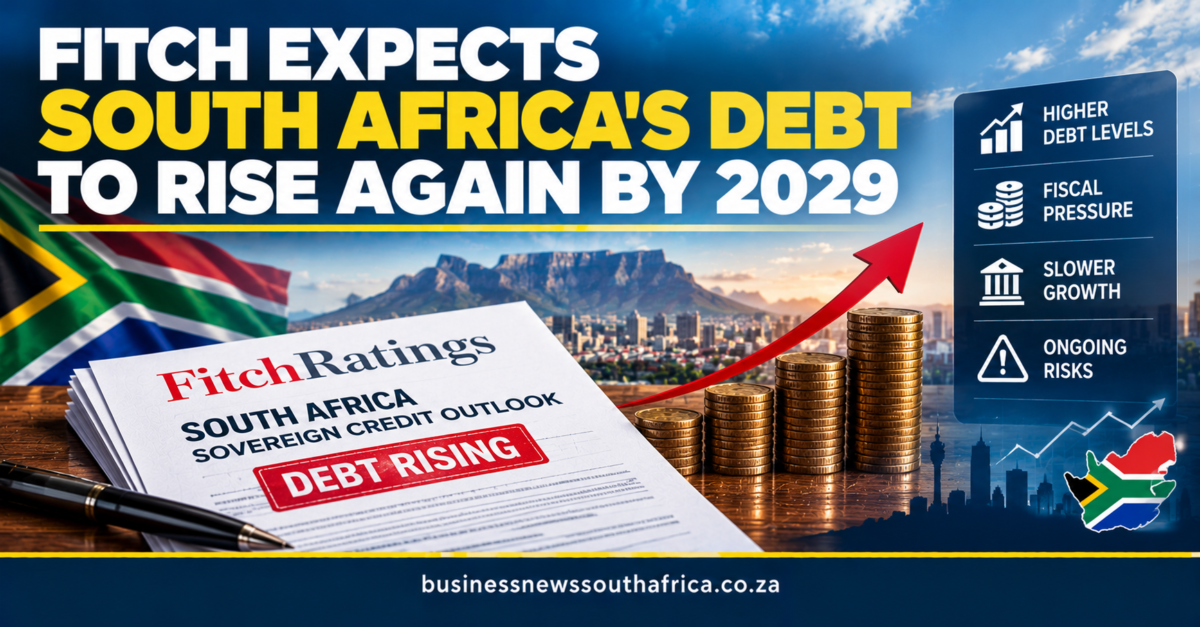
Fitch Ratings said on Monday 26 October 2026 that it expects South Africa’s government debt to start rising again in the financial year to March 2029, reaching 79% of GDP, which puts it at odds with National Treasury’s forecast of a steady decline. According to News24, Fitch blames mainly weak economic growth.
The disagreement is small in percentage terms but lands days before the next two ratings reviews, and it matters to any business that borrows in rand or depends on the cost of capital in South Africa.
What it means for your business
A sovereign credit rating feeds into what the government pays to borrow, and that in turn sets a benchmark for what banks and bond investors charge companies. According to The National, positive ratings help lower government debt-service costs and attract foreign investment. A rating agency that sees debt turning up again is therefore worth watching if you plan to refinance, raise capital or sign a long-term loan. Our reading is that it is a reason to know your funding position before the review dates below, not a reason to panic.
What Fitch said
As reported by BusinessTech, Fitch still expects debt to stabilise at about 78% of GDP over the next two fiscal years. It called that a key factor behind its June 2026 decision to upgrade South Africa to BB, two notches below investment grade, with a stable outlook. The agency then added: “Nevertheless, unlike the government, we expect debt to GDP to very modestly rise again” in 2028/29, to 79% of GDP.
The wording is careful. Fitch is not predicting a deterioration, only a modest reversal after a period of flat debt. We could not open Fitch’s own statement, so the figures here rest on those two outlets, and the quote appears in each of them.
What Treasury and Moody’s expect
Finance Minister Enoch Godongwana said in his medium-term budget statement on 21 October 2026 that debt peaked at 78.4% of GDP in 2025/26 and will decline to 76.6% by 2029/30, according to News24. He said debt as a percentage of GDP is now falling, as quoted by BusinessTech. The same statement cut the 2026 growth forecast to 1.2% from 1.6% in February, with growth of 1.6% in 2027 and 2% by 2029, according to the EWN report on the speech.
Moody’s Ratings, which also rates South Africa two notches below investment grade but with a positive outlook, takes a more upbeat view. News24 reports that Moody’s, whose measure of debt includes most government guarantees to state-owned companies, said debt peaked in the last fiscal year and is set for a “clear, albeit gradual” decline. It described the budget update as credit-positive because fiscal consolidation is on track despite higher oil prices, tighter monetary policy and weaker nominal growth than assumed in February. It also cautioned that the country has limited fiscal space to absorb shocks.
According to The National, Moody’s vice president Evan Wohlmann said high debt-service costs remain the main constraint on deficit reduction. Moody’s said interest payments absorbed 18.8% of general government revenue in fiscal 2025, higher than most similarly rated peers, and that the budget lifts projected debt-service costs by R9 billion in fiscal 2026 and by about R11 billion a year in fiscal 2027 and 2028, partly because of a cumulative 50 basis-point rise in the policy rate to 7.25% since the February Budget.
Dates to watch
- 27 November 2026: Moody’s next scheduled review of South Africa.
- 11 December 2026: Fitch’s next scheduled review.
A Bank of America note reported by TimesLIVE on 17 October, before the Fitch statement, said Moody’s was the most likely of the agencies to act, with a possible upgrade to Ba1, while an S&P upgrade to BB+ was a closer call. The same note said Fitch had less reason to act again in the near term, and that an upgrade to BB+ could come in 2027 if primary surpluses strengthen and debt-service costs keep moderating. That is a bank’s forecast, not a decision by any agency.
What to do
Our suggestions, not advice from any of the agencies:
- If you have a facility coming up for renewal in the next six months, ask your bank now what pricing and tenor it can offer, so you are not negotiating in the days after a rating announcement.
- Check how much of your borrowing is on a variable rate. The repo rate is 7.25% after the Reserve Bank’s September increase, and the Fitch view of weak growth is a reminder that your own revenue assumptions should not lean on a quick recovery.
For more on the budget itself, see our reports on how debt stabilised at 78.4% and the draft fiscal anchor law, the bank forecasts of a rating upgrade after the budget, and Moody’s positive outlook.