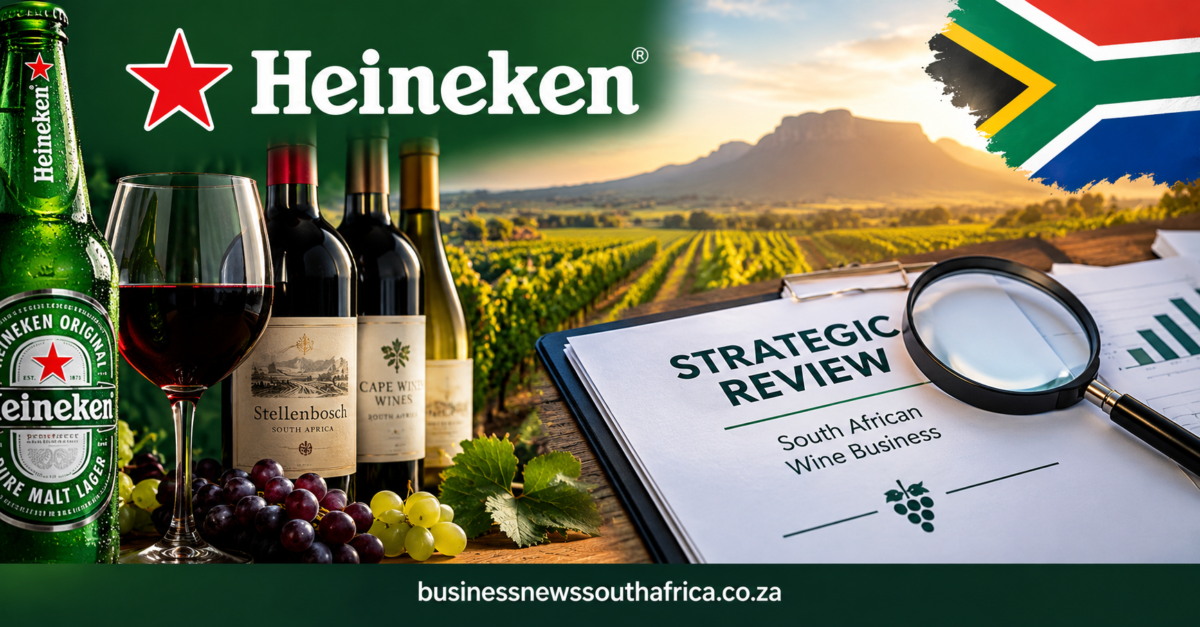
Heineken is putting its South African wine business under strategic review, three years after it completed the purchase of Distell. Chief financial officer Harold van den Broek said so on an analyst call on Wednesday, 28 October 2026, as the Dutch brewer published its third-quarter trading update. “We are not making rash decisions on what to do, but we do have it under strategic review,” he said, according to a Bloomberg report carried by Moneyweb. He did not say what options are being considered or whether they include a sale.
What was said, and where
The review was raised on the conference call, not in the written release. Heineken’s third-quarter statement and its accompanying PDF do not mention a review, so the detail rests on Bloomberg’s account of the call. The release itself says beer and ready-to-drink volume in South Africa grew by a double-digit percentage in the quarter, led by Amstel and Bernini, while “wine remained under pressure”. It adds that Klipdrift had another strong performance in distilled spirits.
Bloomberg reports that all wine brands are under review, naming Nederburg and JC Le Roux as examples. Van den Broek said how the company competes in certain wine segments “is an active discussion with our South Africa business”. He told analysts: “We are really working very hard to bring volumes back into our business in South Africa.”
What a strategic review means
A strategic review is an internal assessment of what a company should do with a business. The outcomes can range from fixing it to restructuring it, partnering or selling it, and companies often say they have no decision. The reports of the call give no timetable and no outcome. Bloomberg’s wording, that the company is looking at the relevance of wine in its South African portfolio, points to a discussion about the category rather than a decision to leave it. Any suggestion of a sale is speculation at this point.
The Distell deal in numbers
Heineken bought the wine brands as part of its €2.2bn purchase of South African wine and spirits group Distell. BusinessTech puts that at R40.8bn, while Moneyweb’s Bloomberg report gives $2.4bn. The deal was agreed in 2021 and completed in 2023, combining Distell and Namibia Breweries with Heineken’s existing South African operations to create Heineken Beverages. According to Bloomberg, more than 5 400 employees from Distell and Namibia Breweries joined Heineken at completion. That is a 2023 figure for the whole combined business, not a count of people in wine, and Heineken has not said any jobs are at risk.
The deal was meant to give Heineken a broader drinks range in the region and help it compete with rivals such as Anheuser-Busch InBev SA and Diageo. Bloomberg says the enlarged business instead struggled with a complex integration and market-share losses. Heineken took a €491m impairment on the business in 2023, less than a year after completion, and then-chief executive Dolf van den Brink later acknowledged that the brewer had “dropped the ball on a couple of commercial elements”.
The group and regional picture
The wine comments came in an otherwise stronger update. Heineken reported total volume growth of 4.8% for the quarter and net revenue growth of 4.6%. In its Africa and Middle East region, total volume rose 4.3% and net revenue grew 6.8%. The company reiterated its 2026 guidance of 2% to 6% organic operating profit growth. According to Bloomberg, group volumes grew more than expected and shares rose as much as 2.2%. The release also says currency translation was helped by a stronger rand.
New chief executive Rafael Oliveira said in the statement: “We have strong foundations, but we are not translating them into consistent growth and winning with consumers and customers as often as we should.” He said he would share more of his perspective when Heineken reports full-year results. Bloomberg describes him as an outsider recently hired to lead a revamp. It is therefore likely, though not confirmed, that the next substantive word on South African wine will come with those results.
What it means for South African businesses
For wine farmers, suppliers and retailers that depend on these brands, nothing has changed yet: Heineken has announced no sale, closure or job cuts. The review does show that one of the biggest foreign investments in the local drinks industry of recent years is being re-examined, while the beer and spirits side performs well. Our earlier reports on Heineken Beverages’ R2bn malt plant investment and its Brand of the Year win at the 2026 Loeries show the scale of the commitment to the South African business. More coverage of listed-company strategy is in our Markets & Finance section.
What is still unknown is which wine segments and brands would be affected, how much of the business wine represents, and whether the review ends in a sale, a restructuring or a decision to keep the portfolio. The coverage of the call does not answer any of those questions.