Petrol and diesel motorists and fleet operators are due a cut at the pumps on Wednesday 4 November, but the relief comes from the state giving up fuel tax rather than from the market. Finance Minister Enoch Godongwana announced a temporary reduction in the general fuel levy in his Medium-Term Budget Policy Statement on 21 October, and the first and larger step of that relief starts on the same day as the local government elections.
What Godongwana announced
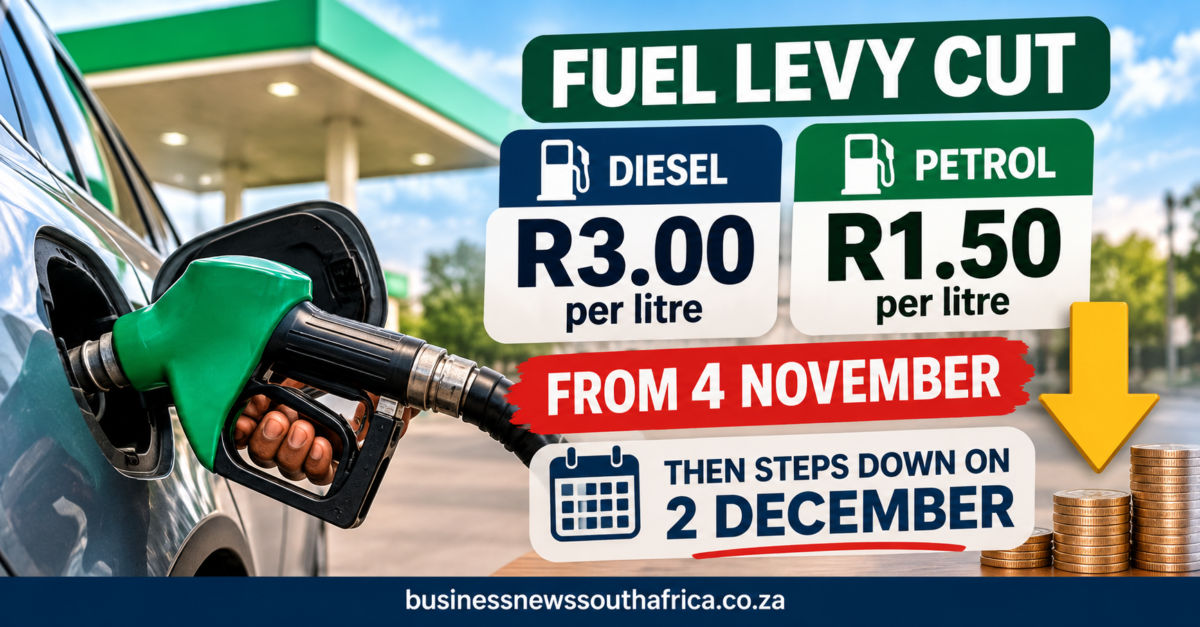
According to SAnews, the government news agency, the fuel levy will fall by R3 per litre for diesel and R1.50 per litre for petrol from 4 November 2026 up to 1 December 2026. After that the relief continues at a lower amount until 5 January 2027. The minister said the diesel levy will be reduced by R1.50 per litre in that second step and the petrol levy by R1 per litre.
In other words, the relief comes in two steps. The first runs from 4 November to 1 December. The second, smaller step runs from the start of December to 5 January 2027. Engineering News reports the same amounts and dates from the speech. The levy that is cut is the general fuel levy. It is the general fuel levy that is being reduced, not the fuel excise.
How the R10 billion is funded
The minister said the measures provide R10 billion in support at a fiscal cost of R10 billion in foregone revenue. To pay for it, the R10 billion that was transferred to the Central Energy Fund will be returned to the National Revenue Fund. SAnews quotes Godongwana as saying the intervention “will help to ease cost of living pressures without compromising the sustainability of the budget”. Engineering News adds that any relief beyond 5 January would rest on a similar assessment and on how much room remains to provide it in a fiscally neutral manner, so businesses should not assume an extension.
Engineering News also reports that Treasury has cut what it expects to collect from the fuel levy in 2026/27 by R30 billion. That figure covers the direct cost of the relief and lower consumption as higher prices bite, according to the report.
What it could do to pump prices
The levy cut does not arrive on a flat price. BusinessTech, working from the Central Energy Fund’s final October data, reports that the fuel basket is still under-recovering: R1.01 a litre on 93 petrol, R1.17 on 95 petrol, R1.42 on 0.05% diesel and R1.32 on 0.005% diesel. An under-recovery points to a price rise before any tax relief is counted. Setting the first-step cut against it gives BusinessTech’s projections for inland prices, which exclude the slate levy and other monthly adjustments:
- 93 petrol: from R29.88 to about R29.39, a fall of 49 cents.
- 95 petrol: from R30.25 to about R29.92, a fall of 33 cents.
- 0.05% diesel: from R31.95 to about R30.37, a fall of R1.58.
- 0.005% diesel: from R33.29 to about R31.61, a fall of R1.68.
These are projections, not the official adjustment. The Department of Mineral Resources and Energy normally announces the monthly fuel prices shortly before they take effect, and at the time of writing we had not found that announcement for 4 November. BusinessTech itself says the expected cuts are “entirely propped up by the government’s intervention”, which is the main point for planning: without the levy relief, the data point to higher prices.
The slate levy and the oil price are still moving
BusinessTech reports that the slate levy rose to 87.6 cents a litre in October, up 4.4 cents, after a cumulative negative slate balance of R10.456 billion at the end of August 2026. It warns that if the negative balance keeps growing, the levy could rise again and cancel part of the relief. The same report puts crude oil above US$111 a barrel and the rand at about R16.60 to the dollar, weaker than R16.20 earlier. It says the pump prices of 95 petrol and 0.005% diesel have risen by R10.15 and R14.84 a litre since March, and that the November adjustments would leave those increases at about R9.82 and R13.16.
The relief followed record retail prices. Engineering News notes large October hikes of more than R3 a litre on both petrol and diesel, after crude rose above US$100 a barrel. SAnews puts 95 petrol at about R30.25 inland and R29.38 at the coast before the cut.
What it means for businesses and households
Diesel users get the larger share of the relief, which matters for freight, farming and any business that runs a vehicle fleet. Petrol users get a smaller cut, and the step-down on 2 December means the benefit shrinks within weeks. Budgeting on the November price alone would overstate the saving, because the levy relief is scheduled to fall in December and to end after 5 January 2027 unless Treasury decides otherwise.
Critics are not convinced the measure is enough. EWN reports that the Automobile Association said the relief is not enough and argued it could be funded through better fiscal management. The longer debate about scrapping fuel levies altogether is covered in our report on the AA backing Godongwana’s aim to scrap fuel levies and the R80bn gap. Our explainer on what the fuel levy costs a vehicle owner each year sets out how the levy works, and our story on the energy department’s vehicle CO2 levy proposal covers the other end of the fuel tax debate. For wider coverage, see Energy & Infrastructure.
What is still unknown
The official pump prices for 4 November are still to be announced, and the final numbers will depend on the exchange rate, oil prices and the slate levy. It is also not yet known whether the government will extend the relief after 5 January 2027. Polling day logistics are covered in our note on what voters and employers need to know about 4 November.