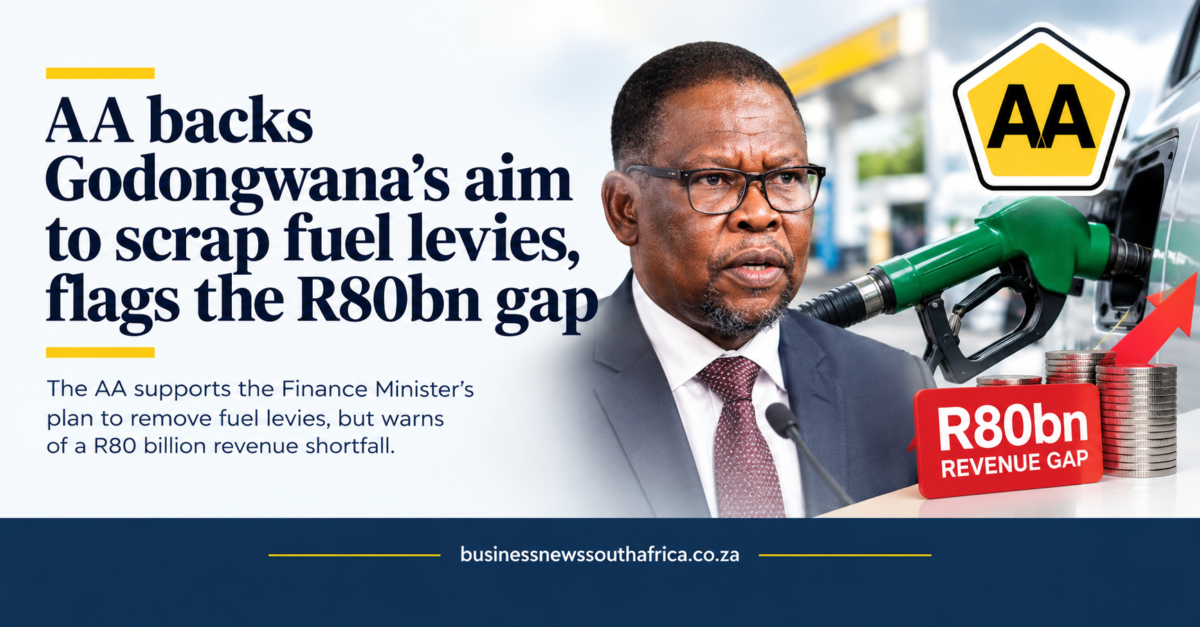
The Automobile Association of South Africa has backed Finance Minister Enoch Godongwana’s stated long-term aim of removing the levies charged on petrol, calling it “a long overdue and welcome call”. In a press release dated 28 October 2026, the AA also asked government to review the formula behind the basic fuel price in public. The minister himself has set no date and no replacement for the money, so this is a stated direction, not a decision.
What the minister actually said
Godongwana made the remarks in an interview with 702 after the Medium-Term Budget Policy Statement of 21 October. According to EWN, he said “The long-term plan is to remove levies on petrol,” and pointed to two charges: the Road Accident Fund (RAF) levy and the general fuel levy.
On the general fuel levy, which flows into the national budget, he said it generates about R80bn and that “We’ve got to find a way of phasing it out.” He added that doing so would cost the state about R80bn in revenue. On the RAF levy, he said the fund’s insurance model would have to change so that it no longer relies on petrol. EWN reports that he did not announce a timetable or a detailed plan for replacing the revenue. Daily Investor, which also carried the interview, says he gave no details on how the RAF model would change.
Two points in circulating copy need care. The R80bn belongs to the general fuel levy alone, not to the two levies combined. And the minister described the RAF levy as about R2 a litre, while the AA and other reports put it at R2.25.
The rand figures, and where sources differ
The AA says the general fuel levy of R4.29, the RAF levy of R2.25 and two smaller duties add R6.58 to every litre of petrol. At October’s record inland 95 unleaded price of R30.25 a litre, that is more than a fifth of the pump price. BusinessTech reports the two main levies at R4.16 for diesel and R4.29 for petrol plus R2.25 for the RAF, giving a combined R6.41 on diesel and R6.54 on petrol, about 22% of the price. The gap between R6.54 and R6.58 is the smaller duties, which BusinessTech does not include.
The labelling of the R4.29 also differs. In our earlier report on the levy, based on a SARS notice of 27 March 2026, the general fuel levy on petrol rose from 401c to 410c a litre from 1 April, with the carbon fuel levy at 19c, which together make 429c. The AA’s release calls R4.29 the general fuel levy; the SARS notice figures suggest it is the two levies combined. Either way, the total on a litre of petrol is the same.
The AA works the cost out for a motorist and a fleet. A driver filling a 50-litre tank pays about R329 in levies. A company running 100 petrol vehicles that each fill up once a week pays about R1.7m a year. Those are the AA’s illustrations, and they assume full 50-litre fills at the R6.58 total.
Temporary relief is already running
The AA notes the minister’s comments come alongside a second round of temporary relief announced in the MTBPS. From 4 November, the general fuel levy falls by R1.50 a litre on petrol and R3.00 on diesel until 1 December. Until 5 January 2027, the cut is R1 on petrol and R1.50 on diesel. The AA says government is funding it by returning R10bn transferred to the Central Energy Fund, and that the first round in April was halved in June and withdrawn in July.
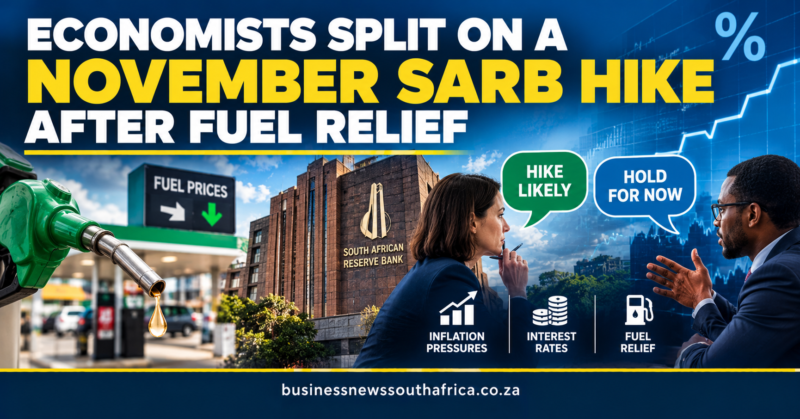
For businesses that budget for fuel, the practical point is that levy relief has changed several times this year and tapers again before the December holidays. We covered how economists read the relief in our report on the November rate debate, and the Budget numbers in our MTBPS guide.
The AA’s wider asks
The AA wants government to remove both levies, review the basic fuel price formula in public, and treat the R80bn gap as a question of how public money is spent as well as how it is raised. Chief executive Bobby Ramagwede said “the problem is not revenue collection. It is expense management and budget allocation,” and described the fiscus as “porous”. He also argued that the RAF levy should be replaced by compulsory third-party motor insurance, as in most developed economies, and that the causes of crashes, such as road user behaviour, decaying infrastructure and unsafe vehicles, should be tackled.
The AA says the Department of Mineral and Petroleum Resources, not Treasury, sets the basic fuel price through a formula that reflects what it would cost to buy fuel on international markets and ship it to South Africa. BusinessTech adds that Treasury has described its own review of the fuel price composition as looking at retailer and wholesaler margins and other smaller levies, not the basic fuel price formula itself.
What is still unknown
Nothing has been tabled. There is no date for phasing out either levy, no replacement revenue source and no design for a new RAF funding model. Government has also moved the other way on the RAF levy: the fund has asked for a levy of up to R3 a litre, which Transport Minister Barbara Creecy has said she will not pursue, as we reported when she blocked the RAF levy rise. The scale of what is at stake shows on the revenue side: BusinessTech has reported that the fuel levy raised R95.2bn in 2025/26, a figure we treated as reported rather than confirmed in our piece on the R7,900 per vehicle average. Godongwana told 702, according to Daily Investor, that closing the R80 billion gap is “a discussion we will have to have”.
For related coverage see Energy & Infrastructure.